

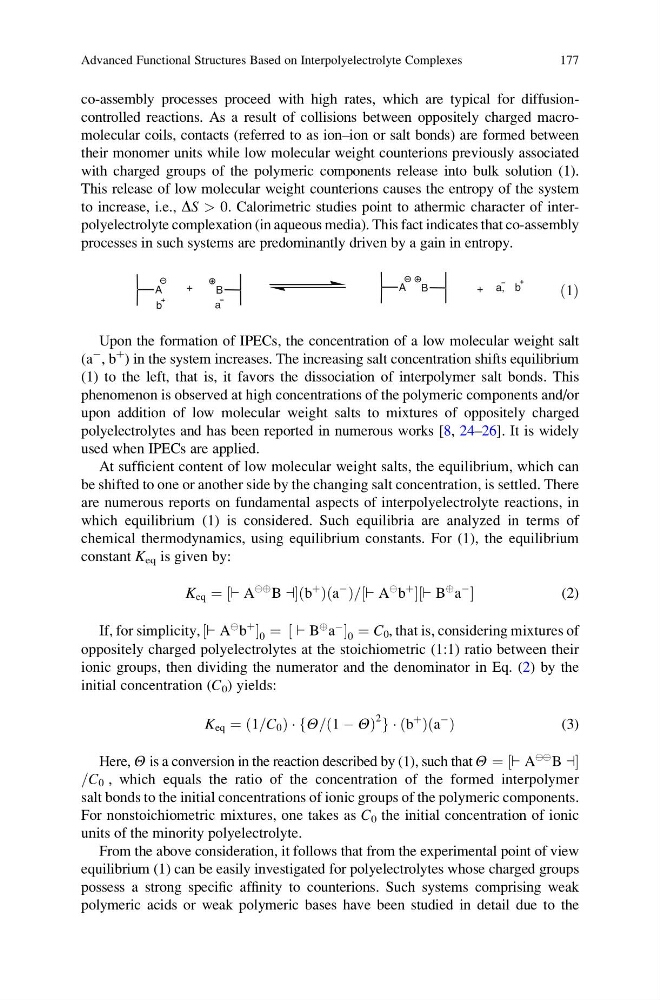
co-assembly processes proceed with high rates, which are typical for diffusioncontrolled reactions. As a result of collisions between oppositely charged macromolecular coils, contacts (referred to as ion–ion or salt bonds) are formed between
their monomer units while low molecular weight counterions previously associated
with charged groups of the polymeric components release into bulk solution (1).
This release of low molecular weight counterions causes the entropy of the system
to increase, i.e., DS > 0. Calorimetric studies point to athermic character of interpolyelectrolyte complexation (in aqueous media). This fact indicates that co-assembly
processes in such systems are predominantly driven by a gain in entropy.
a,
+
+
b
b
a
A B
A
B
ð1Þ
Upon the formation of IPECs, the concentration of a low molecular weight salt
(a
À , b
þ
) in the system increases. The increasing salt concentration shifts equilibrium
(1) to the left, that is, it favors the dissociation of interpolymer salt bonds. This
phenomenon is observed at high concentrations of the polymeric components and/or
upon addition of low molecular weight salts to mixtures of oppositely charged
polyelectrolytes and has been reported in numerous works [8, 24–26]. It is widely
used when IPECs are applied.
At sufficient content of low molecular weight salts, the equilibrium, which can
be shifted to one or another side by the changing salt concentration, is settled. There
are numerous reports on fundamental aspects of interpolyelectrolyte reactions, in
which equilibrium (1) is considered. Such equilibria are analyzed in terms of
chemical thermodynamics, using equilibrium constants. For (1), the equilibrium
constant K eq is given by:
K eq ¼ ½‘ A
ÉÈ B aðb
þ
Þða
À
Þ=½‘ A
É b
þ
½‘ B
È a
À
(2)
If, for simplicity, ½‘ A
É b
þ
0 ¼ ½ ‘ B
È a
À
0 ¼ C 0 , that is, considering mixtures of
oppositely charged polyelectrolytes at the stoichiometric (1:1) ratio between their
ionic groups, then dividing the numerator and the denominator in Eq. (2) by the
initial concentration (C 0 ) yields:
K eq ¼ ð1=C 0 Þ Á fY=ð1 À YÞ
2 g Á ðb
þ
Þða
À
Þ
(3)
Here, Y is a conversion in the reaction described by (1), such that Y ¼ ½‘ A
ÉÈ B a
=C 0 , which equals the ratio of the concentration of the formed interpolymer
salt bonds to the initial concentrations of ionic groups of the polymeric components.
For nonstoichiometric mixtures, one takes as C 0 the initial concentration of ionic
units of the minority polyelectrolyte.
From the above consideration, it follows that from the experimental point of view
equilibrium (1) can be easily investigated for polyelectrolytes whose charged groups
possess a strong specific affinity to counterions. Such systems comprising weak
polymeric acids or weak polymeric bases have been studied in detail due to the
Advanced Functional Structures Based on Interpolyelectrolyte Complexes
177
their monomer units while low molecular weight counterions previously associated
with charged groups of the polymeric components release into bulk solution (1).
This release of low molecular weight counterions causes the entropy of the system
to increase, i.e., DS > 0. Calorimetric studies point to athermic character of interpolyelectrolyte complexation (in aqueous media). This fact indicates that co-assembly
processes in such systems are predominantly driven by a gain in entropy.
a,
+
+
b
b
a
A B
A
B
ð1Þ
Upon the formation of IPECs, the concentration of a low molecular weight salt
(a
À , b
þ
) in the system increases. The increasing salt concentration shifts equilibrium
(1) to the left, that is, it favors the dissociation of interpolymer salt bonds. This
phenomenon is observed at high concentrations of the polymeric components and/or
upon addition of low molecular weight salts to mixtures of oppositely charged
polyelectrolytes and has been reported in numerous works [8, 24–26]. It is widely
used when IPECs are applied.
At sufficient content of low molecular weight salts, the equilibrium, which can
be shifted to one or another side by the changing salt concentration, is settled. There
are numerous reports on fundamental aspects of interpolyelectrolyte reactions, in
which equilibrium (1) is considered. Such equilibria are analyzed in terms of
chemical thermodynamics, using equilibrium constants. For (1), the equilibrium
constant K eq is given by:
K eq ¼ ½‘ A
ÉÈ B aðb
þ
Þða
À
Þ=½‘ A
É b
þ
½‘ B
È a
À
(2)
If, for simplicity, ½‘ A
É b
þ
0 ¼ ½ ‘ B
È a
À
0 ¼ C 0 , that is, considering mixtures of
oppositely charged polyelectrolytes at the stoichiometric (1:1) ratio between their
ionic groups, then dividing the numerator and the denominator in Eq. (2) by the
initial concentration (C 0 ) yields:
K eq ¼ ð1=C 0 Þ Á fY=ð1 À YÞ
2 g Á ðb
þ
Þða
À
Þ
(3)
Here, Y is a conversion in the reaction described by (1), such that Y ¼ ½‘ A
ÉÈ B a
=C 0 , which equals the ratio of the concentration of the formed interpolymer
salt bonds to the initial concentrations of ionic groups of the polymeric components.
For nonstoichiometric mixtures, one takes as C 0 the initial concentration of ionic
units of the minority polyelectrolyte.
From the above consideration, it follows that from the experimental point of view
equilibrium (1) can be easily investigated for polyelectrolytes whose charged groups
possess a strong specific affinity to counterions. Such systems comprising weak
polymeric acids or weak polymeric bases have been studied in detail due to the
Advanced Functional Structures Based on Interpolyelectrolyte Complexes
177