

for high molecular weight polymers [74]. This difference in observations is probably
due to differences in experimental time scale. A longer equilibration time was used
for the latter study, whereas the system of Johansson et al. was most probably not in
equilibrium at the time scale of the measurements [73].
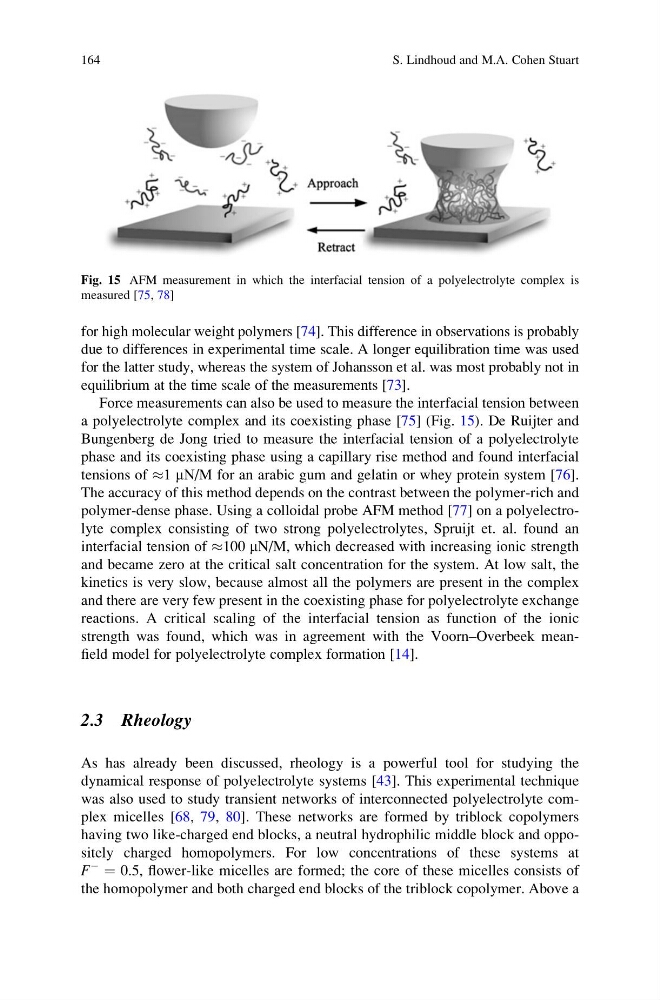
Force measurements can also be used to measure the interfacial tension between
a polyelectrolyte complex and its coexisting phase [75] (Fig. 15). De Ruijter and
Bungenberg de Jong tried to measure the interfacial tension of a polyelectrolyte
phase and its coexisting phase using a capillary rise method and found interfacial
tensions of %1 mN/M for an arabic gum and gelatin or whey protein system [76].
The accuracy of this method depends on the contrast between the polymer-rich and
polymer-dense phase. Using a colloidal probe AFM method [77] on a polyelectrolyte complex consisting of two strong polyelectrolytes, Spruijt et. al. found an
interfacial tension of %100 mN/M, which decreased with increasing ionic strength
and became zero at the critical salt concentration for the system. At low salt, the
kinetics is very slow, because almost all the polymers are present in the complex
and there are very few present in the coexisting phase for polyelectrolyte exchange
reactions. A critical scaling of the interfacial tension as function of the ionic
strength was found, which was in agreement with the Voorn–Overbeek meanfield model for polyelectrolyte complex formation [14].
2.3 Rheology
As has already been discussed, rheology is a powerful tool for studying the
dynamical response of polyelectrolyte systems [43]. This experimental technique
was also used to study transient networks of interconnected polyelectrolyte complex micelles [68, 79, 80]. These networks are formed by triblock copolymers
having two like-charged end blocks, a neutral hydrophilic middle block and oppositely charged homopolymers. For low concentrations of these systems at
F
À
¼ 0.5, flower-like micelles are formed; the core of these micelles consists of
the homopolymer and both charged end blocks of the triblock copolymer. Above a
Fig. 15 AFM measurement in which the interfacial tension of a polyelectrolyte complex is
measured [75, 78]
164
S. Lindhoud and M.A. Cohen Stuart
due to differences in experimental time scale. A longer equilibration time was used
for the latter study, whereas the system of Johansson et al. was most probably not in
equilibrium at the time scale of the measurements [73].
Force measurements can also be used to measure the interfacial tension between
a polyelectrolyte complex and its coexisting phase [75] (Fig. 15). De Ruijter and
Bungenberg de Jong tried to measure the interfacial tension of a polyelectrolyte
phase and its coexisting phase using a capillary rise method and found interfacial
tensions of %1 mN/M for an arabic gum and gelatin or whey protein system [76].
The accuracy of this method depends on the contrast between the polymer-rich and
polymer-dense phase. Using a colloidal probe AFM method [77] on a polyelectrolyte complex consisting of two strong polyelectrolytes, Spruijt et. al. found an
interfacial tension of %100 mN/M, which decreased with increasing ionic strength
and became zero at the critical salt concentration for the system. At low salt, the
kinetics is very slow, because almost all the polymers are present in the complex
and there are very few present in the coexisting phase for polyelectrolyte exchange
reactions. A critical scaling of the interfacial tension as function of the ionic
strength was found, which was in agreement with the Voorn–Overbeek meanfield model for polyelectrolyte complex formation [14].
2.3 Rheology
As has already been discussed, rheology is a powerful tool for studying the
dynamical response of polyelectrolyte systems [43]. This experimental technique
was also used to study transient networks of interconnected polyelectrolyte complex micelles [68, 79, 80]. These networks are formed by triblock copolymers
having two like-charged end blocks, a neutral hydrophilic middle block and oppositely charged homopolymers. For low concentrations of these systems at
F
À
¼ 0.5, flower-like micelles are formed; the core of these micelles consists of
the homopolymer and both charged end blocks of the triblock copolymer. Above a
Fig. 15 AFM measurement in which the interfacial tension of a polyelectrolyte complex is
measured [75, 78]
164
S. Lindhoud and M.A. Cohen Stuart