

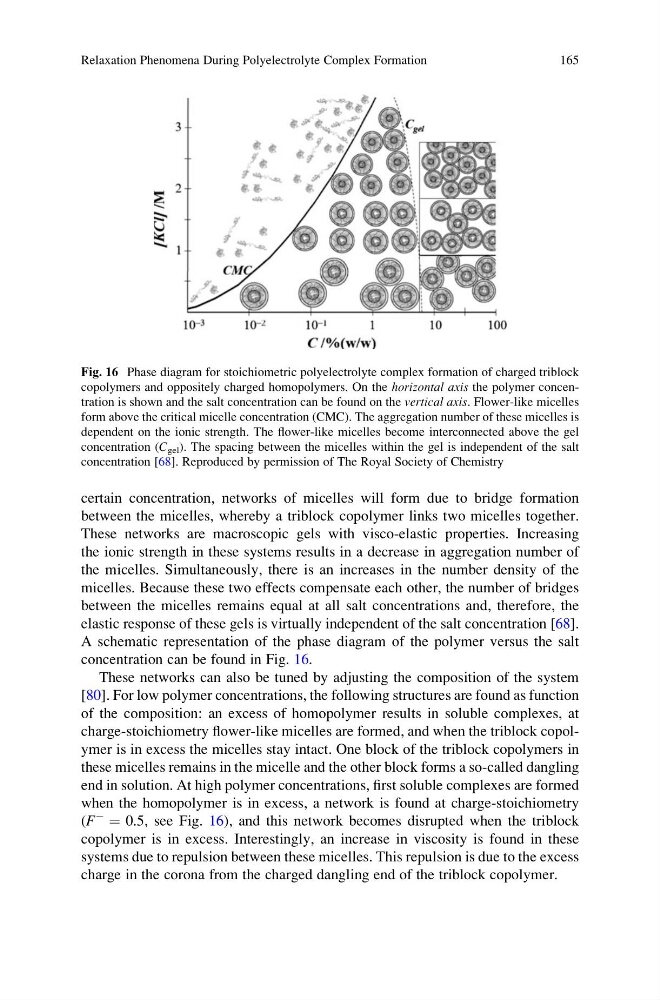
certain concentration, networks of micelles will form due to bridge formation
between the micelles, whereby a triblock copolymer links two micelles together.
These networks are macroscopic gels with visco-elastic properties. Increasing
the ionic strength in these systems results in a decrease in aggregation number of
the micelles. Simultaneously, there is an increases in the number density of the
micelles. Because these two effects compensate each other, the number of bridges
between the micelles remains equal at all salt concentrations and, therefore, the
elastic response of these gels is virtually independent of the salt concentration [68].
A schematic representation of the phase diagram of the polymer versus the salt
concentration can be found in Fig. 16.
These networks can also be tuned by adjusting the composition of the system
[80]. For low polymer concentrations, the following structures are found as function
of the composition: an excess of homopolymer results in soluble complexes, at
charge-stoichiometry flower-like micelles are formed, and when the triblock copolymer is in excess the micelles stay intact. One block of the triblock copolymers in
these micelles remains in the micelle and the other block forms a so-called dangling
end in solution. At high polymer concentrations, first soluble complexes are formed
when the homopolymer is in excess, a network is found at charge-stoichiometry
(F
À
¼ 0.5, see Fig. 16), and this network becomes disrupted when the triblock
copolymer is in excess. Interestingly, an increase in viscosity is found in these
systems due to repulsion between these micelles. This repulsion is due to the excess
charge in the corona from the charged dangling end of the triblock copolymer.
Fig. 16 Phase diagram for stoichiometric polyelectrolyte complex formation of charged triblock
copolymers and oppositely charged homopolymers. On the horizontal axis the polymer concentration is shown and the salt concentration can be found on the vertical axis. Flower-like micelles
form above the critical micelle concentration (CMC). The aggregation number of these micelles is
dependent on the ionic strength. The flower-like micelles become interconnected above the gel
concentration (C gel ). The spacing between the micelles within the gel is independent of the salt
concentration [68]. Reproduced by permission of The Royal Society of Chemistry
Relaxation Phenomena During Polyelectrolyte Complex Formation
165
between the micelles, whereby a triblock copolymer links two micelles together.
These networks are macroscopic gels with visco-elastic properties. Increasing
the ionic strength in these systems results in a decrease in aggregation number of
the micelles. Simultaneously, there is an increases in the number density of the
micelles. Because these two effects compensate each other, the number of bridges
between the micelles remains equal at all salt concentrations and, therefore, the
elastic response of these gels is virtually independent of the salt concentration [68].
A schematic representation of the phase diagram of the polymer versus the salt
concentration can be found in Fig. 16.
These networks can also be tuned by adjusting the composition of the system
[80]. For low polymer concentrations, the following structures are found as function
of the composition: an excess of homopolymer results in soluble complexes, at
charge-stoichiometry flower-like micelles are formed, and when the triblock copolymer is in excess the micelles stay intact. One block of the triblock copolymers in
these micelles remains in the micelle and the other block forms a so-called dangling
end in solution. At high polymer concentrations, first soluble complexes are formed
when the homopolymer is in excess, a network is found at charge-stoichiometry
(F
À
¼ 0.5, see Fig. 16), and this network becomes disrupted when the triblock
copolymer is in excess. Interestingly, an increase in viscosity is found in these
systems due to repulsion between these micelles. This repulsion is due to the excess
charge in the corona from the charged dangling end of the triblock copolymer.
Fig. 16 Phase diagram for stoichiometric polyelectrolyte complex formation of charged triblock
copolymers and oppositely charged homopolymers. On the horizontal axis the polymer concentration is shown and the salt concentration can be found on the vertical axis. Flower-like micelles
form above the critical micelle concentration (CMC). The aggregation number of these micelles is
dependent on the ionic strength. The flower-like micelles become interconnected above the gel
concentration (C gel ). The spacing between the micelles within the gel is independent of the salt
concentration [68]. Reproduced by permission of The Royal Society of Chemistry
Relaxation Phenomena During Polyelectrolyte Complex Formation
165