

coated with PEM. Strong adhesive forces were found for large molecular contact
areas, especially when the substrate was soft and when molecules can migrate across
the interface, increasing the number of entanglements [73]. They found a polymerdependent behaviour and, apparently, the degree of entanglements is determined by
the chemistry of the polymer. Similar behaviour for the dissolution of PEMS was also
found by Kovacevic and coworkers [31]. A chain length dependence of adhesive
forces was also found whereby the adhesive forces for shorter polymers were higher
[73]. This behaviour was explained by the argument that because the chain ends are
more mobile than polymer loops, they could more easily form entanglements
between the layers. Other studies, however, have found stronger adhesive forces
0
–4
–8
0
100
200
300
1.4 M
400
h (nm)
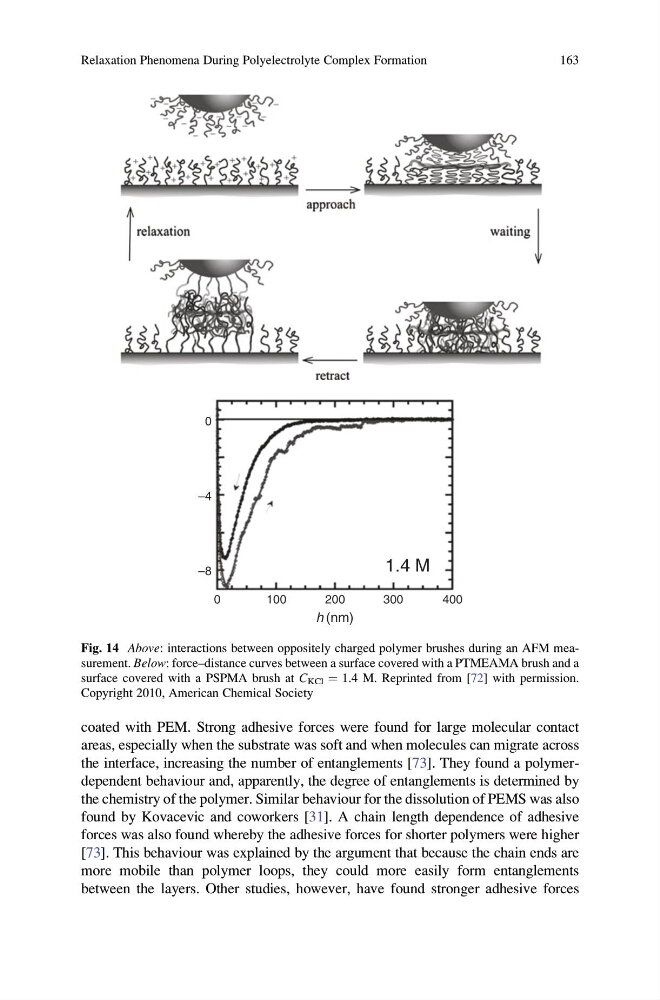
Fig. 14 Above: interactions between oppositely charged polymer brushes during an AFM measurement. Below: force–distance curves between a surface covered with a PTMEAMA brush and a
surface covered with a PSPMA brush at C KCl ¼ 1.4 M. Reprinted from [72] with permission.
Copyright 2010, American Chemical Society
Relaxation Phenomena During Polyelectrolyte Complex Formation
163
areas, especially when the substrate was soft and when molecules can migrate across
the interface, increasing the number of entanglements [73]. They found a polymerdependent behaviour and, apparently, the degree of entanglements is determined by
the chemistry of the polymer. Similar behaviour for the dissolution of PEMS was also
found by Kovacevic and coworkers [31]. A chain length dependence of adhesive
forces was also found whereby the adhesive forces for shorter polymers were higher
[73]. This behaviour was explained by the argument that because the chain ends are
more mobile than polymer loops, they could more easily form entanglements
between the layers. Other studies, however, have found stronger adhesive forces
0
–4
–8
0
100
200
300
1.4 M
400
h (nm)
Fig. 14 Above: interactions between oppositely charged polymer brushes during an AFM measurement. Below: force–distance curves between a surface covered with a PTMEAMA brush and a
surface covered with a PSPMA brush at C KCl ¼ 1.4 M. Reprinted from [72] with permission.
Copyright 2010, American Chemical Society
Relaxation Phenomena During Polyelectrolyte Complex Formation
163