

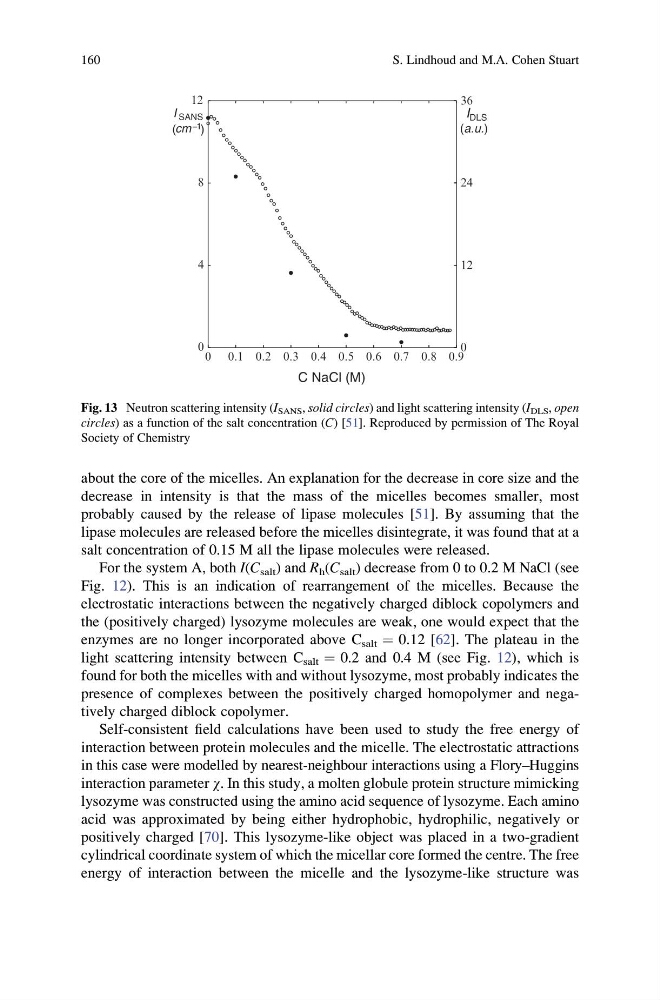
about the core of the micelles. An explanation for the decrease in core size and the
decrease in intensity is that the mass of the micelles becomes smaller, most
probably caused by the release of lipase molecules [51]. By assuming that the
lipase molecules are released before the micelles disintegrate, it was found that at a
salt concentration of 0.15 M all the lipase molecules were released.
For the system A, both I(C salt ) and R h (C salt ) decrease from 0 to 0.2 M NaCl (see
Fig. 12). This is an indication of rearrangement of the micelles. Because the
electrostatic interactions between the negatively charged diblock copolymers and
the (positively charged) lysozyme molecules are weak, one would expect that the
enzymes are no longer incorporated above C salt ¼ 0.12 [62]. The plateau in the
light scattering intensity between C salt ¼ 0.2 and 0.4 M (see Fig. 12), which is
found for both the micelles with and without lysozyme, most probably indicates the
presence of complexes between the positively charged homopolymer and negatively charged diblock copolymer.
Self-consistent field calculations have been used to study the free energy of
interaction between protein molecules and the micelle. The electrostatic attractions
in this case were modelled by nearest-neighbour interactions using a Flory–Huggins
interaction parameter w. In this study, a molten globule protein structure mimicking
lysozyme was constructed using the amino acid sequence of lysozyme. Each amino
acid was approximated by being either hydrophobic, hydrophilic, negatively or
positively charged [70]. This lysozyme-like object was placed in a two-gradient
cylindrical coordinate system of which the micellar core formed the centre. The free
energy of interaction between the micelle and the lysozyme-like structure was
0 0.1 0.2 0.3 0.4 0.5 0.6 0.7 0.8
0
4
8
12
0
12
24
36
C NaCl (M)
I SANS
I DLS
(cm −1 )
(a.u.)
0.9
Fig. 13 Neutron scattering intensity (I SANS , solid circles) and light scattering intensity (I DLS , open
circles) as a function of the salt concentration (C) [51]. Reproduced by permission of The Royal
Society of Chemistry
160
S. Lindhoud and M.A. Cohen Stuart
decrease in intensity is that the mass of the micelles becomes smaller, most
probably caused by the release of lipase molecules [51]. By assuming that the
lipase molecules are released before the micelles disintegrate, it was found that at a
salt concentration of 0.15 M all the lipase molecules were released.
For the system A, both I(C salt ) and R h (C salt ) decrease from 0 to 0.2 M NaCl (see
Fig. 12). This is an indication of rearrangement of the micelles. Because the
electrostatic interactions between the negatively charged diblock copolymers and
the (positively charged) lysozyme molecules are weak, one would expect that the
enzymes are no longer incorporated above C salt ¼ 0.12 [62]. The plateau in the
light scattering intensity between C salt ¼ 0.2 and 0.4 M (see Fig. 12), which is
found for both the micelles with and without lysozyme, most probably indicates the
presence of complexes between the positively charged homopolymer and negatively charged diblock copolymer.
Self-consistent field calculations have been used to study the free energy of
interaction between protein molecules and the micelle. The electrostatic attractions
in this case were modelled by nearest-neighbour interactions using a Flory–Huggins
interaction parameter w. In this study, a molten globule protein structure mimicking
lysozyme was constructed using the amino acid sequence of lysozyme. Each amino
acid was approximated by being either hydrophobic, hydrophilic, negatively or
positively charged [70]. This lysozyme-like object was placed in a two-gradient
cylindrical coordinate system of which the micellar core formed the centre. The free
energy of interaction between the micelle and the lysozyme-like structure was
0 0.1 0.2 0.3 0.4 0.5 0.6 0.7 0.8
0
4
8
12
0
12
24
36
C NaCl (M)
I SANS
I DLS
(cm −1 )
(a.u.)
0.9
Fig. 13 Neutron scattering intensity (I SANS , solid circles) and light scattering intensity (I DLS , open
circles) as a function of the salt concentration (C) [51]. Reproduced by permission of The Royal
Society of Chemistry
160
S. Lindhoud and M.A. Cohen Stuart