

salt concentration favours the formation of polyelectrolyte complexes in solution
and no PEM formation is observed.
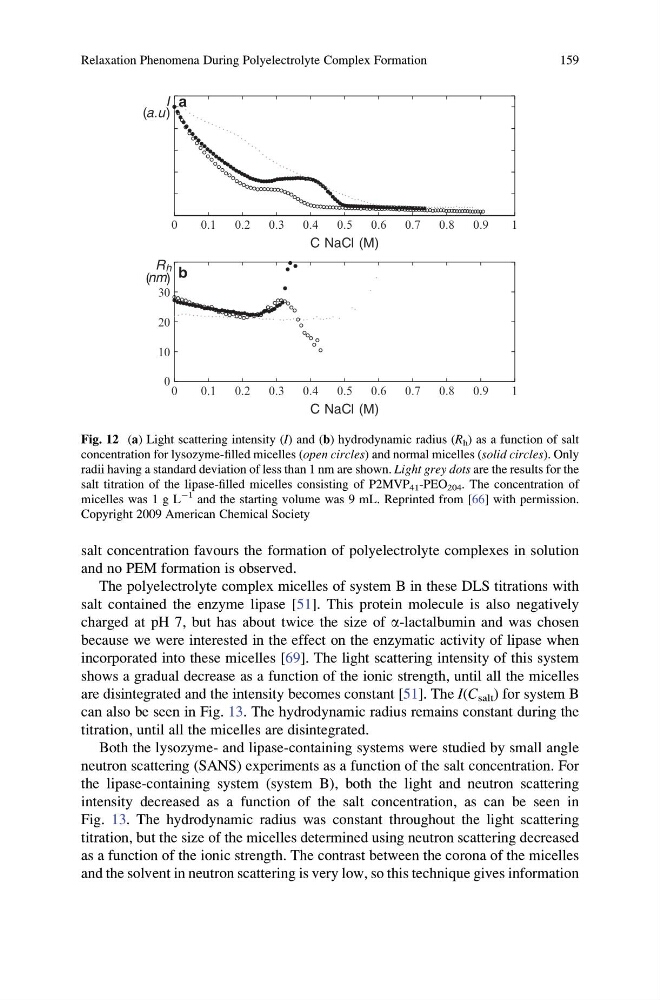
The polyelectrolyte complex micelles of system B in these DLS titrations with
salt contained the enzyme lipase [51]. This protein molecule is also negatively
charged at pH 7, but has about twice the size of a-lactalbumin and was chosen
because we were interested in the effect on the enzymatic activity of lipase when
incorporated into these micelles [69]. The light scattering intensity of this system
shows a gradual decrease as a function of the ionic strength, until all the micelles
are disintegrated and the intensity becomes constant [51]. The I(C salt ) for system B
can also be seen in Fig. 13. The hydrodynamic radius remains constant during the
titration, until all the micelles are disintegrated.
Both the lysozyme- and lipase-containing systems were studied by small angle
neutron scattering (SANS) experiments as a function of the salt concentration. For
the lipase-containing system (system B), both the light and neutron scattering
intensity decreased as a function of the salt concentration, as can be seen in
Fig. 13. The hydrodynamic radius was constant throughout the light scattering
titration, but the size of the micelles determined using neutron scattering decreased
as a function of the ionic strength. The contrast between the corona of the micelles
and the solvent in neutron scattering is very low, so this technique gives information
0
0.1
0.2
0.3
0.4
0.5
0.6
0.7
0.8
0.9
1
C NaCl (M)
0
0.1
0.2
0.3
0.4
0.5
0.6
0.7
0.8
0.9
1
0
10
20
30
C NaCl (M)
a
b
I
R h
(a.u)
(nm)
Fig. 12 (a) Light scattering intensity (I) and (b) hydrodynamic radius (R h ) as a function of salt
concentration for lysozyme-filled micelles (open circles) and normal micelles (solid circles). Only
radii having a standard deviation of less than 1 nm are shown. Light grey dots are the results for the
salt titration of the lipase-filled micelles consisting of P2MVP 41 -PEO 204 . The concentration of
micelles was 1 g L
À1 and the starting volume was 9 mL. Reprinted from [66] with permission.
Copyright 2009 American Chemical Society
Relaxation Phenomena During Polyelectrolyte Complex Formation
159
and no PEM formation is observed.
The polyelectrolyte complex micelles of system B in these DLS titrations with
salt contained the enzyme lipase [51]. This protein molecule is also negatively
charged at pH 7, but has about twice the size of a-lactalbumin and was chosen
because we were interested in the effect on the enzymatic activity of lipase when
incorporated into these micelles [69]. The light scattering intensity of this system
shows a gradual decrease as a function of the ionic strength, until all the micelles
are disintegrated and the intensity becomes constant [51]. The I(C salt ) for system B
can also be seen in Fig. 13. The hydrodynamic radius remains constant during the
titration, until all the micelles are disintegrated.
Both the lysozyme- and lipase-containing systems were studied by small angle
neutron scattering (SANS) experiments as a function of the salt concentration. For
the lipase-containing system (system B), both the light and neutron scattering
intensity decreased as a function of the salt concentration, as can be seen in
Fig. 13. The hydrodynamic radius was constant throughout the light scattering
titration, but the size of the micelles determined using neutron scattering decreased
as a function of the ionic strength. The contrast between the corona of the micelles
and the solvent in neutron scattering is very low, so this technique gives information
0
0.1
0.2
0.3
0.4
0.5
0.6
0.7
0.8
0.9
1
C NaCl (M)
0
0.1
0.2
0.3
0.4
0.5
0.6
0.7
0.8
0.9
1
0
10
20
30
C NaCl (M)
a
b
I
R h
(a.u)
(nm)
Fig. 12 (a) Light scattering intensity (I) and (b) hydrodynamic radius (R h ) as a function of salt
concentration for lysozyme-filled micelles (open circles) and normal micelles (solid circles). Only
radii having a standard deviation of less than 1 nm are shown. Light grey dots are the results for the
salt titration of the lipase-filled micelles consisting of P2MVP 41 -PEO 204 . The concentration of
micelles was 1 g L
À1 and the starting volume was 9 mL. Reprinted from [66] with permission.
Copyright 2009 American Chemical Society
Relaxation Phenomena During Polyelectrolyte Complex Formation
159