

calculated at different positions from the centre of the micelle. A minimum in the
free energy was found at the core–corona interface and a maximum was found in
the centre of the micellar core [70].
For both systems A and B it was found that the protein molecules are released
from the micelles before the entire micelles disintegrate. An explanation for this
behaviour is that the charge density of the protein molecules is much lower than the
charge density of the polyelectrolytes, making the interactions between the protein
molecules and the oppositely charged diblock copolymer much weaker than the
interactions between the diblock copolymer and oppositely charged polyelectrolyte. Moreover, the protein molecules used were globular proteins, having a distinct
3D structure; this further hinders rearrangement of the protein molecules within the
polyelectrolyte complex.
2.1.3 Turbidity
A procedure simpler than performing light scattering titrations is studying the
correlation between multilayer growth and polyelectrolyte complexes in solution
using turbidity measurements. Mjamed et al. studied turbidity as function of the
mixing ratio and NaCl concentration of six different polyelectrolyte combinations
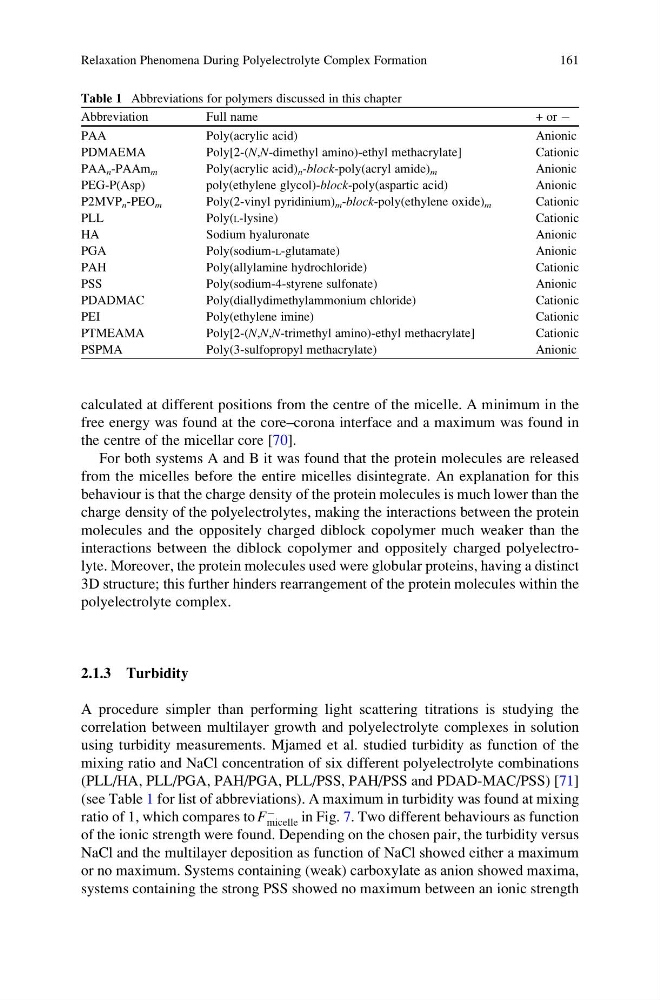
(PLL/HA, PLL/PGA, PAH/PGA, PLL/PSS, PAH/PSS and PDAD-MAC/PSS) [71]
(see Table 1 for list of abbreviations). A maximum in turbidity was found at mixing
ratio of 1, which compares to F
À
micelle in Fig. 7. Two different behaviours as function
of the ionic strength were found. Depending on the chosen pair, the turbidity versus
NaCl and the multilayer deposition as function of NaCl showed either a maximum
or no maximum. Systems containing (weak) carboxylate as anion showed maxima,
systems containing the strong PSS showed no maximum between an ionic strength
Table 1 Abbreviations for polymers discussed in this chapter
Abbreviation
Full name
+ or À
PAA
Poly(acrylic acid)
Anionic
PDMAEMA
Poly[2-(N,N-dimethyl amino)-ethyl methacrylate]
Cationic
PAA n -PAAm m
Poly(acrylic acid) n -block-poly(acryl amide) m
Anionic
PEG-P(Asp)
poly(ethylene glycol)-block-poly(aspartic acid)
Anionic
P2MVP n -PEO m
Poly(2-vinyl pyridinium) m -block-poly(ethylene oxide) m
Cationic
PLL
Poly(L-lysine)
Cationic
HA
Sodium hyaluronate
Anionic
PGA
Poly(sodium-L-glutamate)
Anionic
PAH
Poly(allylamine hydrochloride)
Cationic
PSS
Poly(sodium-4-styrene sulfonate)
Anionic
PDADMAC
Poly(diallydimethylammonium chloride)
Cationic
PEI
Poly(ethylene imine)
Cationic
PTMEAMA
Poly[2-(N,N,N-trimethyl amino)-ethyl methacrylate]
Cationic
PSPMA
Poly(3-sulfopropyl methacrylate)
Anionic
Relaxation Phenomena During Polyelectrolyte Complex Formation
161
free energy was found at the core–corona interface and a maximum was found in
the centre of the micellar core [70].
For both systems A and B it was found that the protein molecules are released
from the micelles before the entire micelles disintegrate. An explanation for this
behaviour is that the charge density of the protein molecules is much lower than the
charge density of the polyelectrolytes, making the interactions between the protein
molecules and the oppositely charged diblock copolymer much weaker than the
interactions between the diblock copolymer and oppositely charged polyelectrolyte. Moreover, the protein molecules used were globular proteins, having a distinct
3D structure; this further hinders rearrangement of the protein molecules within the
polyelectrolyte complex.
2.1.3 Turbidity
A procedure simpler than performing light scattering titrations is studying the
correlation between multilayer growth and polyelectrolyte complexes in solution
using turbidity measurements. Mjamed et al. studied turbidity as function of the
mixing ratio and NaCl concentration of six different polyelectrolyte combinations
(PLL/HA, PLL/PGA, PAH/PGA, PLL/PSS, PAH/PSS and PDAD-MAC/PSS) [71]
(see Table 1 for list of abbreviations). A maximum in turbidity was found at mixing
ratio of 1, which compares to F
À
micelle in Fig. 7. Two different behaviours as function
of the ionic strength were found. Depending on the chosen pair, the turbidity versus
NaCl and the multilayer deposition as function of NaCl showed either a maximum
or no maximum. Systems containing (weak) carboxylate as anion showed maxima,
systems containing the strong PSS showed no maximum between an ionic strength
Table 1 Abbreviations for polymers discussed in this chapter
Abbreviation
Full name
+ or À
PAA
Poly(acrylic acid)
Anionic
PDMAEMA
Poly[2-(N,N-dimethyl amino)-ethyl methacrylate]
Cationic
PAA n -PAAm m
Poly(acrylic acid) n -block-poly(acryl amide) m
Anionic
PEG-P(Asp)
poly(ethylene glycol)-block-poly(aspartic acid)
Anionic
P2MVP n -PEO m
Poly(2-vinyl pyridinium) m -block-poly(ethylene oxide) m
Cationic
PLL
Poly(L-lysine)
Cationic
HA
Sodium hyaluronate
Anionic
PGA
Poly(sodium-L-glutamate)
Anionic
PAH
Poly(allylamine hydrochloride)
Cationic
PSS
Poly(sodium-4-styrene sulfonate)
Anionic
PDADMAC
Poly(diallydimethylammonium chloride)
Cationic
PEI
Poly(ethylene imine)
Cationic
PTMEAMA
Poly[2-(N,N,N-trimethyl amino)-ethyl methacrylate]
Cationic
PSPMA
Poly(3-sulfopropyl methacrylate)
Anionic
Relaxation Phenomena During Polyelectrolyte Complex Formation
161