

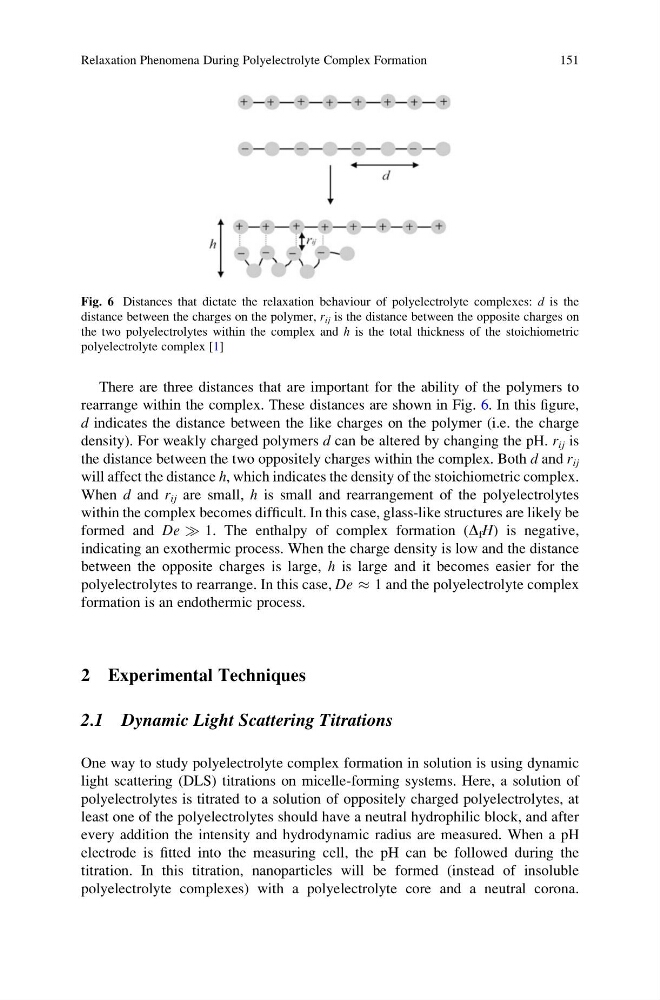
There are three distances that are important for the ability of the polymers to
rearrange within the complex. These distances are shown in Fig. 6. In this figure,
d indicates the distance between the like charges on the polymer (i.e. the charge
density). For weakly charged polymers d can be altered by changing the pH. r ij is
the distance between the two oppositely charges within the complex. Both d and r ij
will affect the distance h, which indicates the density of the stoichiometric complex.
When d and r ij are small, h is small and rearrangement of the polyelectrolytes
within the complex becomes difficult. In this case, glass-like structures are likely be
formed and De ) 1. The enthalpy of complex formation (D f H) is negative,
indicating an exothermic process. When the charge density is low and the distance
between the opposite charges is large, h is large and it becomes easier for the
polyelectrolytes to rearrange. In this case, De % 1 and the polyelectrolyte complex
formation is an endothermic process.
2 Experimental Techniques
2.1 Dynamic Light Scattering Titrations
One way to study polyelectrolyte complex formation in solution is using dynamic
light scattering (DLS) titrations on micelle-forming systems. Here, a solution of
polyelectrolytes is titrated to a solution of oppositely charged polyelectrolytes, at
least one of the polyelectrolytes should have a neutral hydrophilic block, and after
every addition the intensity and hydrodynamic radius are measured. When a pH
electrode is fitted into the measuring cell, the pH can be followed during the
titration. In this titration, nanoparticles will be formed (instead of insoluble
polyelectrolyte complexes) with a polyelectrolyte core and a neutral corona.
Fig. 6 Distances that dictate the relaxation behaviour of polyelectrolyte complexes: d is the
distance between the charges on the polymer, r ij is the distance between the opposite charges on
the two polyelectrolytes within the complex and h is the total thickness of the stoichiometric
polyelectrolyte complex [1]
Relaxation Phenomena During Polyelectrolyte Complex Formation
151
rearrange within the complex. These distances are shown in Fig. 6. In this figure,
d indicates the distance between the like charges on the polymer (i.e. the charge
density). For weakly charged polymers d can be altered by changing the pH. r ij is
the distance between the two oppositely charges within the complex. Both d and r ij
will affect the distance h, which indicates the density of the stoichiometric complex.
When d and r ij are small, h is small and rearrangement of the polyelectrolytes
within the complex becomes difficult. In this case, glass-like structures are likely be
formed and De ) 1. The enthalpy of complex formation (D f H) is negative,
indicating an exothermic process. When the charge density is low and the distance
between the opposite charges is large, h is large and it becomes easier for the
polyelectrolytes to rearrange. In this case, De % 1 and the polyelectrolyte complex
formation is an endothermic process.
2 Experimental Techniques
2.1 Dynamic Light Scattering Titrations
One way to study polyelectrolyte complex formation in solution is using dynamic
light scattering (DLS) titrations on micelle-forming systems. Here, a solution of
polyelectrolytes is titrated to a solution of oppositely charged polyelectrolytes, at
least one of the polyelectrolytes should have a neutral hydrophilic block, and after
every addition the intensity and hydrodynamic radius are measured. When a pH
electrode is fitted into the measuring cell, the pH can be followed during the
titration. In this titration, nanoparticles will be formed (instead of insoluble
polyelectrolyte complexes) with a polyelectrolyte core and a neutral corona.
Fig. 6 Distances that dictate the relaxation behaviour of polyelectrolyte complexes: d is the
distance between the charges on the polymer, r ij is the distance between the opposite charges on
the two polyelectrolytes within the complex and h is the total thickness of the stoichiometric
polyelectrolyte complex [1]
Relaxation Phenomena During Polyelectrolyte Complex Formation
151