

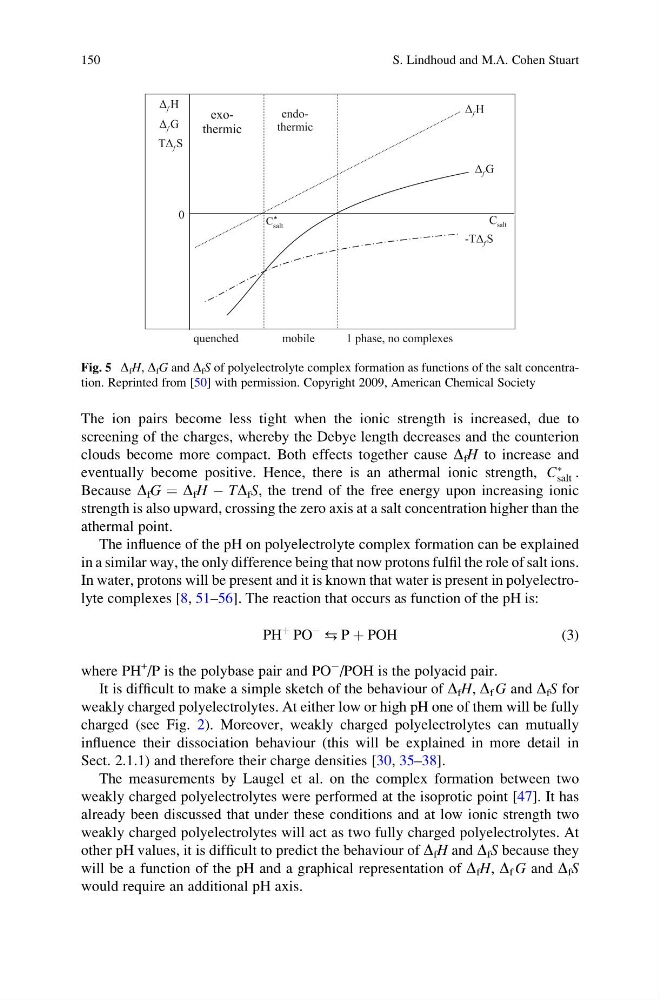
The ion pairs become less tight when the ionic strength is increased, due to
screening of the charges, whereby the Debye length decreases and the counterion
clouds become more compact. Both effects together cause D f H to increase and
eventually become positive. Hence, there is an athermal ionic strength, C
Ã
salt .
Because D f G ¼ D f H À TD f S, the trend of the free energy upon increasing ionic
strength is also upward, crossing the zero axis at a salt concentration higher than the
athermal point.
The influence of the pH on polyelectrolyte complex formation can be explained
in a similar way, the only difference being that now protons fulfil the role of salt ions.
In water, protons will be present and it is known that water is present in polyelectrolyte complexes [8, 51–56]. The reaction that occurs as function of the pH is:
PH
þ PO
À
. P þ POH
(3)
where PH
+
/P is the polybase pair and PO
À /POH is the polyacid pair.
It is difficult to make a simple sketch of the behaviour of D f H, D f G and D f S for
weakly charged polyelectrolytes. At either low or high pH one of them will be fully
charged (see Fig. 2). Moreover, weakly charged polyelectrolytes can mutually
influence their dissociation behaviour (this will be explained in more detail in
Sect. 2.1.1) and therefore their charge densities [30, 35–38].
The measurements by Laugel et al. on the complex formation between two
weakly charged polyelectrolytes were performed at the isoprotic point [47]. It has
already been discussed that under these conditions and at low ionic strength two
weakly charged polyelectrolytes will act as two fully charged polyelectrolytes. At
other pH values, it is difficult to predict the behaviour of D f H and D f S because they
will be a function of the pH and a graphical representation of D f H, D f G and D f S
would require an additional pH axis.
Fig. 5 D f H, D f G and D f S of polyelectrolyte complex formation as functions of the salt concentration. Reprinted from [50] with permission. Copyright 2009, American Chemical Society
150
S. Lindhoud and M.A. Cohen Stuart
screening of the charges, whereby the Debye length decreases and the counterion
clouds become more compact. Both effects together cause D f H to increase and
eventually become positive. Hence, there is an athermal ionic strength, C
Ã
salt .
Because D f G ¼ D f H À TD f S, the trend of the free energy upon increasing ionic
strength is also upward, crossing the zero axis at a salt concentration higher than the
athermal point.
The influence of the pH on polyelectrolyte complex formation can be explained
in a similar way, the only difference being that now protons fulfil the role of salt ions.
In water, protons will be present and it is known that water is present in polyelectrolyte complexes [8, 51–56]. The reaction that occurs as function of the pH is:
PH
þ PO
À
. P þ POH
(3)
where PH
+
/P is the polybase pair and PO
À /POH is the polyacid pair.
It is difficult to make a simple sketch of the behaviour of D f H, D f G and D f S for
weakly charged polyelectrolytes. At either low or high pH one of them will be fully
charged (see Fig. 2). Moreover, weakly charged polyelectrolytes can mutually
influence their dissociation behaviour (this will be explained in more detail in
Sect. 2.1.1) and therefore their charge densities [30, 35–38].
The measurements by Laugel et al. on the complex formation between two
weakly charged polyelectrolytes were performed at the isoprotic point [47]. It has
already been discussed that under these conditions and at low ionic strength two
weakly charged polyelectrolytes will act as two fully charged polyelectrolytes. At
other pH values, it is difficult to predict the behaviour of D f H and D f S because they
will be a function of the pH and a graphical representation of D f H, D f G and D f S
would require an additional pH axis.
Fig. 5 D f H, D f G and D f S of polyelectrolyte complex formation as functions of the salt concentration. Reprinted from [50] with permission. Copyright 2009, American Chemical Society
150
S. Lindhoud and M.A. Cohen Stuart