

differential scanning calorimetry [48]. Apparently, the ability of complexes to
rearrange correlates strongly to the sign of D f H.
Also, simulations have been used to study the entropy and enthalpy of polyelectrolyte complex formation. Ou and Muthukumar used Langevin dynamics
simulations to study the thermodynamic properties of polyelectrolyte complexation
[49]. They studied both strongly and weakly interacting polyelectrolytes at low and
high salt concentrations. As function of the ionic strength, they found that the
enthalpy of polyelectrolyte complex formation is reduced due to screening of the
charges within the system. The entropy of the counterion release also decreases in
the presence of salt. This reduction in entropy is more significant for strongly
interacting systems than for weakly interacting systems.
Let us now try to sketch the behaviour of the enthalpy, entropy and free energy
(D f G) as a function of the salt concentration. Upon increasing the ionic strength, a
change from exothermic to endothermic behaviour is observed. This means that at
low ionic strength the complex formation is enthalpically favourable, but it
becomes entropically driven when the salt concentration is increased. This may
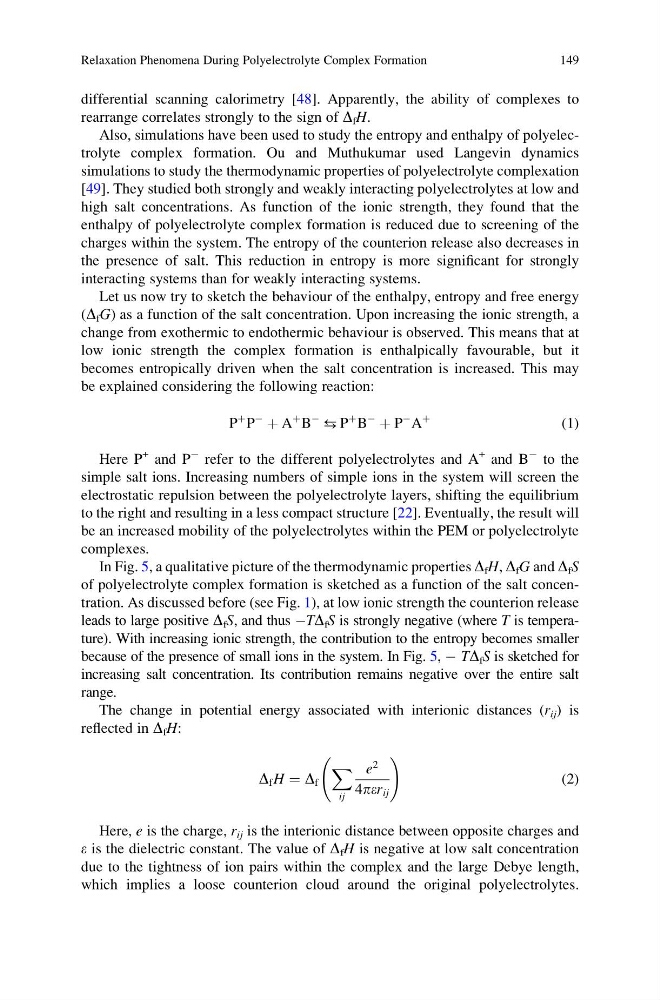
be explained considering the following reaction:
P
þ P
À
þ A
þ B
À
. P
þ B
À
þ P
À A
þ
(1)
Here P
+ and P
À refer to the different polyelectrolytes and A
+ and B
À to the
simple salt ions. Increasing numbers of simple ions in the system will screen the
electrostatic repulsion between the polyelectrolyte layers, shifting the equilibrium
to the right and resulting in a less compact structure [22]. Eventually, the result will
be an increased mobility of the polyelectrolytes within the PEM or polyelectrolyte
complexes.
In Fig. 5, a qualitative picture of the thermodynamic properties D f H, D f G and D f S
of polyelectrolyte complex formation is sketched as a function of the salt concentration. As discussed before (see Fig. 1), at low ionic strength the counterion release
leads to large positive D f S, and thus ÀTD f S is strongly negative (where T is temperature). With increasing ionic strength, the contribution to the entropy becomes smaller
because of the presence of small ions in the system. In Fig. 5, À TD f S is sketched for
increasing salt concentration. Its contribution remains negative over the entire salt
range.
The change in potential energy associated with interionic distances (r ij ) is
reflected in D f H:
D f H ¼ D f
X
ij
e
2
4per ij
!
(2)
Here, e is the charge, r ij is the interionic distance between opposite charges and
e is the dielectric constant. The value of D f H is negative at low salt concentration
due to the tightness of ion pairs within the complex and the large Debye length,
which implies a loose counterion cloud around the original polyelectrolytes.
Relaxation Phenomena During Polyelectrolyte Complex Formation
149
rearrange correlates strongly to the sign of D f H.
Also, simulations have been used to study the entropy and enthalpy of polyelectrolyte complex formation. Ou and Muthukumar used Langevin dynamics
simulations to study the thermodynamic properties of polyelectrolyte complexation
[49]. They studied both strongly and weakly interacting polyelectrolytes at low and
high salt concentrations. As function of the ionic strength, they found that the
enthalpy of polyelectrolyte complex formation is reduced due to screening of the
charges within the system. The entropy of the counterion release also decreases in
the presence of salt. This reduction in entropy is more significant for strongly
interacting systems than for weakly interacting systems.
Let us now try to sketch the behaviour of the enthalpy, entropy and free energy
(D f G) as a function of the salt concentration. Upon increasing the ionic strength, a
change from exothermic to endothermic behaviour is observed. This means that at
low ionic strength the complex formation is enthalpically favourable, but it
becomes entropically driven when the salt concentration is increased. This may
be explained considering the following reaction:
P
þ P
À
þ A
þ B
À
. P
þ B
À
þ P
À A
þ
(1)
Here P
+ and P
À refer to the different polyelectrolytes and A
+ and B
À to the
simple salt ions. Increasing numbers of simple ions in the system will screen the
electrostatic repulsion between the polyelectrolyte layers, shifting the equilibrium
to the right and resulting in a less compact structure [22]. Eventually, the result will
be an increased mobility of the polyelectrolytes within the PEM or polyelectrolyte
complexes.
In Fig. 5, a qualitative picture of the thermodynamic properties D f H, D f G and D f S
of polyelectrolyte complex formation is sketched as a function of the salt concentration. As discussed before (see Fig. 1), at low ionic strength the counterion release
leads to large positive D f S, and thus ÀTD f S is strongly negative (where T is temperature). With increasing ionic strength, the contribution to the entropy becomes smaller
because of the presence of small ions in the system. In Fig. 5, À TD f S is sketched for
increasing salt concentration. Its contribution remains negative over the entire salt
range.
The change in potential energy associated with interionic distances (r ij ) is
reflected in D f H:
D f H ¼ D f
X
ij
e
2
4per ij
!
(2)
Here, e is the charge, r ij is the interionic distance between opposite charges and
e is the dielectric constant. The value of D f H is negative at low salt concentration
due to the tightness of ion pairs within the complex and the large Debye length,
which implies a loose counterion cloud around the original polyelectrolytes.
Relaxation Phenomena During Polyelectrolyte Complex Formation
149