

conductivity spectra, i.e., by plotting log(σ
0 /σ dc ) against log(ν/σ dc ). It should be
noted that a division of the experimental frequency ν by σ dc (instead of σ dc T) is
completely sufficient here, because the temperature is not varied in the RHdependent experiments.
The results in Fig. 22 show that the RH-dependent spectra of a given PEC, can,
indeed, be superimposed to a master curve. The agreement between the curves is
excellent in all parts of the spectra except at low frequencies, where electrode
polarization effects dominate; however, these do not describe material properties.
We can therefore claim that for the presented polyelectrolyte materials there is a
time–humidity superposition-principle (THSP) in analogy to the well-established
TTSP. Moreover, the special case of Summerfield-type scaling is fulfilled. The
same holds true for other investigated PEC compositions not presented here.
We note that a similar concept of generalized dynamics has been found in PEC in
rheological spectra, for which the salt concentration is the parameter causing a general
enhancement of the dynamics; thus, it was termed time–salt superposition [75].
What can be concluded from the above observation of a time–humidity superposition in conductivity spectra? First, the strong exponential increase in the
conductivity with RH shows that its influence on the ion dynamics is much stronger
than expected for a slight softening of the PEC matrix induced by the absorption of
water. The ion dynamics is therefore strongly decoupled from the polyion network
dynamics, a property already previously discussed [40, 47, 67]. The dispersive
conductivity reflects the ion dynamics occurring in a time window, 1/(2πν), and
thus probes ionic hopping occurring on short time and length scales. The long-time
limit of the dynamics is probed by the dc conductivity reflecting macroscopic ion
transport. The THSP implies that the increase in RH of the environment does not
change the basic principle of the ion conduction mechanism, but only leads to the
same enhancement of the ion dynamics on all time and length scales. The reason for
this is that with increasing RH water is absorbed into the PEC, which changes the
energy landscape for the moving ions in such a way that ion long-range transport as
well as local ion motions are strongly facilitated. This can be visualized if the
temperature and the humidity dependence of the dc conductivity are combined in
one equation. Dried polyelectrolyte complexes of type xNaPSS·(1 À x)
PDADMAC behave like strong glass-formers: the dc conductivity is Arrheniusactivated below and even above the glass transition temperature with the same
activation enthalpy. Temperature-dependent measurements show that at constant
elevated humidity the complexes also follow the Arrhenius law, which will be
subject of a forthcoming paper from this laboratory (De et al., unpublished results).
The experimental results can be empirically combined into the following equation:
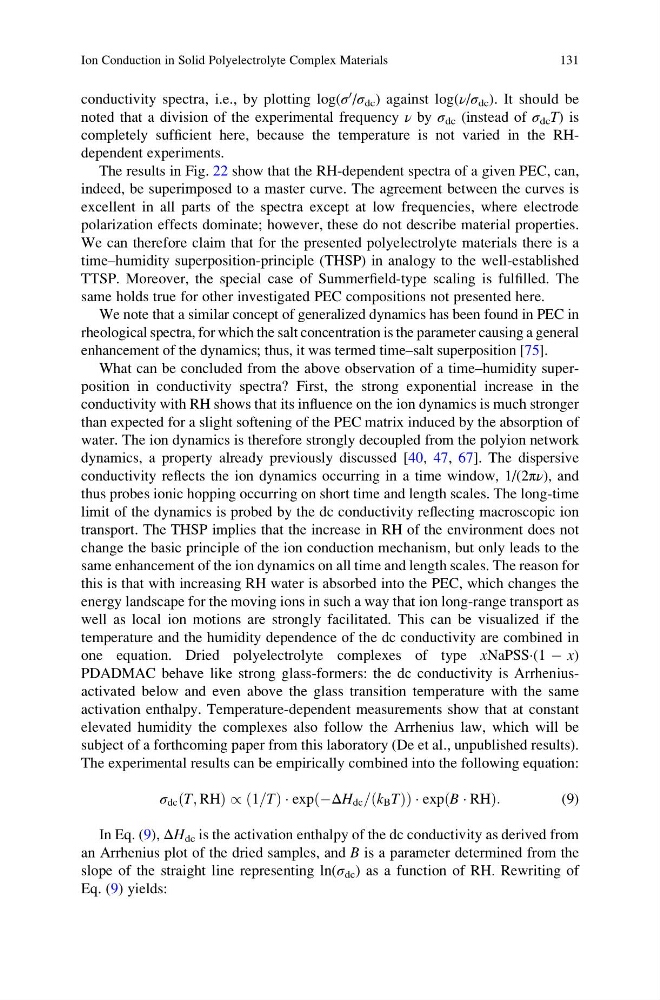
σ dc ðT; RHÞ / ð1=TÞ Á expðÀΔH dc =ðk B TÞÞ Á expðB Á RHÞ:
(9)
In Eq. (9), ΔH dc is the activation enthalpy of the dc conductivity as derived from
an Arrhenius plot of the dried samples, and B is a parameter determined from the
slope of the straight line representing ln(σ dc ) as a function of RH. Rewriting of
Eq. (9) yields:
Ion Conduction in Solid Polyelectrolyte Complex Materials
131
0 /σ dc ) against log(ν/σ dc ). It should be
noted that a division of the experimental frequency ν by σ dc (instead of σ dc T) is
completely sufficient here, because the temperature is not varied in the RHdependent experiments.
The results in Fig. 22 show that the RH-dependent spectra of a given PEC, can,
indeed, be superimposed to a master curve. The agreement between the curves is
excellent in all parts of the spectra except at low frequencies, where electrode
polarization effects dominate; however, these do not describe material properties.
We can therefore claim that for the presented polyelectrolyte materials there is a
time–humidity superposition-principle (THSP) in analogy to the well-established
TTSP. Moreover, the special case of Summerfield-type scaling is fulfilled. The
same holds true for other investigated PEC compositions not presented here.
We note that a similar concept of generalized dynamics has been found in PEC in
rheological spectra, for which the salt concentration is the parameter causing a general
enhancement of the dynamics; thus, it was termed time–salt superposition [75].
What can be concluded from the above observation of a time–humidity superposition in conductivity spectra? First, the strong exponential increase in the
conductivity with RH shows that its influence on the ion dynamics is much stronger
than expected for a slight softening of the PEC matrix induced by the absorption of
water. The ion dynamics is therefore strongly decoupled from the polyion network
dynamics, a property already previously discussed [40, 47, 67]. The dispersive
conductivity reflects the ion dynamics occurring in a time window, 1/(2πν), and
thus probes ionic hopping occurring on short time and length scales. The long-time
limit of the dynamics is probed by the dc conductivity reflecting macroscopic ion
transport. The THSP implies that the increase in RH of the environment does not
change the basic principle of the ion conduction mechanism, but only leads to the
same enhancement of the ion dynamics on all time and length scales. The reason for
this is that with increasing RH water is absorbed into the PEC, which changes the
energy landscape for the moving ions in such a way that ion long-range transport as
well as local ion motions are strongly facilitated. This can be visualized if the
temperature and the humidity dependence of the dc conductivity are combined in
one equation. Dried polyelectrolyte complexes of type xNaPSS·(1 À x)
PDADMAC behave like strong glass-formers: the dc conductivity is Arrheniusactivated below and even above the glass transition temperature with the same
activation enthalpy. Temperature-dependent measurements show that at constant
elevated humidity the complexes also follow the Arrhenius law, which will be
subject of a forthcoming paper from this laboratory (De et al., unpublished results).
The experimental results can be empirically combined into the following equation:
σ dc ðT; RHÞ / ð1=TÞ Á expðÀΔH dc =ðk B TÞÞ Á expðB Á RHÞ:
(9)
In Eq. (9), ΔH dc is the activation enthalpy of the dc conductivity as derived from
an Arrhenius plot of the dried samples, and B is a parameter determined from the
slope of the straight line representing ln(σ dc ) as a function of RH. Rewriting of
Eq. (9) yields:
Ion Conduction in Solid Polyelectrolyte Complex Materials
131