

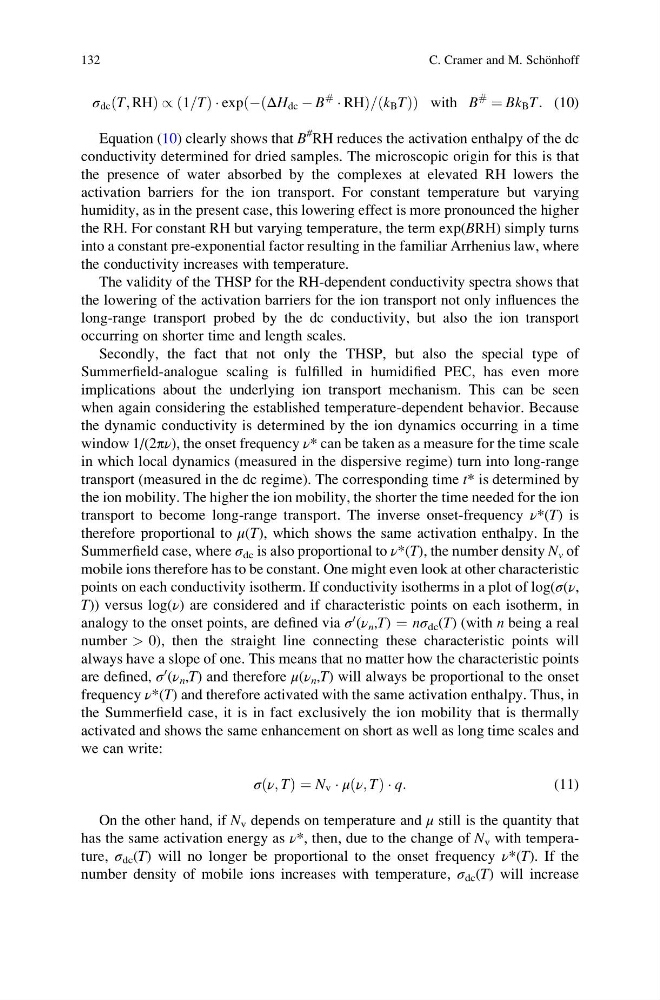
σ dc ðT; RHÞ / ð1=TÞ Á expðÀðΔH dc À B
#
Á RHÞ=ðk B TÞÞ with B
#
¼ Bk B T: (10)
Equation (10) clearly shows that B
# RH reduces the activation enthalpy of the dc
conductivity determined for dried samples. The microscopic origin for this is that
the presence of water absorbed by the complexes at elevated RH lowers the
activation barriers for the ion transport. For constant temperature but varying
humidity, as in the present case, this lowering effect is more pronounced the higher
the RH. For constant RH but varying temperature, the term exp(BRH) simply turns
into a constant pre-exponential factor resulting in the familiar Arrhenius law, where
the conductivity increases with temperature.
The validity of the THSP for the RH-dependent conductivity spectra shows that
the lowering of the activation barriers for the ion transport not only influences the
long-range transport probed by the dc conductivity, but also the ion transport
occurring on shorter time and length scales.
Secondly, the fact that not only the THSP, but also the special type of
Summerfield-analogue scaling is fulfilled in humidified PEC, has even more
implications about the underlying ion transport mechanism. This can be seen
when again considering the established temperature-dependent behavior. Because
the dynamic conductivity is determined by the ion dynamics occurring in a time
window 1/(2πν), the onset frequency ν* can be taken as a measure for the time scale
in which local dynamics (measured in the dispersive regime) turn into long-range
transport (measured in the dc regime). The corresponding time t* is determined by
the ion mobility. The higher the ion mobility, the shorter the time needed for the ion
transport to become long-range transport. The inverse onset-frequency ν*(T) is
therefore proportional to μ(T), which shows the same activation enthalpy. In the
Summerfield case, where σ dc is also proportional to ν*(T), the number density N v of
mobile ions therefore has to be constant. One might even look at other characteristic
points on each conductivity isotherm. If conductivity isotherms in a plot of log(σ(ν,
T)) versus log(ν) are considered and if characteristic points on each isotherm, in
analogy to the onset points, are defined via σ
0 (ν n ,T) ¼ nσ dc (T) (with n being a real
number > 0), then the straight line connecting these characteristic points will
always have a slope of one. This means that no matter how the characteristic points
are defined, σ
0 (ν n ,T) and therefore μ(ν n ,T) will always be proportional to the onset
frequency ν*(T) and therefore activated with the same activation enthalpy. Thus, in
the Summerfield case, it is in fact exclusively the ion mobility that is thermally
activated and shows the same enhancement on short as well as long time scales and
we can write:
σðν; TÞ ¼ N v Á μðν; TÞ Á q:
(11)
On the other hand, if N v depends on temperature and μ still is the quantity that
has the same activation energy as ν*, then, due to the change of N v with temperature, σ dc (T) will no longer be proportional to the onset frequency ν*(T). If the
number density of mobile ions increases with temperature, σ dc (T) will increase
132
C. Cramer and M. Scho ¨nhoff
#
Á RHÞ=ðk B TÞÞ with B
#
¼ Bk B T: (10)
Equation (10) clearly shows that B
# RH reduces the activation enthalpy of the dc
conductivity determined for dried samples. The microscopic origin for this is that
the presence of water absorbed by the complexes at elevated RH lowers the
activation barriers for the ion transport. For constant temperature but varying
humidity, as in the present case, this lowering effect is more pronounced the higher
the RH. For constant RH but varying temperature, the term exp(BRH) simply turns
into a constant pre-exponential factor resulting in the familiar Arrhenius law, where
the conductivity increases with temperature.
The validity of the THSP for the RH-dependent conductivity spectra shows that
the lowering of the activation barriers for the ion transport not only influences the
long-range transport probed by the dc conductivity, but also the ion transport
occurring on shorter time and length scales.
Secondly, the fact that not only the THSP, but also the special type of
Summerfield-analogue scaling is fulfilled in humidified PEC, has even more
implications about the underlying ion transport mechanism. This can be seen
when again considering the established temperature-dependent behavior. Because
the dynamic conductivity is determined by the ion dynamics occurring in a time
window 1/(2πν), the onset frequency ν* can be taken as a measure for the time scale
in which local dynamics (measured in the dispersive regime) turn into long-range
transport (measured in the dc regime). The corresponding time t* is determined by
the ion mobility. The higher the ion mobility, the shorter the time needed for the ion
transport to become long-range transport. The inverse onset-frequency ν*(T) is
therefore proportional to μ(T), which shows the same activation enthalpy. In the
Summerfield case, where σ dc is also proportional to ν*(T), the number density N v of
mobile ions therefore has to be constant. One might even look at other characteristic
points on each conductivity isotherm. If conductivity isotherms in a plot of log(σ(ν,
T)) versus log(ν) are considered and if characteristic points on each isotherm, in
analogy to the onset points, are defined via σ
0 (ν n ,T) ¼ nσ dc (T) (with n being a real
number > 0), then the straight line connecting these characteristic points will
always have a slope of one. This means that no matter how the characteristic points
are defined, σ
0 (ν n ,T) and therefore μ(ν n ,T) will always be proportional to the onset
frequency ν*(T) and therefore activated with the same activation enthalpy. Thus, in
the Summerfield case, it is in fact exclusively the ion mobility that is thermally
activated and shows the same enhancement on short as well as long time scales and
we can write:
σðν; TÞ ¼ N v Á μðν; TÞ Á q:
(11)
On the other hand, if N v depends on temperature and μ still is the quantity that
has the same activation energy as ν*, then, due to the change of N v with temperature, σ dc (T) will no longer be proportional to the onset frequency ν*(T). If the
number density of mobile ions increases with temperature, σ dc (T) will increase
132
C. Cramer and M. Scho ¨nhoff