

Figure 8 shows a strong compositional dependence of both the absolute conductivity values at a given temperature as well as the activation enthalpy (derived from
the slope of the presented lines). The values of the activation enthalpy ΔH dc of the
dc conductivity as well as of the pre-exponential factors of the Arrhenius law:
σ dc T ¼ A dc exp[ÀΔH dc /(k B T)] are summarized in table III of [40].
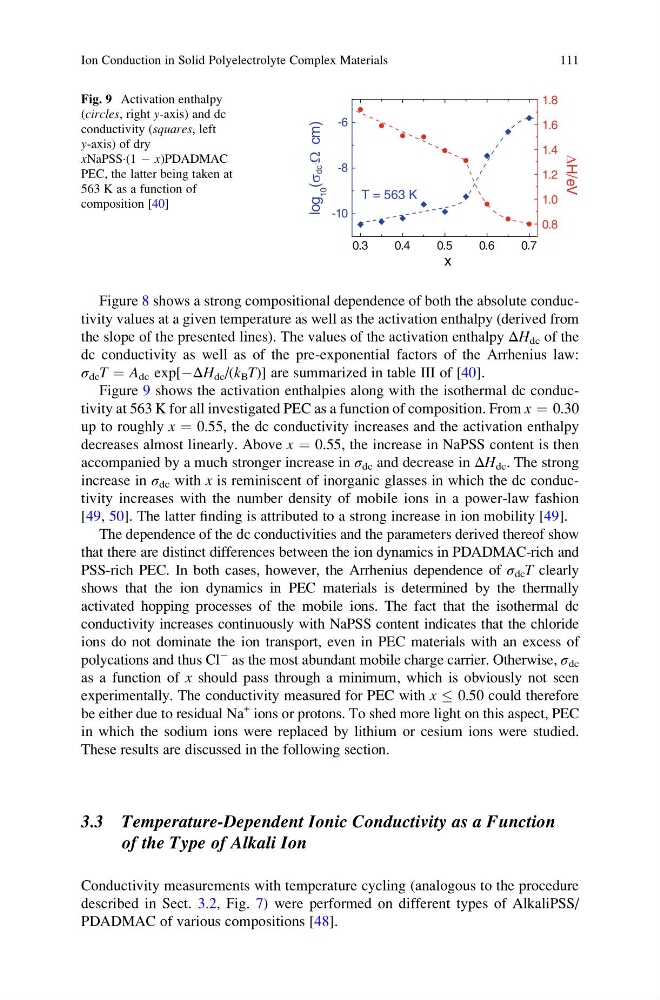
Figure 9 shows the activation enthalpies along with the isothermal dc conductivity at 563 K for all investigated PEC as a function of composition. From x ¼ 0.30
up to roughly x ¼ 0.55, the dc conductivity increases and the activation enthalpy
decreases almost linearly. Above x ¼ 0.55, the increase in NaPSS content is then
accompanied by a much stronger increase in σ dc and decrease in ΔH dc . The strong
increase in σ dc with x is reminiscent of inorganic glasses in which the dc conductivity increases with the number density of mobile ions in a power-law fashion
[49, 50]. The latter finding is attributed to a strong increase in ion mobility [49].
The dependence of the dc conductivities and the parameters derived thereof show
that there are distinct differences between the ion dynamics in PDADMAC-rich and
PSS-rich PEC. In both cases, however, the Arrhenius dependence of σ dc T clearly
shows that the ion dynamics in PEC materials is determined by the thermally
activated hopping processes of the mobile ions. The fact that the isothermal dc
conductivity increases continuously with NaPSS content indicates that the chloride
ions do not dominate the ion transport, even in PEC materials with an excess of
polycations and thus Cl
À as the most abundant mobile charge carrier. Otherwise, σ dc
as a function of x should pass through a minimum, which is obviously not seen
experimentally. The conductivity measured for PEC with x 0.50 could therefore
be either due to residual Na
+ ions or protons. To shed more light on this aspect, PEC
in which the sodium ions were replaced by lithium or cesium ions were studied.
These results are discussed in the following section.
3.3 Temperature-Dependent Ionic Conductivity as a Function
of the Type of Alkali Ion
Conductivity measurements with temperature cycling (analogous to the procedure
described in Sect. 3.2, Fig. 7) were performed on different types of AlkaliPSS/
PDADMAC of various compositions [48].
0.3
0.4
0.5
0.6
0.7
-10
-8
-6
x
log
10
(s
dc
.
W cm)
T = 563 K
0.8
1.0
1.2
1.4
1.6
1.8
DH/eV
Fig. 9 Activation enthalpy
(circles, right y-axis) and dc
conductivity (squares, left
y-axis) of dry
xNaPSS·(1 À x)PDADMAC
PEC, the latter being taken at
563 K as a function of
composition [40]
Ion Conduction in Solid Polyelectrolyte Complex Materials
111
the slope of the presented lines). The values of the activation enthalpy ΔH dc of the
dc conductivity as well as of the pre-exponential factors of the Arrhenius law:
σ dc T ¼ A dc exp[ÀΔH dc /(k B T)] are summarized in table III of [40].
Figure 9 shows the activation enthalpies along with the isothermal dc conductivity at 563 K for all investigated PEC as a function of composition. From x ¼ 0.30
up to roughly x ¼ 0.55, the dc conductivity increases and the activation enthalpy
decreases almost linearly. Above x ¼ 0.55, the increase in NaPSS content is then
accompanied by a much stronger increase in σ dc and decrease in ΔH dc . The strong
increase in σ dc with x is reminiscent of inorganic glasses in which the dc conductivity increases with the number density of mobile ions in a power-law fashion
[49, 50]. The latter finding is attributed to a strong increase in ion mobility [49].
The dependence of the dc conductivities and the parameters derived thereof show
that there are distinct differences between the ion dynamics in PDADMAC-rich and
PSS-rich PEC. In both cases, however, the Arrhenius dependence of σ dc T clearly
shows that the ion dynamics in PEC materials is determined by the thermally
activated hopping processes of the mobile ions. The fact that the isothermal dc
conductivity increases continuously with NaPSS content indicates that the chloride
ions do not dominate the ion transport, even in PEC materials with an excess of
polycations and thus Cl
À as the most abundant mobile charge carrier. Otherwise, σ dc
as a function of x should pass through a minimum, which is obviously not seen
experimentally. The conductivity measured for PEC with x 0.50 could therefore
be either due to residual Na
+ ions or protons. To shed more light on this aspect, PEC
in which the sodium ions were replaced by lithium or cesium ions were studied.
These results are discussed in the following section.
3.3 Temperature-Dependent Ionic Conductivity as a Function
of the Type of Alkali Ion
Conductivity measurements with temperature cycling (analogous to the procedure
described in Sect. 3.2, Fig. 7) were performed on different types of AlkaliPSS/
PDADMAC of various compositions [48].
0.3
0.4
0.5
0.6
0.7
-10
-8
-6
x
log
10
(s
dc
.
W cm)
T = 563 K
0.8
1.0
1.2
1.4
1.6
1.8
DH/eV
Fig. 9 Activation enthalpy
(circles, right y-axis) and dc
conductivity (squares, left
y-axis) of dry
xNaPSS·(1 À x)PDADMAC
PEC, the latter being taken at
563 K as a function of
composition [40]
Ion Conduction in Solid Polyelectrolyte Complex Materials
111