

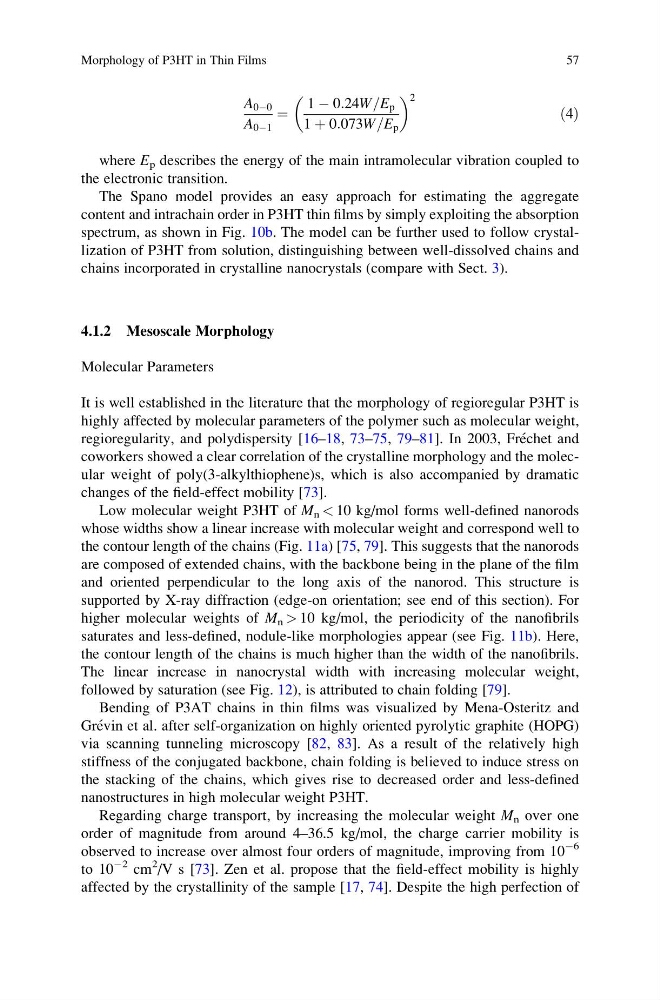
A 0À0
A 0À1
¼
1 À 0:24W=E p
1 þ 0:073W=E p
2
ð4Þ
where E p describes the energy of the main intramolecular vibration coupled to
the electronic transition.
The Spano model provides an easy approach for estimating the aggregate
content and intrachain order in P3HT thin films by simply exploiting the absorption
spectrum, as shown in Fig. 10b. The model can be further used to follow crystallization of P3HT from solution, distinguishing between well-dissolved chains and
chains incorporated in crystalline nanocrystals (compare with Sect. 3).
4.1.2 Mesoscale Morphology
Molecular Parameters
It is well established in the literature that the morphology of regioregular P3HT is
highly affected by molecular parameters of the polymer such as molecular weight,
regioregularity, and polydispersity [16–18, 73–75, 79–81]. In 2003, Fre ´chet and
coworkers showed a clear correlation of the crystalline morphology and the molecular weight of poly(3-alkylthiophene)s, which is also accompanied by dramatic
changes of the field-effect mobility [73].
Low molecular weight P3HT of M n < 10 kg/mol forms well-defined nanorods
whose widths show a linear increase with molecular weight and correspond well to
the contour length of the chains (Fig. 11a) [75, 79]. This suggests that the nanorods
are composed of extended chains, with the backbone being in the plane of the film
and oriented perpendicular to the long axis of the nanorod. This structure is
supported by X-ray diffraction (edge-on orientation; see end of this section). For
higher molecular weights of M n > 10 kg/mol, the periodicity of the nanofibrils
saturates and less-defined, nodule-like morphologies appear (see Fig. 11b). Here,
the contour length of the chains is much higher than the width of the nanofibrils.
The linear increase in nanocrystal width with increasing molecular weight,
followed by saturation (see Fig. 12), is attributed to chain folding [79].
Bending of P3AT chains in thin films was visualized by Mena-Osteritz and
Gre ´vin et al. after self-organization on highly oriented pyrolytic graphite (HOPG)
via scanning tunneling microscopy [82, 83]. As a result of the relatively high
stiffness of the conjugated backbone, chain folding is believed to induce stress on
the stacking of the chains, which gives rise to decreased order and less-defined
nanostructures in high molecular weight P3HT.
Regarding charge transport, by increasing the molecular weight M n over one
order of magnitude from around 4–36.5 kg/mol, the charge carrier mobility is
observed to increase over almost four orders of magnitude, improving from 10
À6
to 10
À2 cm
2 /V s [73]. Zen et al. propose that the field-effect mobility is highly
affected by the crystallinity of the sample [17, 74]. Despite the high perfection of
Morphology of P3HT in Thin Films
57
A 0À1
¼
1 À 0:24W=E p
1 þ 0:073W=E p
2
ð4Þ
where E p describes the energy of the main intramolecular vibration coupled to
the electronic transition.
The Spano model provides an easy approach for estimating the aggregate
content and intrachain order in P3HT thin films by simply exploiting the absorption
spectrum, as shown in Fig. 10b. The model can be further used to follow crystallization of P3HT from solution, distinguishing between well-dissolved chains and
chains incorporated in crystalline nanocrystals (compare with Sect. 3).
4.1.2 Mesoscale Morphology
Molecular Parameters
It is well established in the literature that the morphology of regioregular P3HT is
highly affected by molecular parameters of the polymer such as molecular weight,
regioregularity, and polydispersity [16–18, 73–75, 79–81]. In 2003, Fre ´chet and
coworkers showed a clear correlation of the crystalline morphology and the molecular weight of poly(3-alkylthiophene)s, which is also accompanied by dramatic
changes of the field-effect mobility [73].
Low molecular weight P3HT of M n < 10 kg/mol forms well-defined nanorods
whose widths show a linear increase with molecular weight and correspond well to
the contour length of the chains (Fig. 11a) [75, 79]. This suggests that the nanorods
are composed of extended chains, with the backbone being in the plane of the film
and oriented perpendicular to the long axis of the nanorod. This structure is
supported by X-ray diffraction (edge-on orientation; see end of this section). For
higher molecular weights of M n > 10 kg/mol, the periodicity of the nanofibrils
saturates and less-defined, nodule-like morphologies appear (see Fig. 11b). Here,
the contour length of the chains is much higher than the width of the nanofibrils.
The linear increase in nanocrystal width with increasing molecular weight,
followed by saturation (see Fig. 12), is attributed to chain folding [79].
Bending of P3AT chains in thin films was visualized by Mena-Osteritz and
Gre ´vin et al. after self-organization on highly oriented pyrolytic graphite (HOPG)
via scanning tunneling microscopy [82, 83]. As a result of the relatively high
stiffness of the conjugated backbone, chain folding is believed to induce stress on
the stacking of the chains, which gives rise to decreased order and less-defined
nanostructures in high molecular weight P3HT.
Regarding charge transport, by increasing the molecular weight M n over one
order of magnitude from around 4–36.5 kg/mol, the charge carrier mobility is
observed to increase over almost four orders of magnitude, improving from 10
À6
to 10
À2 cm
2 /V s [73]. Zen et al. propose that the field-effect mobility is highly
affected by the crystallinity of the sample [17, 74]. Despite the high perfection of
Morphology of P3HT in Thin Films
57