

the crystalline nanorods in low molecular weight P3HT, charge transport seems to
be mainly determined by twisted chains in the amorphous matrix. In contrast,
chains of high molecular weight adopt a planar chain conformation, enabling strong
π–π-interactions and hence efficient charge transport. Kline et al. take into account
that charges become trapped at grain boundaries between nanocrystals [18, 73]. In
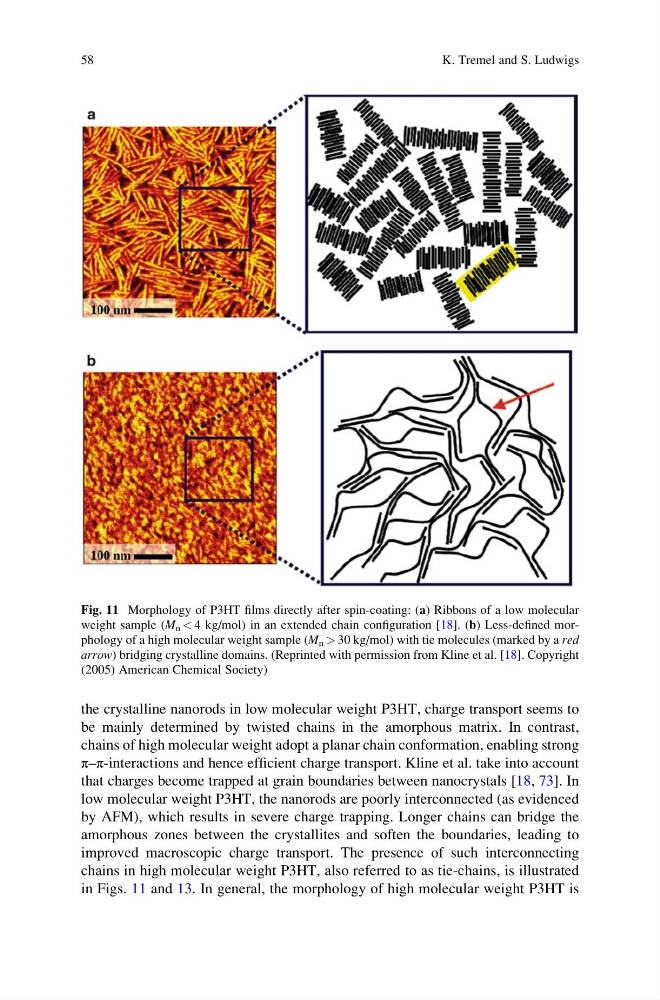
low molecular weight P3HT, the nanorods are poorly interconnected (as evidenced
by AFM), which results in severe charge trapping. Longer chains can bridge the
amorphous zones between the crystallites and soften the boundaries, leading to
improved macroscopic charge transport. The presence of such interconnecting
chains in high molecular weight P3HT, also referred to as tie-chains, is illustrated
in Figs. 11 and 13. In general, the morphology of high molecular weight P3HT is
Fig. 11 Morphology of P3HT films directly after spin-coating: (a) Ribbons of a low molecular
weight sample (M n < 4 kg/mol) in an extended chain configuration [18]. (b) Less-defined morphology of a high molecular weight sample (M n > 30 kg/mol) with tie molecules (marked by a red
arrow) bridging crystalline domains. (Reprinted with permission from Kline et al. [18]. Copyright
(2005) American Chemical Society)
58
K. Tremel and S. Ludwigs
be mainly determined by twisted chains in the amorphous matrix. In contrast,
chains of high molecular weight adopt a planar chain conformation, enabling strong
π–π-interactions and hence efficient charge transport. Kline et al. take into account
that charges become trapped at grain boundaries between nanocrystals [18, 73]. In
low molecular weight P3HT, the nanorods are poorly interconnected (as evidenced
by AFM), which results in severe charge trapping. Longer chains can bridge the
amorphous zones between the crystallites and soften the boundaries, leading to
improved macroscopic charge transport. The presence of such interconnecting
chains in high molecular weight P3HT, also referred to as tie-chains, is illustrated
in Figs. 11 and 13. In general, the morphology of high molecular weight P3HT is
Fig. 11 Morphology of P3HT films directly after spin-coating: (a) Ribbons of a low molecular
weight sample (M n < 4 kg/mol) in an extended chain configuration [18]. (b) Less-defined morphology of a high molecular weight sample (M n > 30 kg/mol) with tie molecules (marked by a red
arrow) bridging crystalline domains. (Reprinted with permission from Kline et al. [18]. Copyright
(2005) American Chemical Society)
58
K. Tremel and S. Ludwigs