

As shown in Fig. 22, the carrier density within the blend layer changes with
illumination intensity I, cell voltage V, and temperature T. Combining n(I, V, T )
with charge carrier lifetime data determined with TPV at comparable carrier
densities allows calculation of the loss current density J NG via Eq. (8). Finally,
the current characteristics under steady-state illumination are reconstructed with the
assumption of a field-independent generation current density, J gen ffi J sc . This
approach has been successfully applied to both as-prepared and annealed P3HT:
PCBM layers [173, 205]. The data in Fig. 22c, d also show that the annealed device
displays larger carrier lifetimes and lower recombination coefficients than the
as-cast sample at comparable carrier densities. This has been quoted as the main
cause for the superior performance of the thermally treated sample [173, 205].
We will, finally, comment briefly on the importance of establishing high electron
and hole mobilities in P3HT:PCBM blends. Clearly, a high mobility of both types
of carriers ensures rapid extraction of photogenerated charge out of the blend
layers, rendering these carriers less vulnerable to recombination loss. Goodman
and Rose [208] and later Mihailetchi et al. [209] stated that unequal carrier
mobilities cause formation of space charge within the active layer, which renders
part of the blend essentially field-free. As a consequence, the extracted current
becomes significantly smaller than the photogenerated current:
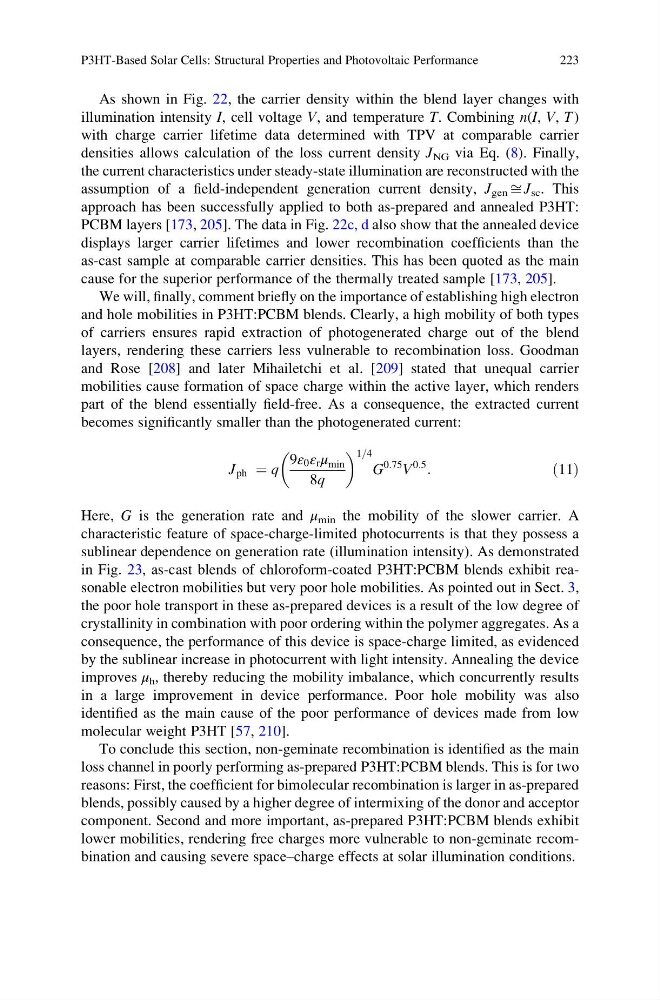
J ph ¼ q
9ε 0 ε r μ min
8q
1=4
G
0:75 V
0:5
:
ð11Þ
Here, G is the generation rate and μ min the mobility of the slower carrier. A
characteristic feature of space-charge-limited photocurrents is that they possess a
sublinear dependence on generation rate (illumination intensity). As demonstrated
in Fig. 23, as-cast blends of chloroform-coated P3HT:PCBM blends exhibit reasonable electron mobilities but very poor hole mobilities. As pointed out in Sect. 3,
the poor hole transport in these as-prepared devices is a result of the low degree of
crystallinity in combination with poor ordering within the polymer aggregates. As a
consequence, the performance of this device is space-charge limited, as evidenced
by the sublinear increase in photocurrent with light intensity. Annealing the device
improves μ h , thereby reducing the mobility imbalance, which concurrently results
in a large improvement in device performance. Poor hole mobility was also
identified as the main cause of the poor performance of devices made from low
molecular weight P3HT [57, 210].
To conclude this section, non-geminate recombination is identified as the main
loss channel in poorly performing as-prepared P3HT:PCBM blends. This is for two
reasons: First, the coefficient for bimolecular recombination is larger in as-prepared
blends, possibly caused by a higher degree of intermixing of the donor and acceptor
component. Second and more important, as-prepared P3HT:PCBM blends exhibit
lower mobilities, rendering free charges more vulnerable to non-geminate recombination and causing severe space–charge effects at solar illumination conditions.
P3HT-Based Solar Cells: Structural Properties and Photovoltaic Performance
223
illumination intensity I, cell voltage V, and temperature T. Combining n(I, V, T )
with charge carrier lifetime data determined with TPV at comparable carrier
densities allows calculation of the loss current density J NG via Eq. (8). Finally,
the current characteristics under steady-state illumination are reconstructed with the
assumption of a field-independent generation current density, J gen ffi J sc . This
approach has been successfully applied to both as-prepared and annealed P3HT:
PCBM layers [173, 205]. The data in Fig. 22c, d also show that the annealed device
displays larger carrier lifetimes and lower recombination coefficients than the
as-cast sample at comparable carrier densities. This has been quoted as the main
cause for the superior performance of the thermally treated sample [173, 205].
We will, finally, comment briefly on the importance of establishing high electron
and hole mobilities in P3HT:PCBM blends. Clearly, a high mobility of both types
of carriers ensures rapid extraction of photogenerated charge out of the blend
layers, rendering these carriers less vulnerable to recombination loss. Goodman
and Rose [208] and later Mihailetchi et al. [209] stated that unequal carrier
mobilities cause formation of space charge within the active layer, which renders
part of the blend essentially field-free. As a consequence, the extracted current
becomes significantly smaller than the photogenerated current:
J ph ¼ q
9ε 0 ε r μ min
8q
1=4
G
0:75 V
0:5
:
ð11Þ
Here, G is the generation rate and μ min the mobility of the slower carrier. A
characteristic feature of space-charge-limited photocurrents is that they possess a
sublinear dependence on generation rate (illumination intensity). As demonstrated
in Fig. 23, as-cast blends of chloroform-coated P3HT:PCBM blends exhibit reasonable electron mobilities but very poor hole mobilities. As pointed out in Sect. 3,
the poor hole transport in these as-prepared devices is a result of the low degree of
crystallinity in combination with poor ordering within the polymer aggregates. As a
consequence, the performance of this device is space-charge limited, as evidenced
by the sublinear increase in photocurrent with light intensity. Annealing the device
improves μ h , thereby reducing the mobility imbalance, which concurrently results
in a large improvement in device performance. Poor hole mobility was also
identified as the main cause of the poor performance of devices made from low
molecular weight P3HT [57, 210].
To conclude this section, non-geminate recombination is identified as the main
loss channel in poorly performing as-prepared P3HT:PCBM blends. This is for two
reasons: First, the coefficient for bimolecular recombination is larger in as-prepared
blends, possibly caused by a higher degree of intermixing of the donor and acceptor
component. Second and more important, as-prepared P3HT:PCBM blends exhibit
lower mobilities, rendering free charges more vulnerable to non-geminate recombination and causing severe space–charge effects at solar illumination conditions.
P3HT-Based Solar Cells: Structural Properties and Photovoltaic Performance
223