

5 Summary, Conclusions, and Outlook
From 2003 to 2013, P3HT:PCBM was the “fruit fly” system to study for understanding organic photovoltaic properties. The understanding of these properties has
not been straightforward because of the complex way that P3HT and PCBM
interact with each other, with themselves, and with the substrates. In particular,
mixed BHJ films, which self-assemble from solution in the length range from
10
À10 to 10
À5 m, have a hierarchical variety of film features. Because the film forms
via self-assembly, changing the fabrication conditions that affect the solvation of
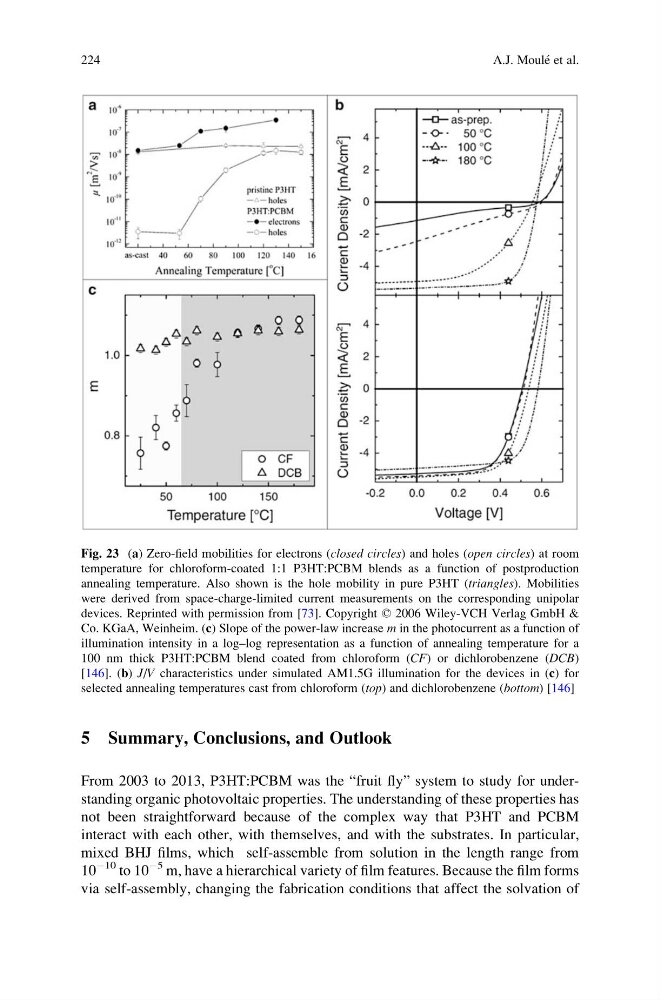
Fig. 23 (a) Zero-field mobilities for electrons (closed circles) and holes (open circles) at room
temperature for chloroform-coated 1:1 P3HT:PCBM blends as a function of postproduction
annealing temperature. Also shown is the hole mobility in pure P3HT (triangles). Mobilities
were derived from space-charge-limited current measurements on the corresponding unipolar
devices. Reprinted with permission from [73]. Copyright © 2006 Wiley-VCH Verlag GmbH &
Co. KGaA, Weinheim. (c) Slope of the power-law increase m in the photocurrent as a function of
illumination intensity in a log–log representation as a function of annealing temperature for a
100 nm thick P3HT:PCBM blend coated from chloroform (CF) or dichlorobenzene (DCB)
[146]. (b) J/V characteristics under simulated AM1.5G illumination for the devices in (c) for
selected annealing temperatures cast from chloroform (top) and dichlorobenzene (bottom) [146]
224
A.J. Moule ´ et al.
From 2003 to 2013, P3HT:PCBM was the “fruit fly” system to study for understanding organic photovoltaic properties. The understanding of these properties has
not been straightforward because of the complex way that P3HT and PCBM
interact with each other, with themselves, and with the substrates. In particular,
mixed BHJ films, which self-assemble from solution in the length range from
10
À10 to 10
À5 m, have a hierarchical variety of film features. Because the film forms
via self-assembly, changing the fabrication conditions that affect the solvation of
Fig. 23 (a) Zero-field mobilities for electrons (closed circles) and holes (open circles) at room
temperature for chloroform-coated 1:1 P3HT:PCBM blends as a function of postproduction
annealing temperature. Also shown is the hole mobility in pure P3HT (triangles). Mobilities
were derived from space-charge-limited current measurements on the corresponding unipolar
devices. Reprinted with permission from [73]. Copyright © 2006 Wiley-VCH Verlag GmbH &
Co. KGaA, Weinheim. (c) Slope of the power-law increase m in the photocurrent as a function of
illumination intensity in a log–log representation as a function of annealing temperature for a
100 nm thick P3HT:PCBM blend coated from chloroform (CF) or dichlorobenzene (DCB)
[146]. (b) J/V characteristics under simulated AM1.5G illumination for the devices in (c) for
selected annealing temperatures cast from chloroform (top) and dichlorobenzene (bottom) [146]
224
A.J. Moule ´ et al.