

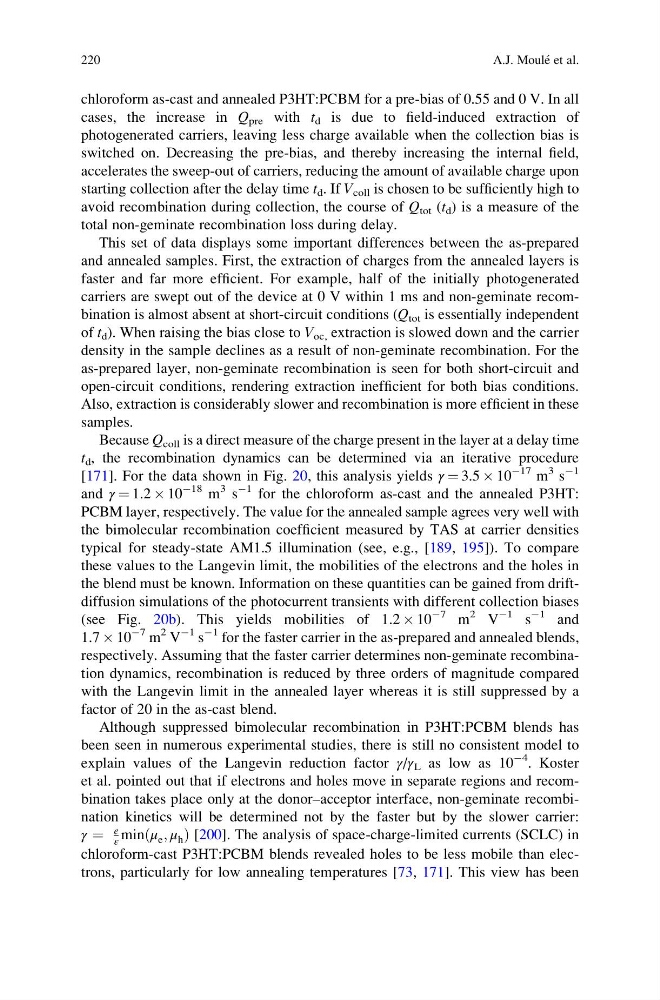
chloroform as-cast and annealed P3HT:PCBM for a pre-bias of 0.55 and 0 V. In all
cases, the increase in Q pre with t d is due to field-induced extraction of
photogenerated carriers, leaving less charge available when the collection bias is
switched on. Decreasing the pre-bias, and thereby increasing the internal field,
accelerates the sweep-out of carriers, reducing the amount of available charge upon
starting collection after the delay time t d . If V coll is chosen to be sufficiently high to
avoid recombination during collection, the course of Q tot (t d ) is a measure of the
total non-geminate recombination loss during delay.
This set of data displays some important differences between the as-prepared
and annealed samples. First, the extraction of charges from the annealed layers is
faster and far more efficient. For example, half of the initially photogenerated
carriers are swept out of the device at 0 V within 1 ms and non-geminate recombination is almost absent at short-circuit conditions (Q tot is essentially independent
of t d ). When raising the bias close to V oc, extraction is slowed down and the carrier
density in the sample declines as a result of non-geminate recombination. For the
as-prepared layer, non-geminate recombination is seen for both short-circuit and
open-circuit conditions, rendering extraction inefficient for both bias conditions.
Also, extraction is considerably slower and recombination is more efficient in these
samples.
Because Q coll is a direct measure of the charge present in the layer at a delay time
t d , the recombination dynamics can be determined via an iterative procedure
[171]. For the data shown in Fig. 20, this analysis yields γ ¼ 3.5 Â 10
À17 m
3 s
À1
and γ ¼ 1.2 Â 10
À18 m
3 s
À1 for the chloroform as-cast and the annealed P3HT:
PCBM layer, respectively. The value for the annealed sample agrees very well with
the bimolecular recombination coefficient measured by TAS at carrier densities
typical for steady-state AM1.5 illumination (see, e.g., [189, 195]). To compare
these values to the Langevin limit, the mobilities of the electrons and the holes in
the blend must be known. Information on these quantities can be gained from driftdiffusion simulations of the photocurrent transients with different collection biases
(see Fig. 20b). This yields mobilities of 1.2 Â 10
À7 m
2 V
À1 s
À1 and
1.7 Â 10
À7 m
2 V
À1 s
À1 for the faster carrier in the as-prepared and annealed blends,
respectively. Assuming that the faster carrier determines non-geminate recombination dynamics, recombination is reduced by three orders of magnitude compared
with the Langevin limit in the annealed layer whereas it is still suppressed by a
factor of 20 in the as-cast blend.
Although suppressed bimolecular recombination in P3HT:PCBM blends has
been seen in numerous experimental studies, there is still no consistent model to
explain values of the Langevin reduction factor γ/γ L as low as 10
À4 . Koster
et al. pointed out that if electrons and holes move in separate regions and recombination takes place only at the donor–acceptor interface, non-geminate recombination kinetics will be determined not by the faster but by the slower carrier:
γ ¼
e
ε min μ e ; μ h
ð
Þ[200]. The analysis of space-charge-limited currents (SCLC) in
chloroform-cast P3HT:PCBM blends revealed holes to be less mobile than electrons, particularly for low annealing temperatures [73, 171]. This view has been
220
A.J. Moule ´ et al.
cases, the increase in Q pre with t d is due to field-induced extraction of
photogenerated carriers, leaving less charge available when the collection bias is
switched on. Decreasing the pre-bias, and thereby increasing the internal field,
accelerates the sweep-out of carriers, reducing the amount of available charge upon
starting collection after the delay time t d . If V coll is chosen to be sufficiently high to
avoid recombination during collection, the course of Q tot (t d ) is a measure of the
total non-geminate recombination loss during delay.
This set of data displays some important differences between the as-prepared
and annealed samples. First, the extraction of charges from the annealed layers is
faster and far more efficient. For example, half of the initially photogenerated
carriers are swept out of the device at 0 V within 1 ms and non-geminate recombination is almost absent at short-circuit conditions (Q tot is essentially independent
of t d ). When raising the bias close to V oc, extraction is slowed down and the carrier
density in the sample declines as a result of non-geminate recombination. For the
as-prepared layer, non-geminate recombination is seen for both short-circuit and
open-circuit conditions, rendering extraction inefficient for both bias conditions.
Also, extraction is considerably slower and recombination is more efficient in these
samples.
Because Q coll is a direct measure of the charge present in the layer at a delay time
t d , the recombination dynamics can be determined via an iterative procedure
[171]. For the data shown in Fig. 20, this analysis yields γ ¼ 3.5 Â 10
À17 m
3 s
À1
and γ ¼ 1.2 Â 10
À18 m
3 s
À1 for the chloroform as-cast and the annealed P3HT:
PCBM layer, respectively. The value for the annealed sample agrees very well with
the bimolecular recombination coefficient measured by TAS at carrier densities
typical for steady-state AM1.5 illumination (see, e.g., [189, 195]). To compare
these values to the Langevin limit, the mobilities of the electrons and the holes in
the blend must be known. Information on these quantities can be gained from driftdiffusion simulations of the photocurrent transients with different collection biases
(see Fig. 20b). This yields mobilities of 1.2 Â 10
À7 m
2 V
À1 s
À1 and
1.7 Â 10
À7 m
2 V
À1 s
À1 for the faster carrier in the as-prepared and annealed blends,
respectively. Assuming that the faster carrier determines non-geminate recombination dynamics, recombination is reduced by three orders of magnitude compared
with the Langevin limit in the annealed layer whereas it is still suppressed by a
factor of 20 in the as-cast blend.
Although suppressed bimolecular recombination in P3HT:PCBM blends has
been seen in numerous experimental studies, there is still no consistent model to
explain values of the Langevin reduction factor γ/γ L as low as 10
À4 . Koster
et al. pointed out that if electrons and holes move in separate regions and recombination takes place only at the donor–acceptor interface, non-geminate recombination kinetics will be determined not by the faster but by the slower carrier:
γ ¼
e
ε min μ e ; μ h
ð
Þ[200]. The analysis of space-charge-limited currents (SCLC) in
chloroform-cast P3HT:PCBM blends revealed holes to be less mobile than electrons, particularly for low annealing temperatures [73, 171]. This view has been
220
A.J. Moule ´ et al.