

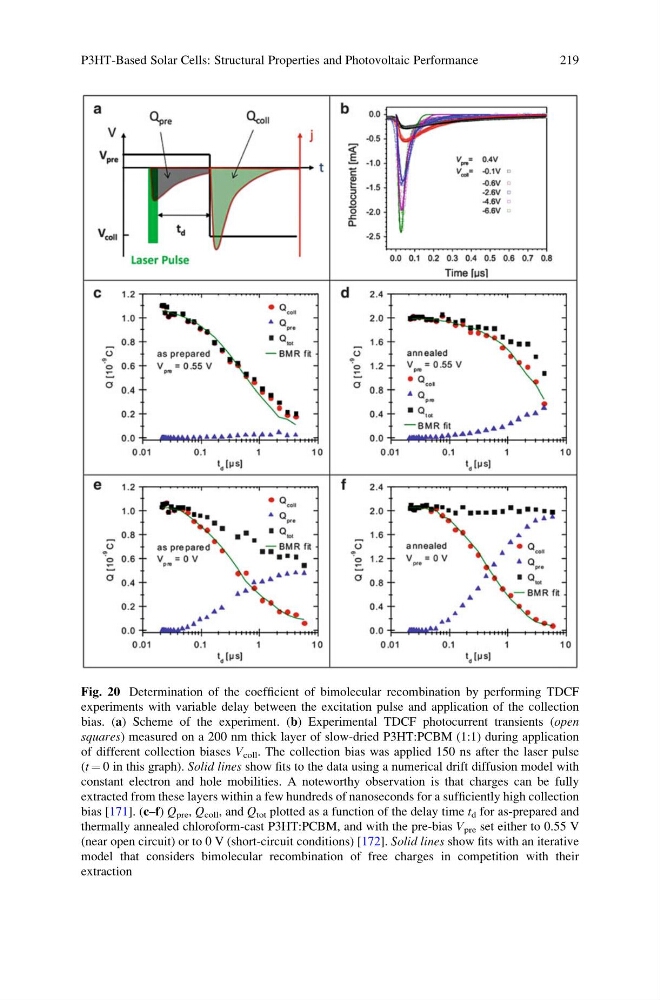
Fig. 20 Determination of the coefficient of bimolecular recombination by performing TDCF
experiments with variable delay between the excitation pulse and application of the collection
bias. (a) Scheme of the experiment. (b) Experimental TDCF photocurrent transients (open
squares) measured on a 200 nm thick layer of slow-dried P3HT:PCBM (1:1) during application
of different collection biases V coll . The collection bias was applied 150 ns after the laser pulse
(t ¼ 0 in this graph). Solid lines show fits to the data using a numerical drift diffusion model with
constant electron and hole mobilities. A noteworthy observation is that charges can be fully
extracted from these layers within a few hundreds of nanoseconds for a sufficiently high collection
bias [171]. (c–f) Q pre , Q coll , and Q tot plotted as a function of the delay time t d for as-prepared and
thermally annealed chloroform-cast P3HT:PCBM, and with the pre-bias V pre set either to 0.55 V
(near open circuit) or to 0 V (short-circuit conditions) [172]. Solid lines show fits with an iterative
model that considers bimolecular recombination of free charges in competition with their
extraction
P3HT-Based Solar Cells: Structural Properties and Photovoltaic Performance
219
experiments with variable delay between the excitation pulse and application of the collection
bias. (a) Scheme of the experiment. (b) Experimental TDCF photocurrent transients (open
squares) measured on a 200 nm thick layer of slow-dried P3HT:PCBM (1:1) during application
of different collection biases V coll . The collection bias was applied 150 ns after the laser pulse
(t ¼ 0 in this graph). Solid lines show fits to the data using a numerical drift diffusion model with
constant electron and hole mobilities. A noteworthy observation is that charges can be fully
extracted from these layers within a few hundreds of nanoseconds for a sufficiently high collection
bias [171]. (c–f) Q pre , Q coll , and Q tot plotted as a function of the delay time t d for as-prepared and
thermally annealed chloroform-cast P3HT:PCBM, and with the pre-bias V pre set either to 0.55 V
(near open circuit) or to 0 V (short-circuit conditions) [172]. Solid lines show fits with an iterative
model that considers bimolecular recombination of free charges in competition with their
extraction
P3HT-Based Solar Cells: Structural Properties and Photovoltaic Performance
219