

Various methods have been applied to P3HT:PCBM in order to quantify the
parameters that describe non-geminate recombination (see, e.g., [187–194]).
Knowledge about γ and λ + 1 was mostly derived from transient pump-probe
measurements (see, e.g., [169, 189, 195]). In these experiments, a short laser
pulse excites the sample and the fate of the photogenerated charge is followed by
measuring the transient polaron-induced absorption signal. In a homogenous
medium with low carrier mobility, the decrease in carrier density via
non-geminate recombination is predicted to follow Langevin-type bimolecular
recombination:
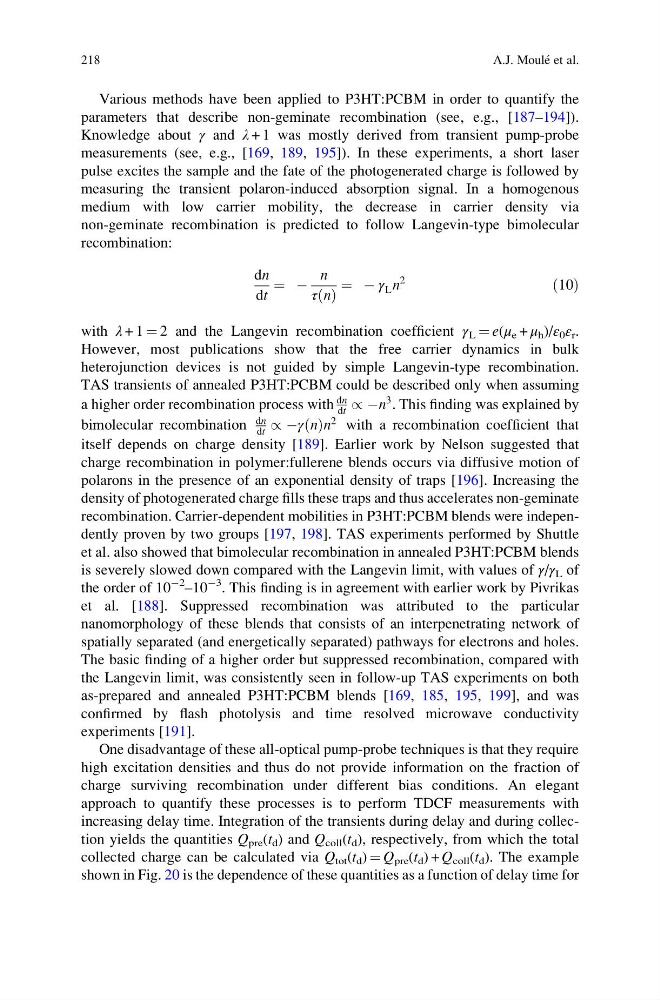
dn
dt
¼ À
n
τ n
ð Þ
¼ À γ L n
2
ð10Þ
with λ + 1 ¼ 2 and the Langevin recombination coefficient γ L ¼ e(μ e + μ h )/ε 0 ε r .
However, most publications show that the free carrier dynamics in bulk
heterojunction devices is not guided by simple Langevin-type recombination.
TAS transients of annealed P3HT:PCBM could be described only when assuming
a higher order recombination process with
dn
dt / Àn
3 . This finding was explained by
bimolecular recombination
dn
dt / Àγ n
ð Þn
2 with a recombination coefficient that
itself depends on charge density [189]. Earlier work by Nelson suggested that
charge recombination in polymer:fullerene blends occurs via diffusive motion of
polarons in the presence of an exponential density of traps [196]. Increasing the
density of photogenerated charge fills these traps and thus accelerates non-geminate
recombination. Carrier-dependent mobilities in P3HT:PCBM blends were independently proven by two groups [197, 198]. TAS experiments performed by Shuttle
et al. also showed that bimolecular recombination in annealed P3HT:PCBM blends
is severely slowed down compared with the Langevin limit, with values of γ/γ L of
the order of 10
À2 –10
À3 . This finding is in agreement with earlier work by Pivrikas
et al. [188]. Suppressed recombination was attributed to the particular
nanomorphology of these blends that consists of an interpenetrating network of
spatially separated (and energetically separated) pathways for electrons and holes.
The basic finding of a higher order but suppressed recombination, compared with
the Langevin limit, was consistently seen in follow-up TAS experiments on both
as-prepared and annealed P3HT:PCBM blends [169, 185, 195, 199], and was
confirmed by flash photolysis and time resolved microwave conductivity
experiments [191].
One disadvantage of these all-optical pump-probe techniques is that they require
high excitation densities and thus do not provide information on the fraction of
charge surviving recombination under different bias conditions. An elegant
approach to quantify these processes is to perform TDCF measurements with
increasing delay time. Integration of the transients during delay and during collection yields the quantities Q pre (t d ) and Q coll (t d ), respectively, from which the total
collected charge can be calculated via Q tot (t d ) ¼ Q pre (t d ) + Q coll (t d ). The example
shown in Fig. 20 is the dependence of these quantities as a function of delay time for
218
A.J. Moule ´ et al.
parameters that describe non-geminate recombination (see, e.g., [187–194]).
Knowledge about γ and λ + 1 was mostly derived from transient pump-probe
measurements (see, e.g., [169, 189, 195]). In these experiments, a short laser
pulse excites the sample and the fate of the photogenerated charge is followed by
measuring the transient polaron-induced absorption signal. In a homogenous
medium with low carrier mobility, the decrease in carrier density via
non-geminate recombination is predicted to follow Langevin-type bimolecular
recombination:
dn
dt
¼ À
n
τ n
ð Þ
¼ À γ L n
2
ð10Þ
with λ + 1 ¼ 2 and the Langevin recombination coefficient γ L ¼ e(μ e + μ h )/ε 0 ε r .
However, most publications show that the free carrier dynamics in bulk
heterojunction devices is not guided by simple Langevin-type recombination.
TAS transients of annealed P3HT:PCBM could be described only when assuming
a higher order recombination process with
dn
dt / Àn
3 . This finding was explained by
bimolecular recombination
dn
dt / Àγ n
ð Þn
2 with a recombination coefficient that
itself depends on charge density [189]. Earlier work by Nelson suggested that
charge recombination in polymer:fullerene blends occurs via diffusive motion of
polarons in the presence of an exponential density of traps [196]. Increasing the
density of photogenerated charge fills these traps and thus accelerates non-geminate
recombination. Carrier-dependent mobilities in P3HT:PCBM blends were independently proven by two groups [197, 198]. TAS experiments performed by Shuttle
et al. also showed that bimolecular recombination in annealed P3HT:PCBM blends
is severely slowed down compared with the Langevin limit, with values of γ/γ L of
the order of 10
À2 –10
À3 . This finding is in agreement with earlier work by Pivrikas
et al. [188]. Suppressed recombination was attributed to the particular
nanomorphology of these blends that consists of an interpenetrating network of
spatially separated (and energetically separated) pathways for electrons and holes.
The basic finding of a higher order but suppressed recombination, compared with
the Langevin limit, was consistently seen in follow-up TAS experiments on both
as-prepared and annealed P3HT:PCBM blends [169, 185, 195, 199], and was
confirmed by flash photolysis and time resolved microwave conductivity
experiments [191].
One disadvantage of these all-optical pump-probe techniques is that they require
high excitation densities and thus do not provide information on the fraction of
charge surviving recombination under different bias conditions. An elegant
approach to quantify these processes is to perform TDCF measurements with
increasing delay time. Integration of the transients during delay and during collection yields the quantities Q pre (t d ) and Q coll (t d ), respectively, from which the total
collected charge can be calculated via Q tot (t d ) ¼ Q pre (t d ) + Q coll (t d ). The example
shown in Fig. 20 is the dependence of these quantities as a function of delay time for
218
A.J. Moule ´ et al.