

poor performance exhibit a considerable concentration of P3HT aggregates, which
guarantee efficient CT split-up at the local scale.
4.2 Charge Extraction Versus Non-geminate Recombination
As pointed out in the previous section, free carrier generation in P3HT:PCBM
blends proceeds at the picosecond time scale, unassisted by the applied electric
field. It must, therefore, be the free carrier recombination (non-geminate recombination) in competition with charge extraction that accounts for most of the photocurrent loss within the working regime of P3HT:PCBM blends.
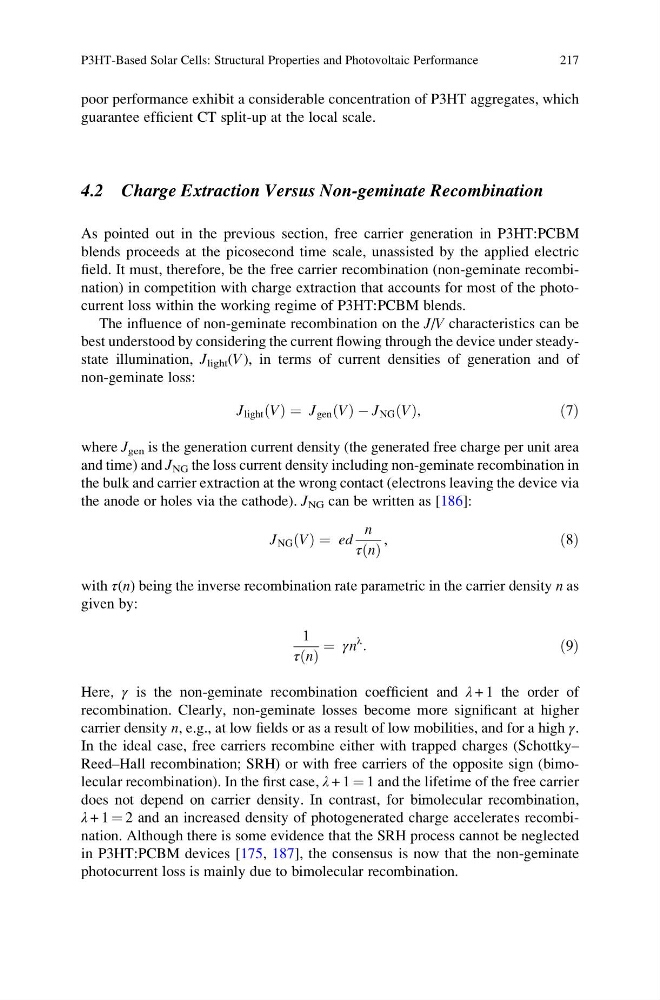
The influence of non-geminate recombination on the J/V characteristics can be
best understood by considering the current flowing through the device under steadystate illumination, J light (V), in terms of current densities of generation and of
non-geminate loss:
J light V
ð Þ ¼ J gen V
ð Þ À J NG V
ð Þ,
ð7Þ
where J gen is the generation current density (the generated free charge per unit area
and time) and J NG the loss current density including non-geminate recombination in
the bulk and carrier extraction at the wrong contact (electrons leaving the device via
the anode or holes via the cathode). J NG can be written as [186]:
J NG V
ð Þ ¼ ed
n
τ n
ð Þ
,
ð8Þ
with τ(n) being the inverse recombination rate parametric in the carrier density n as
given by:
1
τ n
ð Þ
¼ γn
λ
:
ð9Þ
Here, γ is the non-geminate recombination coefficient and λ + 1 the order of
recombination. Clearly, non-geminate losses become more significant at higher
carrier density n, e.g., at low fields or as a result of low mobilities, and for a high γ.
In the ideal case, free carriers recombine either with trapped charges (Schottky–
Reed–Hall recombination; SRH) or with free carriers of the opposite sign (bimolecular recombination). In the first case, λ + 1 ¼ 1 and the lifetime of the free carrier
does not depend on carrier density. In contrast, for bimolecular recombination,
λ + 1 ¼ 2 and an increased density of photogenerated charge accelerates recombination. Although there is some evidence that the SRH process cannot be neglected
in P3HT:PCBM devices [175, 187], the consensus is now that the non-geminate
photocurrent loss is mainly due to bimolecular recombination.
P3HT-Based Solar Cells: Structural Properties and Photovoltaic Performance
217
guarantee efficient CT split-up at the local scale.
4.2 Charge Extraction Versus Non-geminate Recombination
As pointed out in the previous section, free carrier generation in P3HT:PCBM
blends proceeds at the picosecond time scale, unassisted by the applied electric
field. It must, therefore, be the free carrier recombination (non-geminate recombination) in competition with charge extraction that accounts for most of the photocurrent loss within the working regime of P3HT:PCBM blends.
The influence of non-geminate recombination on the J/V characteristics can be
best understood by considering the current flowing through the device under steadystate illumination, J light (V), in terms of current densities of generation and of
non-geminate loss:
J light V
ð Þ ¼ J gen V
ð Þ À J NG V
ð Þ,
ð7Þ
where J gen is the generation current density (the generated free charge per unit area
and time) and J NG the loss current density including non-geminate recombination in
the bulk and carrier extraction at the wrong contact (electrons leaving the device via
the anode or holes via the cathode). J NG can be written as [186]:
J NG V
ð Þ ¼ ed
n
τ n
ð Þ
,
ð8Þ
with τ(n) being the inverse recombination rate parametric in the carrier density n as
given by:
1
τ n
ð Þ
¼ γn
λ
:
ð9Þ
Here, γ is the non-geminate recombination coefficient and λ + 1 the order of
recombination. Clearly, non-geminate losses become more significant at higher
carrier density n, e.g., at low fields or as a result of low mobilities, and for a high γ.
In the ideal case, free carriers recombine either with trapped charges (Schottky–
Reed–Hall recombination; SRH) or with free carriers of the opposite sign (bimolecular recombination). In the first case, λ + 1 ¼ 1 and the lifetime of the free carrier
does not depend on carrier density. In contrast, for bimolecular recombination,
λ + 1 ¼ 2 and an increased density of photogenerated charge accelerates recombination. Although there is some evidence that the SRH process cannot be neglected
in P3HT:PCBM devices [175, 187], the consensus is now that the non-geminate
photocurrent loss is mainly due to bimolecular recombination.
P3HT-Based Solar Cells: Structural Properties and Photovoltaic Performance
217