

excitons formed strongly bound CT states that decayed geminately to the ground
state within 2 ns.
Field-independent photogeneration in solvent-annealed P3HT:PCBM was
unambiguously proven by Kniepert et al. using time-delayed collection field
(TDCF) experiments [171]. In a TDCF measurement, as schematically shown in
Fig. 17a, the sample is illuminated by a short laser pulse while being kept at a
constant pre-bias voltage V pre . After the delay time, t d , a rectangular pulse with
voltage V coll is applied to sweep out all remaining free carriers. Therefore, TDCF is
analogous to TAS with an electrical probe instead of an optical probe. In contrast to
steady-state current–voltage measurements, classical time-of-flight experiments, or
the photo-CELIV (charge extraction by a linearly increasing voltage upon
photogeneration) technique, TDCF allows application of different biases during
generation and collection of the charge carriers. To measure the field dependence of
free carrier formation, TDCF experiments are performed with variable pre-bias, a
short delay time, and a large collection field. Thereby, the delay time must be
carefully chosen to ensure that geminate recombination is completed within the
delay time. Also, the pulse fluence must be kept low to avoid non-geminate
recombination prior to application of the collection bias. Provided that these
conditions are safely met, the total collected charge as a function of the pre-bias
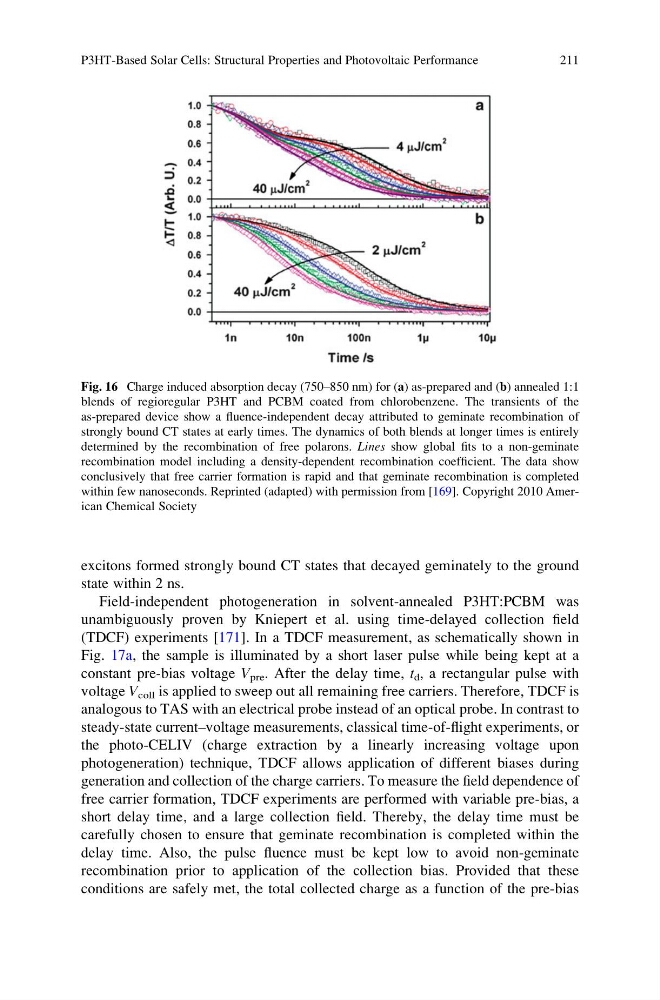
Fig. 16 Charge induced absorption decay (750–850 nm) for (a) as-prepared and (b) annealed 1:1
blends of regioregular P3HT and PCBM coated from chlorobenzene. The transients of the
as-prepared device show a fluence-independent decay attributed to geminate recombination of
strongly bound CT states at early times. The dynamics of both blends at longer times is entirely
determined by the recombination of free polarons. Lines show global fits to a non-geminate
recombination model including a density-dependent recombination coefficient. The data show
conclusively that free carrier formation is rapid and that geminate recombination is completed
within few nanoseconds. Reprinted (adapted) with permission from [169]. Copyright 2010 American Chemical Society
P3HT-Based Solar Cells: Structural Properties and Photovoltaic Performance
211
state within 2 ns.
Field-independent photogeneration in solvent-annealed P3HT:PCBM was
unambiguously proven by Kniepert et al. using time-delayed collection field
(TDCF) experiments [171]. In a TDCF measurement, as schematically shown in
Fig. 17a, the sample is illuminated by a short laser pulse while being kept at a
constant pre-bias voltage V pre . After the delay time, t d , a rectangular pulse with
voltage V coll is applied to sweep out all remaining free carriers. Therefore, TDCF is
analogous to TAS with an electrical probe instead of an optical probe. In contrast to
steady-state current–voltage measurements, classical time-of-flight experiments, or
the photo-CELIV (charge extraction by a linearly increasing voltage upon
photogeneration) technique, TDCF allows application of different biases during
generation and collection of the charge carriers. To measure the field dependence of
free carrier formation, TDCF experiments are performed with variable pre-bias, a
short delay time, and a large collection field. Thereby, the delay time must be
carefully chosen to ensure that geminate recombination is completed within the
delay time. Also, the pulse fluence must be kept low to avoid non-geminate
recombination prior to application of the collection bias. Provided that these
conditions are safely met, the total collected charge as a function of the pre-bias
Fig. 16 Charge induced absorption decay (750–850 nm) for (a) as-prepared and (b) annealed 1:1
blends of regioregular P3HT and PCBM coated from chlorobenzene. The transients of the
as-prepared device show a fluence-independent decay attributed to geminate recombination of
strongly bound CT states at early times. The dynamics of both blends at longer times is entirely
determined by the recombination of free polarons. Lines show global fits to a non-geminate
recombination model including a density-dependent recombination coefficient. The data show
conclusively that free carrier formation is rapid and that geminate recombination is completed
within few nanoseconds. Reprinted (adapted) with permission from [169]. Copyright 2010 American Chemical Society
P3HT-Based Solar Cells: Structural Properties and Photovoltaic Performance
211