

considered to be free if their distance exceeds the Coulomb capture radius, meaning
that the thermal energy is larger than the mutual Coulombic binding energy of the
geminate pair. Free carrier formation involves a Brownian-type random walk that is
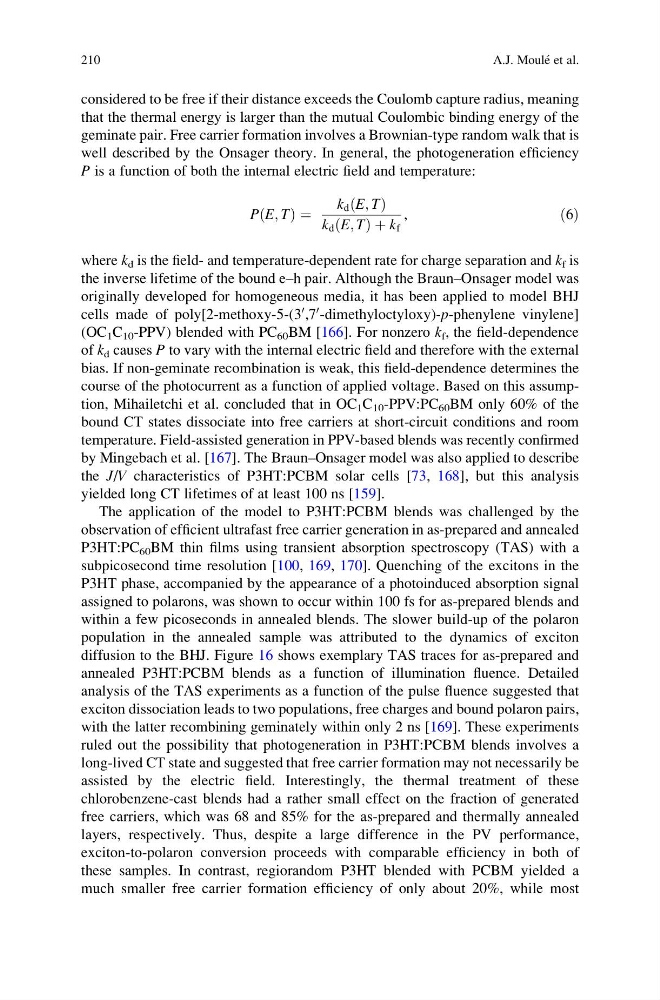
well described by the Onsager theory. In general, the photogeneration efficiency
P is a function of both the internal electric field and temperature:
P E; T
ð
Þ ¼
k d E; T
ð
Þ
k d E; T
ð
Þþk f
,
ð6Þ
where k d is the field- and temperature-dependent rate for charge separation and k f is
the inverse lifetime of the bound e–h pair. Although the Braun–Onsager model was
originally developed for homogeneous media, it has been applied to model BHJ
cells made of poly[2-methoxy-5-(3
0 ,7
0 -dimethyloctyloxy)-p-phenylene vinylene]
(OC 1 C 10 -PPV) blended with PC 60 BM [166]. For nonzero k f , the field-dependence
of k d causes P to vary with the internal electric field and therefore with the external
bias. If non-geminate recombination is weak, this field-dependence determines the
course of the photocurrent as a function of applied voltage. Based on this assumption, Mihailetchi et al. concluded that in OC 1 C 10 -PPV:PC 60 BM only 60% of the
bound CT states dissociate into free carriers at short-circuit conditions and room
temperature. Field-assisted generation in PPV-based blends was recently confirmed
by Mingebach et al. [167]. The Braun–Onsager model was also applied to describe
the J/V characteristics of P3HT:PCBM solar cells [73, 168], but this analysis
yielded long CT lifetimes of at least 100 ns [159].
The application of the model to P3HT:PCBM blends was challenged by the
observation of efficient ultrafast free carrier generation in as-prepared and annealed
P3HT:PC 60 BM thin films using transient absorption spectroscopy (TAS) with a
subpicosecond time resolution [100, 169, 170]. Quenching of the excitons in the
P3HT phase, accompanied by the appearance of a photoinduced absorption signal
assigned to polarons, was shown to occur within 100 fs for as-prepared blends and
within a few picoseconds in annealed blends. The slower build-up of the polaron
population in the annealed sample was attributed to the dynamics of exciton
diffusion to the BHJ. Figure 16 shows exemplary TAS traces for as-prepared and
annealed P3HT:PCBM blends as a function of illumination fluence. Detailed
analysis of the TAS experiments as a function of the pulse fluence suggested that
exciton dissociation leads to two populations, free charges and bound polaron pairs,
with the latter recombining geminately within only 2 ns [169]. These experiments
ruled out the possibility that photogeneration in P3HT:PCBM blends involves a
long-lived CT state and suggested that free carrier formation may not necessarily be
assisted by the electric field. Interestingly, the thermal treatment of these
chlorobenzene-cast blends had a rather small effect on the fraction of generated
free carriers, which was 68 and 85% for the as-prepared and thermally annealed
layers, respectively. Thus, despite a large difference in the PV performance,
exciton-to-polaron conversion proceeds with comparable efficiency in both of
these samples. In contrast, regiorandom P3HT blended with PCBM yielded a
much smaller free carrier formation efficiency of only about 20%, while most
210
A.J. Moule ´ et al.
that the thermal energy is larger than the mutual Coulombic binding energy of the
geminate pair. Free carrier formation involves a Brownian-type random walk that is
well described by the Onsager theory. In general, the photogeneration efficiency
P is a function of both the internal electric field and temperature:
P E; T
ð
Þ ¼
k d E; T
ð
Þ
k d E; T
ð
Þþk f
,
ð6Þ
where k d is the field- and temperature-dependent rate for charge separation and k f is
the inverse lifetime of the bound e–h pair. Although the Braun–Onsager model was
originally developed for homogeneous media, it has been applied to model BHJ
cells made of poly[2-methoxy-5-(3
0 ,7
0 -dimethyloctyloxy)-p-phenylene vinylene]
(OC 1 C 10 -PPV) blended with PC 60 BM [166]. For nonzero k f , the field-dependence
of k d causes P to vary with the internal electric field and therefore with the external
bias. If non-geminate recombination is weak, this field-dependence determines the
course of the photocurrent as a function of applied voltage. Based on this assumption, Mihailetchi et al. concluded that in OC 1 C 10 -PPV:PC 60 BM only 60% of the
bound CT states dissociate into free carriers at short-circuit conditions and room
temperature. Field-assisted generation in PPV-based blends was recently confirmed
by Mingebach et al. [167]. The Braun–Onsager model was also applied to describe
the J/V characteristics of P3HT:PCBM solar cells [73, 168], but this analysis
yielded long CT lifetimes of at least 100 ns [159].
The application of the model to P3HT:PCBM blends was challenged by the
observation of efficient ultrafast free carrier generation in as-prepared and annealed
P3HT:PC 60 BM thin films using transient absorption spectroscopy (TAS) with a
subpicosecond time resolution [100, 169, 170]. Quenching of the excitons in the
P3HT phase, accompanied by the appearance of a photoinduced absorption signal
assigned to polarons, was shown to occur within 100 fs for as-prepared blends and
within a few picoseconds in annealed blends. The slower build-up of the polaron
population in the annealed sample was attributed to the dynamics of exciton
diffusion to the BHJ. Figure 16 shows exemplary TAS traces for as-prepared and
annealed P3HT:PCBM blends as a function of illumination fluence. Detailed
analysis of the TAS experiments as a function of the pulse fluence suggested that
exciton dissociation leads to two populations, free charges and bound polaron pairs,
with the latter recombining geminately within only 2 ns [169]. These experiments
ruled out the possibility that photogeneration in P3HT:PCBM blends involves a
long-lived CT state and suggested that free carrier formation may not necessarily be
assisted by the electric field. Interestingly, the thermal treatment of these
chlorobenzene-cast blends had a rather small effect on the fraction of generated
free carriers, which was 68 and 85% for the as-prepared and thermally annealed
layers, respectively. Thus, despite a large difference in the PV performance,
exciton-to-polaron conversion proceeds with comparable efficiency in both of
these samples. In contrast, regiorandom P3HT blended with PCBM yielded a
much smaller free carrier formation efficiency of only about 20%, while most
210
A.J. Moule ´ et al.