

transfer (CT) state with energy E CT , and the charge separated (CS) state with
energy E CS . The CS state is different from the CT state in having overcome any
mutual electron–hole interactions.
Because of the low dielectric constant of organic materials, the interfacial
electron–hole pair is bound by Coulombic forces. Consequently, the energy of the
CT state is expected to be smaller than that of the free electron–hole pair E CT < E CS .
On the other hand, efficient photon-to-electron conversion is energetically favored
only if the energy of the primary excitation is larger than that of the final product,
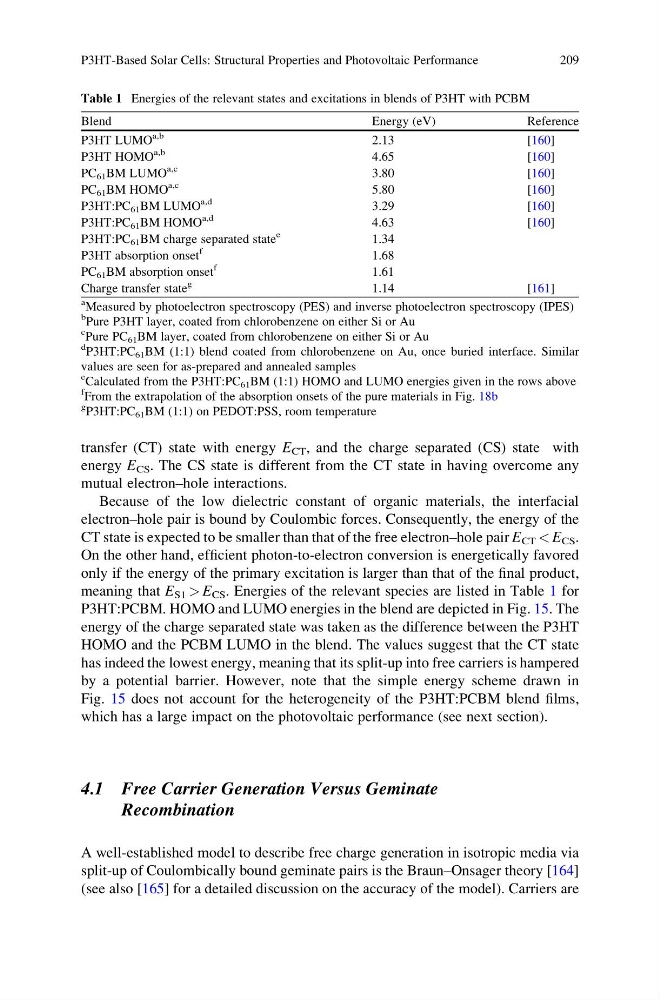
meaning that E S1 > E CS . Energies of the relevant species are listed in Table 1 for
P3HT:PCBM. HOMO and LUMO energies in the blend are depicted in Fig. 15. The
energy of the charge separated state was taken as the difference between the P3HT
HOMO and the PCBM LUMO in the blend. The values suggest that the CT state
has indeed the lowest energy, meaning that its split-up into free carriers is hampered
by a potential barrier. However, note that the simple energy scheme drawn in
Fig. 15 does not account for the heterogeneity of the P3HT:PCBM blend films,
which has a large impact on the photovoltaic performance (see next section).
4.1 Free Carrier Generation Versus Geminate
Recombination
A well-established model to describe free charge generation in isotropic media via
split-up of Coulombically bound geminate pairs is the Braun–Onsager theory [164]
(see also [165] for a detailed discussion on the accuracy of the model). Carriers are
Table 1 Energies of the relevant states and excitations in blends of P3HT with PCBM
Blend
Energy (eV)
Reference
P3HT LUMO
a,b
2.13
[160]
P3HT HOMO
a,b
4.65
[160]
PC 61 BM LUMO
a,c
3.80
[160]
PC 61 BM HOMO
a,c
5.80
[160]
P3HT:PC 61 BM LUMO
a,d
3.29
[160]
P3HT:PC 61 BM HOMO
a,d
4.63
[160]
P3HT:PC 61 BM charge separated state
e
1.34
P3HT absorption onset
f
1.68
PC 61 BM absorption onset
f
1.61
Charge transfer state
g
1.14
[161]
a
Measured by photoelectron spectroscopy (PES) and inverse photoelectron spectroscopy (IPES)
b
Pure P3HT layer, coated from chlorobenzene on either Si or Au
c
Pure PC 61 BM layer, coated from chlorobenzene on either Si or Au
d
P3HT:PC 61 BM (1:1) blend coated from chlorobenzene on Au, once buried interface. Similar
values are seen for as-prepared and annealed samples
e
Calculated from the P3HT:PC 61 BM (1:1) HOMO and LUMO energies given in the rows above
f
From the extrapolation of the absorption onsets of the pure materials in Fig. 18b
g
P3HT:PC 61 BM (1:1) on PEDOT:PSS, room temperature
P3HT-Based Solar Cells: Structural Properties and Photovoltaic Performance
209
energy E CS . The CS state is different from the CT state in having overcome any
mutual electron–hole interactions.
Because of the low dielectric constant of organic materials, the interfacial
electron–hole pair is bound by Coulombic forces. Consequently, the energy of the
CT state is expected to be smaller than that of the free electron–hole pair E CT < E CS .
On the other hand, efficient photon-to-electron conversion is energetically favored
only if the energy of the primary excitation is larger than that of the final product,
meaning that E S1 > E CS . Energies of the relevant species are listed in Table 1 for
P3HT:PCBM. HOMO and LUMO energies in the blend are depicted in Fig. 15. The
energy of the charge separated state was taken as the difference between the P3HT
HOMO and the PCBM LUMO in the blend. The values suggest that the CT state
has indeed the lowest energy, meaning that its split-up into free carriers is hampered
by a potential barrier. However, note that the simple energy scheme drawn in
Fig. 15 does not account for the heterogeneity of the P3HT:PCBM blend films,
which has a large impact on the photovoltaic performance (see next section).
4.1 Free Carrier Generation Versus Geminate
Recombination
A well-established model to describe free charge generation in isotropic media via
split-up of Coulombically bound geminate pairs is the Braun–Onsager theory [164]
(see also [165] for a detailed discussion on the accuracy of the model). Carriers are
Table 1 Energies of the relevant states and excitations in blends of P3HT with PCBM
Blend
Energy (eV)
Reference
P3HT LUMO
a,b
2.13
[160]
P3HT HOMO
a,b
4.65
[160]
PC 61 BM LUMO
a,c
3.80
[160]
PC 61 BM HOMO
a,c
5.80
[160]
P3HT:PC 61 BM LUMO
a,d
3.29
[160]
P3HT:PC 61 BM HOMO
a,d
4.63
[160]
P3HT:PC 61 BM charge separated state
e
1.34
P3HT absorption onset
f
1.68
PC 61 BM absorption onset
f
1.61
Charge transfer state
g
1.14
[161]
a
Measured by photoelectron spectroscopy (PES) and inverse photoelectron spectroscopy (IPES)
b
Pure P3HT layer, coated from chlorobenzene on either Si or Au
c
Pure PC 61 BM layer, coated from chlorobenzene on either Si or Au
d
P3HT:PC 61 BM (1:1) blend coated from chlorobenzene on Au, once buried interface. Similar
values are seen for as-prepared and annealed samples
e
Calculated from the P3HT:PC 61 BM (1:1) HOMO and LUMO energies given in the rows above
f
From the extrapolation of the absorption onsets of the pure materials in Fig. 18b
g
P3HT:PC 61 BM (1:1) on PEDOT:PSS, room temperature
P3HT-Based Solar Cells: Structural Properties and Photovoltaic Performance
209