

photogenerated
exciton
charge transfer
state
geminate
recombinaƟon
free electron
and hole
extracƟon
to electrodes
t
fs
ps
ns
ms
non-geminate
recombinaƟon
or
or
or
exciton
recombinaƟon
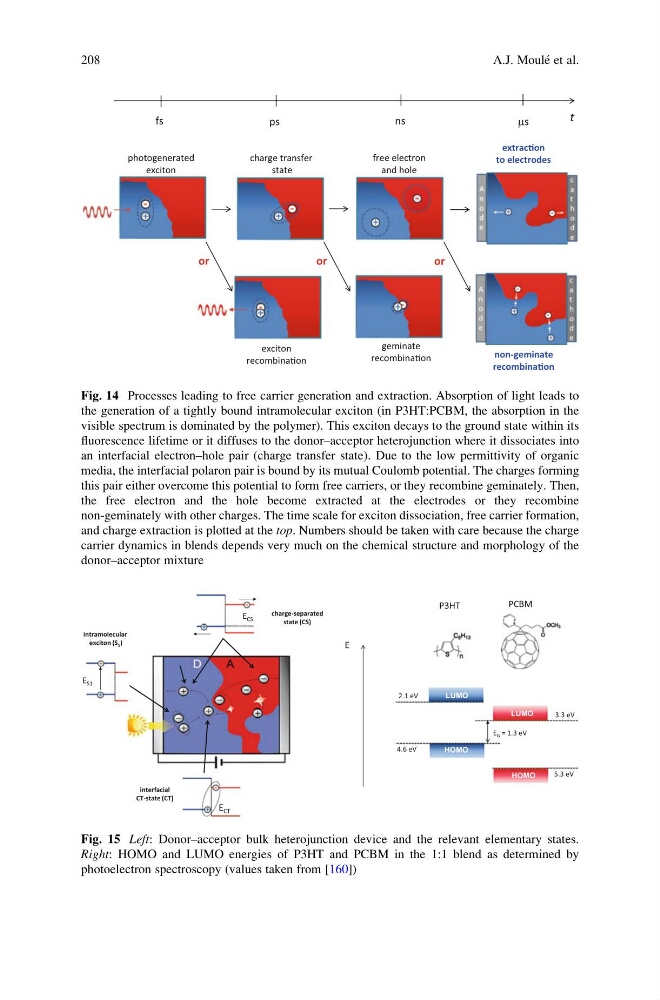
Fig. 14 Processes leading to free carrier generation and extraction. Absorption of light leads to
the generation of a tightly bound intramolecular exciton (in P3HT:PCBM, the absorption in the
visible spectrum is dominated by the polymer). This exciton decays to the ground state within its
fluorescence lifetime or it diffuses to the donor–acceptor heterojunction where it dissociates into
an interfacial electron–hole pair (charge transfer state). Due to the low permittivity of organic
media, the interfacial polaron pair is bound by its mutual Coulomb potential. The charges forming
this pair either overcome this potential to form free carriers, or they recombine geminately. Then,
the free electron and the hole become extracted at the electrodes or they recombine
non-geminately with other charges. The time scale for exciton dissociation, free carrier formation,
and charge extraction is plotted at the top. Numbers should be taken with care because the charge
carrier dynamics in blends depends very much on the chemical structure and morphology of the
donor–acceptor mixture
intramolecular
exciton (S 1 )
E S1
interfacial
CT-state (CT)
E CT
charge-separated
state (CS)
E CS
PCBM
P3HT
2.1 eV
4.6 eV
5.3 eV
3.3 eV
E G = 1.3 eV
E
LUMO
LUMO
HOMO
HOMO
Fig. 15 Left: Donor–acceptor bulk heterojunction device and the relevant elementary states.
Right: HOMO and LUMO energies of P3HT and PCBM in the 1:1 blend as determined by
photoelectron spectroscopy (values taken from [160])
208
A.J. Moule ´ et al.
exciton
charge transfer
state
geminate
recombinaƟon
free electron
and hole
extracƟon
to electrodes
t
fs
ps
ns
ms
non-geminate
recombinaƟon
or
or
or
exciton
recombinaƟon
Fig. 14 Processes leading to free carrier generation and extraction. Absorption of light leads to
the generation of a tightly bound intramolecular exciton (in P3HT:PCBM, the absorption in the
visible spectrum is dominated by the polymer). This exciton decays to the ground state within its
fluorescence lifetime or it diffuses to the donor–acceptor heterojunction where it dissociates into
an interfacial electron–hole pair (charge transfer state). Due to the low permittivity of organic
media, the interfacial polaron pair is bound by its mutual Coulomb potential. The charges forming
this pair either overcome this potential to form free carriers, or they recombine geminately. Then,
the free electron and the hole become extracted at the electrodes or they recombine
non-geminately with other charges. The time scale for exciton dissociation, free carrier formation,
and charge extraction is plotted at the top. Numbers should be taken with care because the charge
carrier dynamics in blends depends very much on the chemical structure and morphology of the
donor–acceptor mixture
intramolecular
exciton (S 1 )
E S1
interfacial
CT-state (CT)
E CT
charge-separated
state (CS)
E CS
PCBM
P3HT
2.1 eV
4.6 eV
5.3 eV
3.3 eV
E G = 1.3 eV
E
LUMO
LUMO
HOMO
HOMO
Fig. 15 Left: Donor–acceptor bulk heterojunction device and the relevant elementary states.
Right: HOMO and LUMO energies of P3HT and PCBM in the 1:1 blend as determined by
photoelectron spectroscopy (values taken from [160])
208
A.J. Moule ´ et al.