

measures the field-dependence of free charge generation in competition with
geminate recombination.
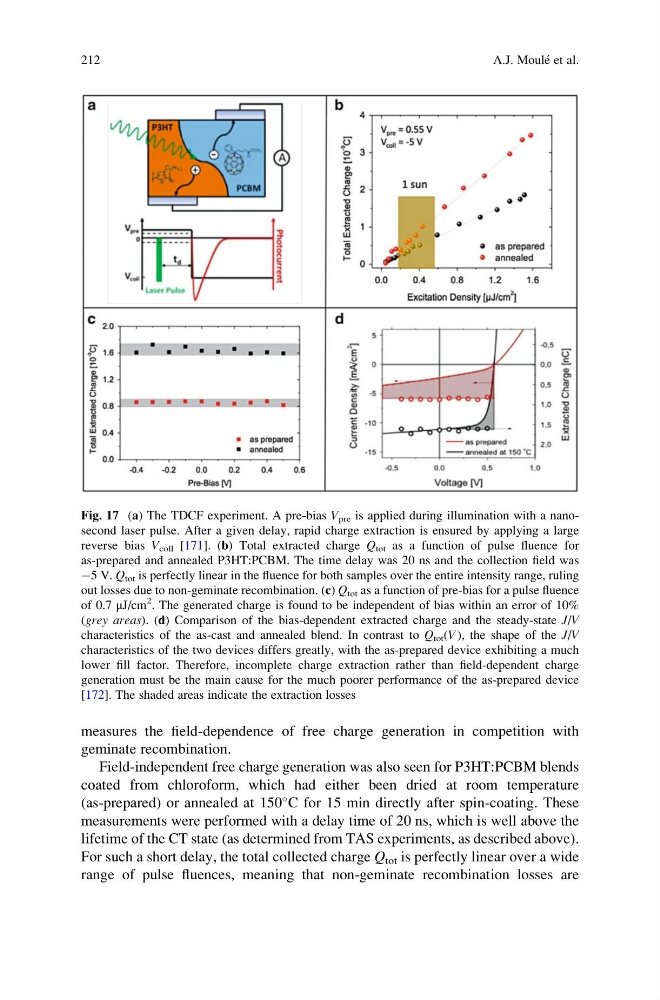
Field-independent free charge generation was also seen for P3HT:PCBM blends
coated from chloroform, which had either been dried at room temperature
(as-prepared) or annealed at 150
C for 15 min directly after spin-coating. These
measurements were performed with a delay time of 20 ns, which is well above the
lifetime of the CT state (as determined from TAS experiments, as described above).
For such a short delay, the total collected charge Q tot is perfectly linear over a wide
range of pulse fluences, meaning that non-geminate recombination losses are
Fig. 17 (a) The TDCF experiment. A pre-bias V pre is applied during illumination with a nanosecond laser pulse. After a given delay, rapid charge extraction is ensured by applying a large
reverse bias V coll [171]. (b) Total extracted charge Q tot as a function of pulse fluence for
as-prepared and annealed P3HT:PCBM. The time delay was 20 ns and the collection field was
À5 V. Q tot is perfectly linear in the fluence for both samples over the entire intensity range, ruling
out losses due to non-geminate recombination. (c) Q tot as a function of pre-bias for a pulse fluence
of 0.7 μJ/cm
2
. The generated charge is found to be independent of bias within an error of 10%
(grey areas). (d) Comparison of the bias-dependent extracted charge and the steady-state J/V
characteristics of the as-cast and annealed blend. In contrast to Q tot (V ), the shape of the J/V
characteristics of the two devices differs greatly, with the as-prepared device exhibiting a much
lower fill factor. Therefore, incomplete charge extraction rather than field-dependent charge
generation must be the main cause for the much poorer performance of the as-prepared device
[172]. The shaded areas indicate the extraction losses
212
A.J. Moule ´ et al.
geminate recombination.
Field-independent free charge generation was also seen for P3HT:PCBM blends
coated from chloroform, which had either been dried at room temperature
(as-prepared) or annealed at 150
C for 15 min directly after spin-coating. These
measurements were performed with a delay time of 20 ns, which is well above the
lifetime of the CT state (as determined from TAS experiments, as described above).
For such a short delay, the total collected charge Q tot is perfectly linear over a wide
range of pulse fluences, meaning that non-geminate recombination losses are
Fig. 17 (a) The TDCF experiment. A pre-bias V pre is applied during illumination with a nanosecond laser pulse. After a given delay, rapid charge extraction is ensured by applying a large
reverse bias V coll [171]. (b) Total extracted charge Q tot as a function of pulse fluence for
as-prepared and annealed P3HT:PCBM. The time delay was 20 ns and the collection field was
À5 V. Q tot is perfectly linear in the fluence for both samples over the entire intensity range, ruling
out losses due to non-geminate recombination. (c) Q tot as a function of pre-bias for a pulse fluence
of 0.7 μJ/cm
2
. The generated charge is found to be independent of bias within an error of 10%
(grey areas). (d) Comparison of the bias-dependent extracted charge and the steady-state J/V
characteristics of the as-cast and annealed blend. In contrast to Q tot (V ), the shape of the J/V
characteristics of the two devices differs greatly, with the as-prepared device exhibiting a much
lower fill factor. Therefore, incomplete charge extraction rather than field-dependent charge
generation must be the main cause for the much poorer performance of the as-prepared device
[172]. The shaded areas indicate the extraction losses
212
A.J. Moule ´ et al.