

This model has been successfully applied to understand the morphological
changes of the P3HT phase in a 50:50 wt% P3HT:PCBM blend, where information
about the crystallinity and interchain ordering of the polymer phase was determined
[146]. A low and a high boiling point solvent were investigated with the use of
different annealing temperatures. The absorption spectra analysis was compared
with the solar cell performance in devices with identical active layers (Fig. 13). The
low boiling point solvent, chloroform, led to a non-optimized initial film morphology. Compared to the as-prepared blend prepared from the high boiling point
solvent dichlorobenzene, the chloroform-cast layer exhibited smaller aggregates,
a lower degree of crystallinity, and a larger absorption bandwidth. Upon annealing,
the degree of crystallinity of the P3HT component increased up to a temperature of
ca. 70
C, with a correlated increase in the aggregate width from ca. 7 to 10 nm. The
glass transition of a 1:1 blend of P3HT:PCBM has been observed to range from
ca. 10 to 70
C [151–153]. It has, therefore, been concluded that annealing above the
glass transition provides the chains with sufficient mobility to allow for the growth
of existing polymer crystallites. Beyond the glass transition range, annealing had a
surprisingly weak effect on the further changes to the degree of crystallinity.
Neither the percentage of aggregated P3HT chains nor the aggregate width of
annealed chloroform-cast layers reached the same level as found in the pristine
P3HT layer cast from chloroform or as found in any of the dichlorobenzene-cast
blends. It is plausible to assume that a further growth of P3HT crystallites in the
chloroform-cast layers upon annealing at higher temperatures is prevented by an
already-existing network of agglomerated PCBM molecules [154]. The Gaussian
line width σ in the absorption spectra, however, decreased throughout the entire
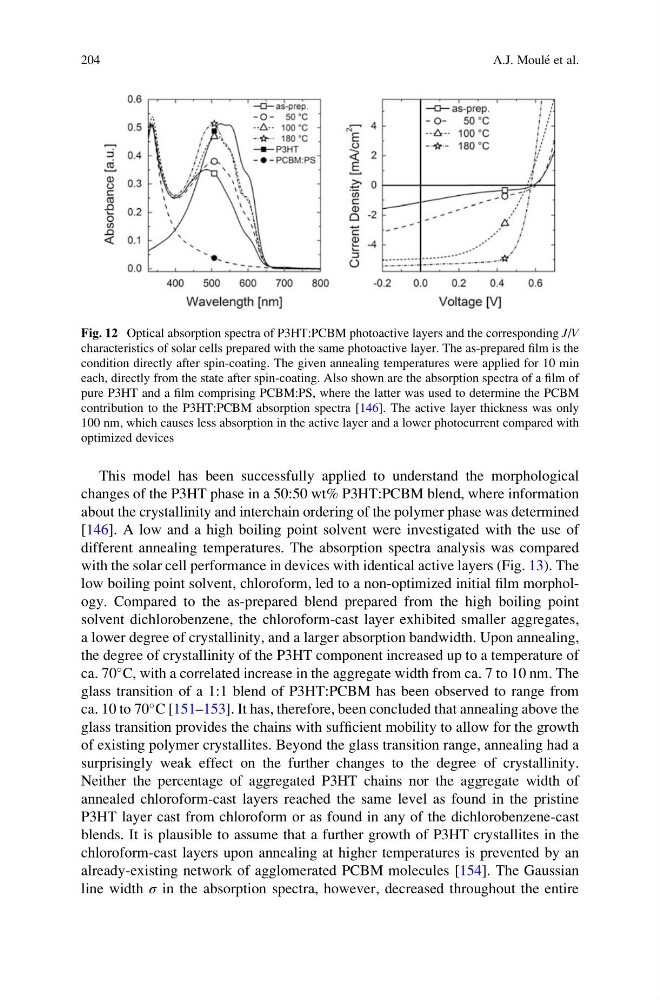
Fig. 12 Optical absorption spectra of P3HT:PCBM photoactive layers and the corresponding J/V
characteristics of solar cells prepared with the same photoactive layer. The as-prepared film is the
condition directly after spin-coating. The given annealing temperatures were applied for 10 min
each, directly from the state after spin-coating. Also shown are the absorption spectra of a film of
pure P3HT and a film comprising PCBM:PS, where the latter was used to determine the PCBM
contribution to the P3HT:PCBM absorption spectra [146]. The active layer thickness was only
100 nm, which causes less absorption in the active layer and a lower photocurrent compared with
optimized devices
204
A.J. Moule ´ et al.
changes of the P3HT phase in a 50:50 wt% P3HT:PCBM blend, where information
about the crystallinity and interchain ordering of the polymer phase was determined
[146]. A low and a high boiling point solvent were investigated with the use of
different annealing temperatures. The absorption spectra analysis was compared
with the solar cell performance in devices with identical active layers (Fig. 13). The
low boiling point solvent, chloroform, led to a non-optimized initial film morphology. Compared to the as-prepared blend prepared from the high boiling point
solvent dichlorobenzene, the chloroform-cast layer exhibited smaller aggregates,
a lower degree of crystallinity, and a larger absorption bandwidth. Upon annealing,
the degree of crystallinity of the P3HT component increased up to a temperature of
ca. 70
C, with a correlated increase in the aggregate width from ca. 7 to 10 nm. The
glass transition of a 1:1 blend of P3HT:PCBM has been observed to range from
ca. 10 to 70
C [151–153]. It has, therefore, been concluded that annealing above the
glass transition provides the chains with sufficient mobility to allow for the growth
of existing polymer crystallites. Beyond the glass transition range, annealing had a
surprisingly weak effect on the further changes to the degree of crystallinity.
Neither the percentage of aggregated P3HT chains nor the aggregate width of
annealed chloroform-cast layers reached the same level as found in the pristine
P3HT layer cast from chloroform or as found in any of the dichlorobenzene-cast
blends. It is plausible to assume that a further growth of P3HT crystallites in the
chloroform-cast layers upon annealing at higher temperatures is prevented by an
already-existing network of agglomerated PCBM molecules [154]. The Gaussian
line width σ in the absorption spectra, however, decreased throughout the entire
Fig. 12 Optical absorption spectra of P3HT:PCBM photoactive layers and the corresponding J/V
characteristics of solar cells prepared with the same photoactive layer. The as-prepared film is the
condition directly after spin-coating. The given annealing temperatures were applied for 10 min
each, directly from the state after spin-coating. Also shown are the absorption spectra of a film of
pure P3HT and a film comprising PCBM:PS, where the latter was used to determine the PCBM
contribution to the P3HT:PCBM absorption spectra [146]. The active layer thickness was only
100 nm, which causes less absorption in the active layer and a lower photocurrent compared with
optimized devices
204
A.J. Moule ´ et al.