

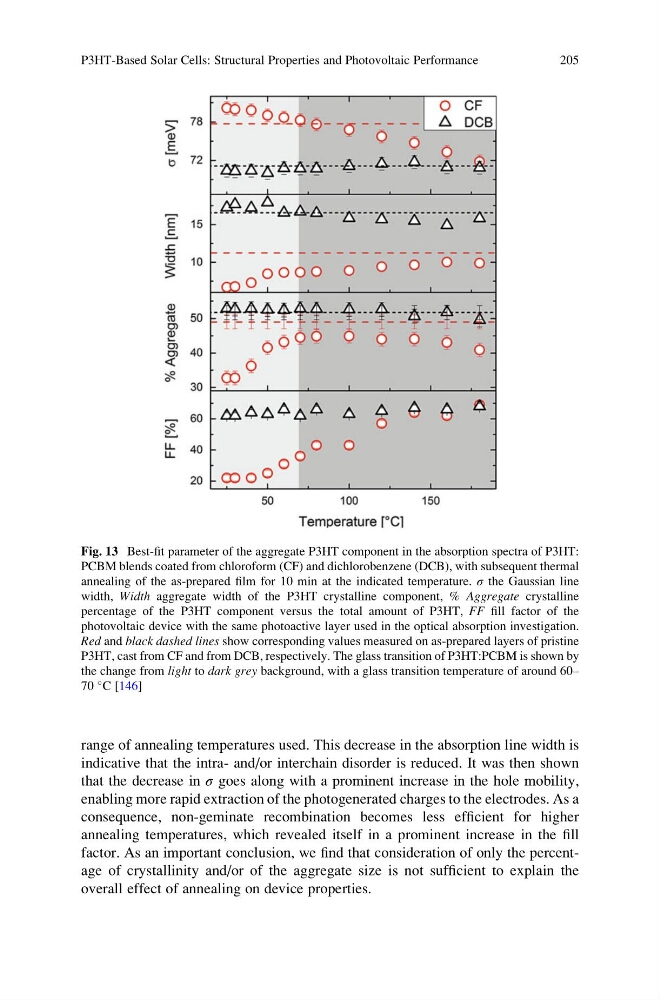
range of annealing temperatures used. This decrease in the absorption line width is
indicative that the intra- and/or interchain disorder is reduced. It was then shown
that the decrease in σ goes along with a prominent increase in the hole mobility,
enabling more rapid extraction of the photogenerated charges to the electrodes. As a
consequence, non-geminate recombination becomes less efficient for higher
annealing temperatures, which revealed itself in a prominent increase in the fill
factor. As an important conclusion, we find that consideration of only the percentage of crystallinity and/or of the aggregate size is not sufficient to explain the
overall effect of annealing on device properties.
Fig. 13 Best-fit parameter of the aggregate P3HT component in the absorption spectra of P3HT:
PCBM blends coated from chloroform (CF) and dichlorobenzene (DCB), with subsequent thermal
annealing of the as-prepared film for 10 min at the indicated temperature. σ the Gaussian line
width, Width aggregate width of the P3HT crystalline component, % Aggregate crystalline
percentage of the P3HT component versus the total amount of P3HT, FF fill factor of the
photovoltaic device with the same photoactive layer used in the optical absorption investigation.
Red and black dashed lines show corresponding values measured on as-prepared layers of pristine
P3HT, cast from CF and from DCB, respectively. The glass transition of P3HT:PCBM is shown by
the change from light to dark grey background, with a glass transition temperature of around 60–
70
C [146]
P3HT-Based Solar Cells: Structural Properties and Photovoltaic Performance
205
indicative that the intra- and/or interchain disorder is reduced. It was then shown
that the decrease in σ goes along with a prominent increase in the hole mobility,
enabling more rapid extraction of the photogenerated charges to the electrodes. As a
consequence, non-geminate recombination becomes less efficient for higher
annealing temperatures, which revealed itself in a prominent increase in the fill
factor. As an important conclusion, we find that consideration of only the percentage of crystallinity and/or of the aggregate size is not sufficient to explain the
overall effect of annealing on device properties.
Fig. 13 Best-fit parameter of the aggregate P3HT component in the absorption spectra of P3HT:
PCBM blends coated from chloroform (CF) and dichlorobenzene (DCB), with subsequent thermal
annealing of the as-prepared film for 10 min at the indicated temperature. σ the Gaussian line
width, Width aggregate width of the P3HT crystalline component, % Aggregate crystalline
percentage of the P3HT component versus the total amount of P3HT, FF fill factor of the
photovoltaic device with the same photoactive layer used in the optical absorption investigation.
Red and black dashed lines show corresponding values measured on as-prepared layers of pristine
P3HT, cast from CF and from DCB, respectively. The glass transition of P3HT:PCBM is shown by
the change from light to dark grey background, with a glass transition temperature of around 60–
70
C [146]
P3HT-Based Solar Cells: Structural Properties and Photovoltaic Performance
205