

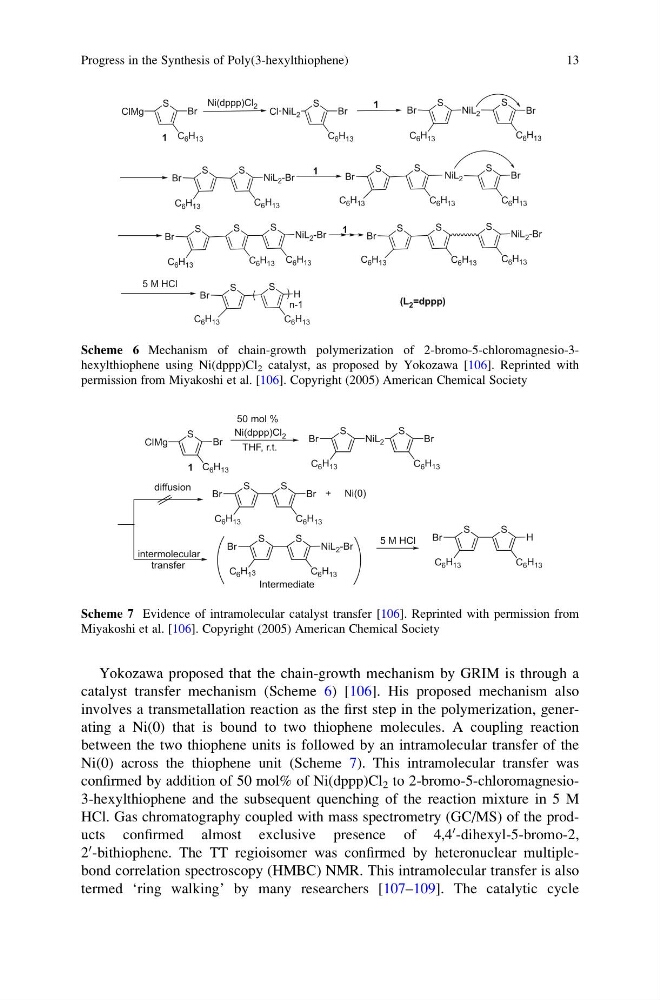
Yokozawa proposed that the chain-growth mechanism by GRIM is through a
catalyst transfer mechanism (Scheme 6) [106]. His proposed mechanism also
involves a transmetallation reaction as the first step in the polymerization, generating a Ni(0) that is bound to two thiophene molecules. A coupling reaction
between the two thiophene units is followed by an intramolecular transfer of the
Ni(0) across the thiophene unit (Scheme 7). This intramolecular transfer was
confirmed by addition of 50 mol% of Ni(dppp)Cl 2 to 2-bromo-5-chloromagnesio3-hexylthiophene and the subsequent quenching of the reaction mixture in 5 M
HCl. Gas chromatography coupled with mass spectrometry (GC/MS) of the products confirmed almost exclusive presence of 4,4
0 -dihexyl-5-bromo-2,
2
0 -bithiophene. The TT regioisomer was confirmed by heteronuclear multiplebond correlation spectroscopy (HMBC) NMR. This intramolecular transfer is also
termed ‘ring walking’ by many researchers [107–109]. The catalytic cycle
Ni(dppp)Cl 2
1
S
Br
C 6 H 13
S
C 6 H 13
S
NiL 2
Br
C 6 H 13
S
Br
C 6 H 13
1
S
Br
C 6 H 13
S
C 6 H 13
NiL 2
S
Br
C 6 H 13
S
NiL 2 -Br
C 6 H 13
S
Br
C 6 H 13
S
C 6 H 13
S
NiL 2 -Br
C 6 H 13
1
S
Br
C 6 H 13
S
C 6 H 13
S
NiL 2 -Br
C 6 H 13
5 M HCl
S
Br
C 6 H 13
S
H
C 6 H 13
n-1
(L 2 =dppp)
1
Br
ClMg
S
C 6 H 13
Br
NiL 2
Cl
Scheme 6 Mechanism of chain-growth polymerization of 2-bromo-5-chloromagnesio-3hexylthiophene using Ni(dppp)Cl 2 catalyst, as proposed by Yokozawa [106]. Reprinted with
permission from Miyakoshi et al. [106]. Copyright (2005) American Chemical Society
S
Br
C 6 H 13
ClMg
Ni(dppp)Cl 2
50 mol %
THF, r.t.
S
NiL 2
Br
C 6 H 13
S
Br
C 6 H 13
S
Br
C 6 H 13
S
Br
C 6 H 13
+ Ni(0)
S
Br
C 6 H 13
S
NiL 2 -Br
C 6 H 13
5 M HCl
1
Intermediate
S
Br
C 6 H 13
S
H
C 6 H 13
diffusion
intermolecular
transfer
Scheme 7 Evidence of intramolecular catalyst transfer [106]. Reprinted with permission from
Miyakoshi et al. [106]. Copyright (2005) American Chemical Society
Progress in the Synthesis of Poly(3-hexylthiophene)
13
catalyst transfer mechanism (Scheme 6) [106]. His proposed mechanism also
involves a transmetallation reaction as the first step in the polymerization, generating a Ni(0) that is bound to two thiophene molecules. A coupling reaction
between the two thiophene units is followed by an intramolecular transfer of the
Ni(0) across the thiophene unit (Scheme 7). This intramolecular transfer was
confirmed by addition of 50 mol% of Ni(dppp)Cl 2 to 2-bromo-5-chloromagnesio3-hexylthiophene and the subsequent quenching of the reaction mixture in 5 M
HCl. Gas chromatography coupled with mass spectrometry (GC/MS) of the products confirmed almost exclusive presence of 4,4
0 -dihexyl-5-bromo-2,
2
0 -bithiophene. The TT regioisomer was confirmed by heteronuclear multiplebond correlation spectroscopy (HMBC) NMR. This intramolecular transfer is also
termed ‘ring walking’ by many researchers [107–109]. The catalytic cycle
Ni(dppp)Cl 2
1
S
Br
C 6 H 13
S
C 6 H 13
S
NiL 2
Br
C 6 H 13
S
Br
C 6 H 13
1
S
Br
C 6 H 13
S
C 6 H 13
NiL 2
S
Br
C 6 H 13
S
NiL 2 -Br
C 6 H 13
S
Br
C 6 H 13
S
C 6 H 13
S
NiL 2 -Br
C 6 H 13
1
S
Br
C 6 H 13
S
C 6 H 13
S
NiL 2 -Br
C 6 H 13
5 M HCl
S
Br
C 6 H 13
S
H
C 6 H 13
n-1
(L 2 =dppp)
1
Br
ClMg
S
C 6 H 13
Br
NiL 2
Cl
Scheme 6 Mechanism of chain-growth polymerization of 2-bromo-5-chloromagnesio-3hexylthiophene using Ni(dppp)Cl 2 catalyst, as proposed by Yokozawa [106]. Reprinted with
permission from Miyakoshi et al. [106]. Copyright (2005) American Chemical Society
S
Br
C 6 H 13
ClMg
Ni(dppp)Cl 2
50 mol %
THF, r.t.
S
NiL 2
Br
C 6 H 13
S
Br
C 6 H 13
S
Br
C 6 H 13
S
Br
C 6 H 13
+ Ni(0)
S
Br
C 6 H 13
S
NiL 2 -Br
C 6 H 13
5 M HCl
1
Intermediate
S
Br
C 6 H 13
S
H
C 6 H 13
diffusion
intermolecular
transfer
Scheme 7 Evidence of intramolecular catalyst transfer [106]. Reprinted with permission from
Miyakoshi et al. [106]. Copyright (2005) American Chemical Society
Progress in the Synthesis of Poly(3-hexylthiophene)
13