

continues with further transmetallation followed by an intramolecular chain transfer reaction. Quenching the polymerization reaction with 5 M HCl afforded a
polymer with Br/H endgroups, which was confirmed by matrix-assisted laser
desorption ionization–time of flight (MALDI-TOF) MS. The presence of only
Br/H end groups and the absence of polymer chains terminated by Br/Br or H/H
indicated that the attached NiL 2 group does not fall off the growing polymer chain.
To further prove that the propagating group is the Ni complex, Yokozawa and
colleagues added ArMgCl to the polymerization mixture to observe an Ar/Arterminated polymer chain (if the MgCl group is involved in the transfer, a H/Arterminated polymer chain should be observed) upon quenching the polymerization.
They also predicted that the chain growth proceeds in only one direction, with only
one NiL 2 group involved with one polymer chain. They termed the polymerization
a catalyst transfer polycondensation reaction, which was later named the Kumada
catalyst transfer polycondensation (KCTP).
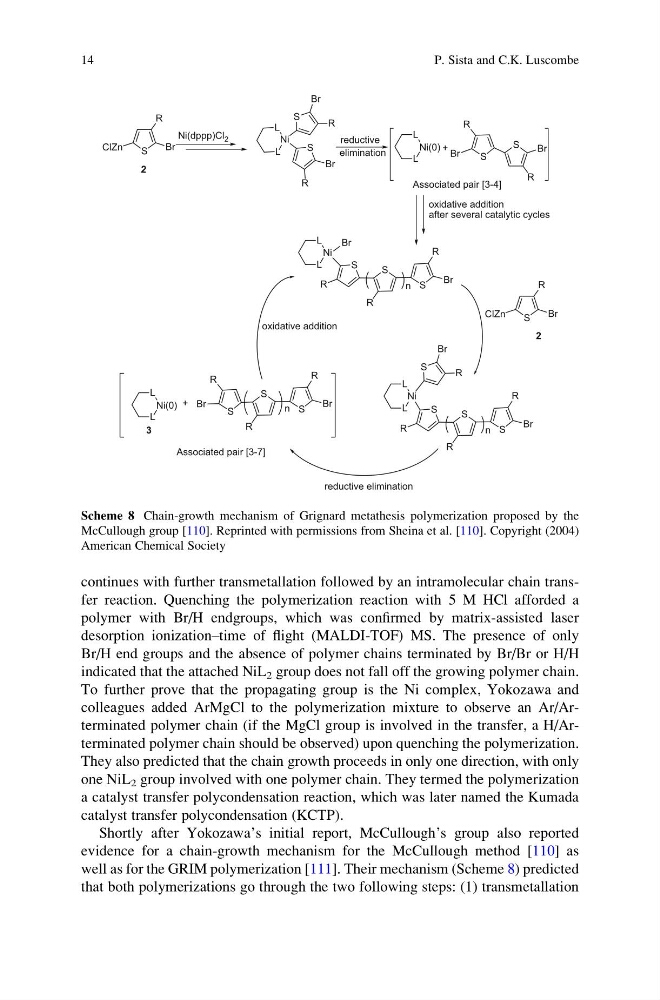
Shortly after Yokozawa’s initial report, McCullough’s group also reported
evidence for a chain-growth mechanism for the McCullough method [110] as
well as for the GRIM polymerization [111]. Their mechanism (Scheme 8) predicted
that both polymerizations go through the two following steps: (1) transmetallation
S
R
Br
ClZn
Ni(dppp)Cl 2
S
Br
R
reductive
elimination
S
Br
R
+
S
Br
R
2
Associated pair [3-4]
oxidative addition
after several catalytic cycles
S
R
S
R
Br
S
R
n
S
R
S
R
Br
S
R
n
S
Br
R
S
R
Br
ClZn
2
S
R
S
R
Br
n
S
Br
R
+
3
Associated pair [3-7]
reductive elimination
oxidative addition
L
Ni
L
Br
L
Ni(0)
L
L
Ni
L
L
Ni(0)
L
L
Ni
L
S
Br
R
Scheme 8 Chain-growth mechanism of Grignard metathesis polymerization proposed by the
McCullough group [110]. Reprinted with permissions from Sheina et al. [110]. Copyright (2004)
American Chemical Society
14
P. Sista and C.K. Luscombe
polymer with Br/H endgroups, which was confirmed by matrix-assisted laser
desorption ionization–time of flight (MALDI-TOF) MS. The presence of only
Br/H end groups and the absence of polymer chains terminated by Br/Br or H/H
indicated that the attached NiL 2 group does not fall off the growing polymer chain.
To further prove that the propagating group is the Ni complex, Yokozawa and
colleagues added ArMgCl to the polymerization mixture to observe an Ar/Arterminated polymer chain (if the MgCl group is involved in the transfer, a H/Arterminated polymer chain should be observed) upon quenching the polymerization.
They also predicted that the chain growth proceeds in only one direction, with only
one NiL 2 group involved with one polymer chain. They termed the polymerization
a catalyst transfer polycondensation reaction, which was later named the Kumada
catalyst transfer polycondensation (KCTP).
Shortly after Yokozawa’s initial report, McCullough’s group also reported
evidence for a chain-growth mechanism for the McCullough method [110] as
well as for the GRIM polymerization [111]. Their mechanism (Scheme 8) predicted
that both polymerizations go through the two following steps: (1) transmetallation
S
R
Br
ClZn
Ni(dppp)Cl 2
S
Br
R
reductive
elimination
S
Br
R
+
S
Br
R
2
Associated pair [3-4]
oxidative addition
after several catalytic cycles
S
R
S
R
Br
S
R
n
S
R
S
R
Br
S
R
n
S
Br
R
S
R
Br
ClZn
2
S
R
S
R
Br
n
S
Br
R
+
3
Associated pair [3-7]
reductive elimination
oxidative addition
L
Ni
L
Br
L
Ni(0)
L
L
Ni
L
L
Ni(0)
L
L
Ni
L
S
Br
R
Scheme 8 Chain-growth mechanism of Grignard metathesis polymerization proposed by the
McCullough group [110]. Reprinted with permissions from Sheina et al. [110]. Copyright (2004)
American Chemical Society
14
P. Sista and C.K. Luscombe