

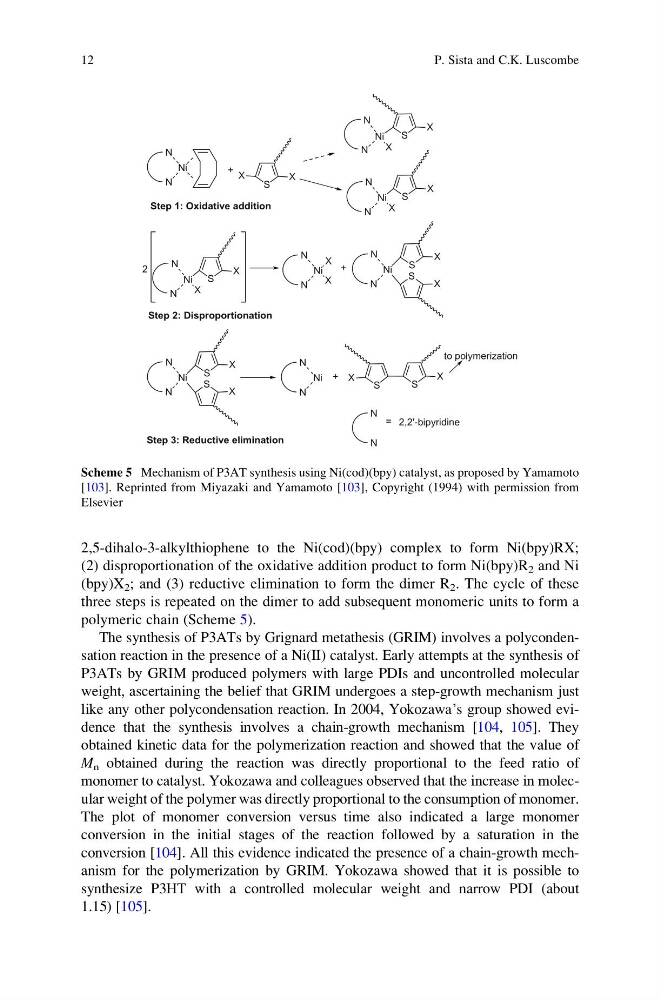
2,5-dihalo-3-alkylthiophene to the Ni(cod)(bpy) complex to form Ni(bpy)RX;
(2) disproportionation of the oxidative addition product to form Ni(bpy)R 2 and Ni
(bpy)X 2 ; and (3) reductive elimination to form the dimer R 2 . The cycle of these
three steps is repeated on the dimer to add subsequent monomeric units to form a
polymeric chain (Scheme 5).
The synthesis of P3ATs by Grignard metathesis (GRIM) involves a polycondensation reaction in the presence of a Ni(II) catalyst. Early attempts at the synthesis of
P3ATs by GRIM produced polymers with large PDIs and uncontrolled molecular
weight, ascertaining the belief that GRIM undergoes a step-growth mechanism just
like any other polycondensation reaction. In 2004, Yokozawa’s group showed evidence that the synthesis involves a chain-growth mechanism [104, 105]. They
obtained kinetic data for the polymerization reaction and showed that the value of
M n obtained during the reaction was directly proportional to the feed ratio of
monomer to catalyst. Yokozawa and colleagues observed that the increase in molecular weight of the polymer was directly proportional to the consumption of monomer.
The plot of monomer conversion versus time also indicated a large monomer
conversion in the initial stages of the reaction followed by a saturation in the
conversion [104]. All this evidence indicated the presence of a chain-growth mechanism for the polymerization by GRIM. Yokozawa showed that it is possible to
synthesize P3HT with a controlled molecular weight and narrow PDI (about
1.15) [105].
N
N
Ni
+
S
X
X
N
N
Ni
X
S
X
N
N
Ni
X
S
X
Step 1: Oxidative addition
N
N
Ni
X
S
X
2
N
N
Ni
X
X +
N
N
Ni
S
X
S
Step 2: Disproportionation
N
N
Ni
S
X
S
X
X
N
N
Ni +
S
X
S
X
to polymerization
Step 3: Reductive elimination
N
N
= 2,2'-bipyridine
Scheme 5 Mechanism of P3AT synthesis using Ni(cod)(bpy) catalyst, as proposed by Yamamoto
[103]. Reprinted from Miyazaki and Yamamoto [103], Copyright (1994) with permission from
Elsevier
12
P. Sista and C.K. Luscombe
(2) disproportionation of the oxidative addition product to form Ni(bpy)R 2 and Ni
(bpy)X 2 ; and (3) reductive elimination to form the dimer R 2 . The cycle of these
three steps is repeated on the dimer to add subsequent monomeric units to form a
polymeric chain (Scheme 5).
The synthesis of P3ATs by Grignard metathesis (GRIM) involves a polycondensation reaction in the presence of a Ni(II) catalyst. Early attempts at the synthesis of
P3ATs by GRIM produced polymers with large PDIs and uncontrolled molecular
weight, ascertaining the belief that GRIM undergoes a step-growth mechanism just
like any other polycondensation reaction. In 2004, Yokozawa’s group showed evidence that the synthesis involves a chain-growth mechanism [104, 105]. They
obtained kinetic data for the polymerization reaction and showed that the value of
M n obtained during the reaction was directly proportional to the feed ratio of
monomer to catalyst. Yokozawa and colleagues observed that the increase in molecular weight of the polymer was directly proportional to the consumption of monomer.
The plot of monomer conversion versus time also indicated a large monomer
conversion in the initial stages of the reaction followed by a saturation in the
conversion [104]. All this evidence indicated the presence of a chain-growth mechanism for the polymerization by GRIM. Yokozawa showed that it is possible to
synthesize P3HT with a controlled molecular weight and narrow PDI (about
1.15) [105].
N
N
Ni
+
S
X
X
N
N
Ni
X
S
X
N
N
Ni
X
S
X
Step 1: Oxidative addition
N
N
Ni
X
S
X
2
N
N
Ni
X
X +
N
N
Ni
S
X
S
Step 2: Disproportionation
N
N
Ni
S
X
S
X
X
N
N
Ni +
S
X
S
X
to polymerization
Step 3: Reductive elimination
N
N
= 2,2'-bipyridine
Scheme 5 Mechanism of P3AT synthesis using Ni(cod)(bpy) catalyst, as proposed by Yamamoto
[103]. Reprinted from Miyazaki and Yamamoto [103], Copyright (1994) with permission from
Elsevier
12
P. Sista and C.K. Luscombe