

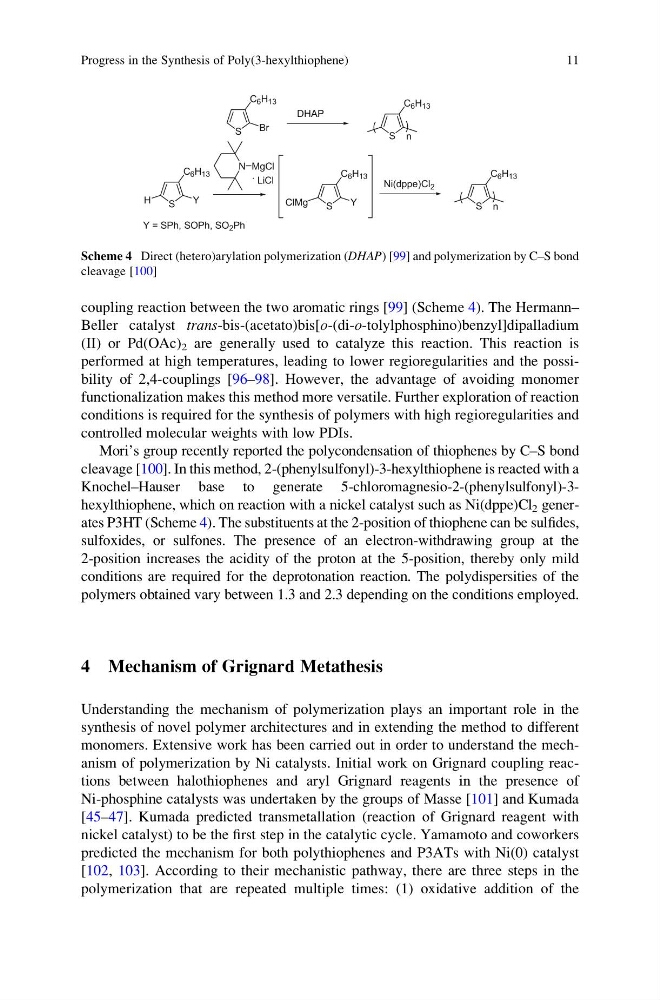
coupling reaction between the two aromatic rings [99] (Scheme 4). The Hermann–
Beller catalyst trans-bis-(acetato)bis[o-(di-o-tolylphosphino)benzyl]dipalladium
(II) or Pd(OAc) 2 are generally used to catalyze this reaction. This reaction is
performed at high temperatures, leading to lower regioregularities and the possibility of 2,4-couplings [96–98]. However, the advantage of avoiding monomer
functionalization makes this method more versatile. Further exploration of reaction
conditions is required for the synthesis of polymers with high regioregularities and
controlled molecular weights with low PDIs.
Mori’s group recently reported the polycondensation of thiophenes by C–S bond
cleavage [100]. In this method, 2-(phenylsulfonyl)-3-hexylthiophene is reacted with a
Knochel–Hauser base to generate 5-chloromagnesio-2-(phenylsulfonyl)-3hexylthiophene, which on reaction with a nickel catalyst such as Ni(dppe)Cl 2 generates P3HT (Scheme 4). The substituents at the 2-position of thiophene can be sulfides,
sulfoxides, or sulfones. The presence of an electron-withdrawing group at the
2-position increases the acidity of the proton at the 5-position, thereby only mild
conditions are required for the deprotonation reaction. The polydispersities of the
polymers obtained vary between 1.3 and 2.3 depending on the conditions employed.
4 Mechanism of Grignard Metathesis
Understanding the mechanism of polymerization plays an important role in the
synthesis of novel polymer architectures and in extending the method to different
monomers. Extensive work has been carried out in order to understand the mechanism of polymerization by Ni catalysts. Initial work on Grignard coupling reactions between halothiophenes and aryl Grignard reagents in the presence of
Ni-phosphine catalysts was undertaken by the groups of Masse [101] and Kumada
[45–47]. Kumada predicted transmetallation (reaction of Grignard reagent with
nickel catalyst) to be the first step in the catalytic cycle. Yamamoto and coworkers
predicted the mechanism for both polythiophenes and P3ATs with Ni(0) catalyst
[102, 103]. According to their mechanistic pathway, there are three steps in the
polymerization that are repeated multiple times: (1) oxidative addition of the
N MgCl
LiCl
S
H
Y
C 6 H 13
S
ClMg
Y
C 6 H 13
Ni(dppe)Cl 2
S
C 6 H 13
n
Y = SPh, SOPh, SO 2 Ph
S
Br
C 6 H 13
S
C 6 H 13
n
DHAP
Scheme 4 Direct (hetero)arylation polymerization (DHAP) [99] and polymerization by C–S bond
cleavage [100]
Progress in the Synthesis of Poly(3-hexylthiophene)
11
Beller catalyst trans-bis-(acetato)bis[o-(di-o-tolylphosphino)benzyl]dipalladium
(II) or Pd(OAc) 2 are generally used to catalyze this reaction. This reaction is
performed at high temperatures, leading to lower regioregularities and the possibility of 2,4-couplings [96–98]. However, the advantage of avoiding monomer
functionalization makes this method more versatile. Further exploration of reaction
conditions is required for the synthesis of polymers with high regioregularities and
controlled molecular weights with low PDIs.
Mori’s group recently reported the polycondensation of thiophenes by C–S bond
cleavage [100]. In this method, 2-(phenylsulfonyl)-3-hexylthiophene is reacted with a
Knochel–Hauser base to generate 5-chloromagnesio-2-(phenylsulfonyl)-3hexylthiophene, which on reaction with a nickel catalyst such as Ni(dppe)Cl 2 generates P3HT (Scheme 4). The substituents at the 2-position of thiophene can be sulfides,
sulfoxides, or sulfones. The presence of an electron-withdrawing group at the
2-position increases the acidity of the proton at the 5-position, thereby only mild
conditions are required for the deprotonation reaction. The polydispersities of the
polymers obtained vary between 1.3 and 2.3 depending on the conditions employed.
4 Mechanism of Grignard Metathesis
Understanding the mechanism of polymerization plays an important role in the
synthesis of novel polymer architectures and in extending the method to different
monomers. Extensive work has been carried out in order to understand the mechanism of polymerization by Ni catalysts. Initial work on Grignard coupling reactions between halothiophenes and aryl Grignard reagents in the presence of
Ni-phosphine catalysts was undertaken by the groups of Masse [101] and Kumada
[45–47]. Kumada predicted transmetallation (reaction of Grignard reagent with
nickel catalyst) to be the first step in the catalytic cycle. Yamamoto and coworkers
predicted the mechanism for both polythiophenes and P3ATs with Ni(0) catalyst
[102, 103]. According to their mechanistic pathway, there are three steps in the
polymerization that are repeated multiple times: (1) oxidative addition of the
N MgCl
LiCl
S
H
Y
C 6 H 13
S
ClMg
Y
C 6 H 13
Ni(dppe)Cl 2
S
C 6 H 13
n
Y = SPh, SOPh, SO 2 Ph
S
Br
C 6 H 13
S
C 6 H 13
n
DHAP
Scheme 4 Direct (hetero)arylation polymerization (DHAP) [99] and polymerization by C–S bond
cleavage [100]
Progress in the Synthesis of Poly(3-hexylthiophene)
11