

due to increased energetic disorder. Additionally, the intramolecular contribution to
the DOS was found to only have a negligible effect on localization length and,
hence, transport in the high-regioregularity regime [108]. The conclusion is that the
higher mobility in the more regioregular material is entirely attributable to a
narrowing of the DOS that results from increased order in hole–quadrupole interaction distances.
The effect of energetic disorder is further amplified in the case of P3HT due to
the one-dimensional character of transport, since a single energetic trap can impede
transport through the entire lamella [93]. This effect is visualized in Fig. 10 [13],
where the energetic landscape is exemplified for five different simulation times and
four materials. Here, the widths of the bonds connecting the hopping sites are
proportional to the logarithm of squared electronic coupling elements, while the
heights of the vertical bars are proportional to the occupation probability of a
specific site. The gray scale indicates the average mobility of a particular lamella,
with darker colors corresponding to lower mobilities. One can see that site-energy
profiles are highly corrugated and spatially correlated, with weaker correlations in
the case of reduced regioregularity. Note also that the deep energetic traps found in
CC-90 and CA-90 persist throughout the entire time range shown here, as expected
from the associated time autocorrelation functions. Studying the landscapemobility correlation more closely, it becomes apparent that transport in CC-100
and CA-100 is strongly dominated by weak links (small transfer integrals) that
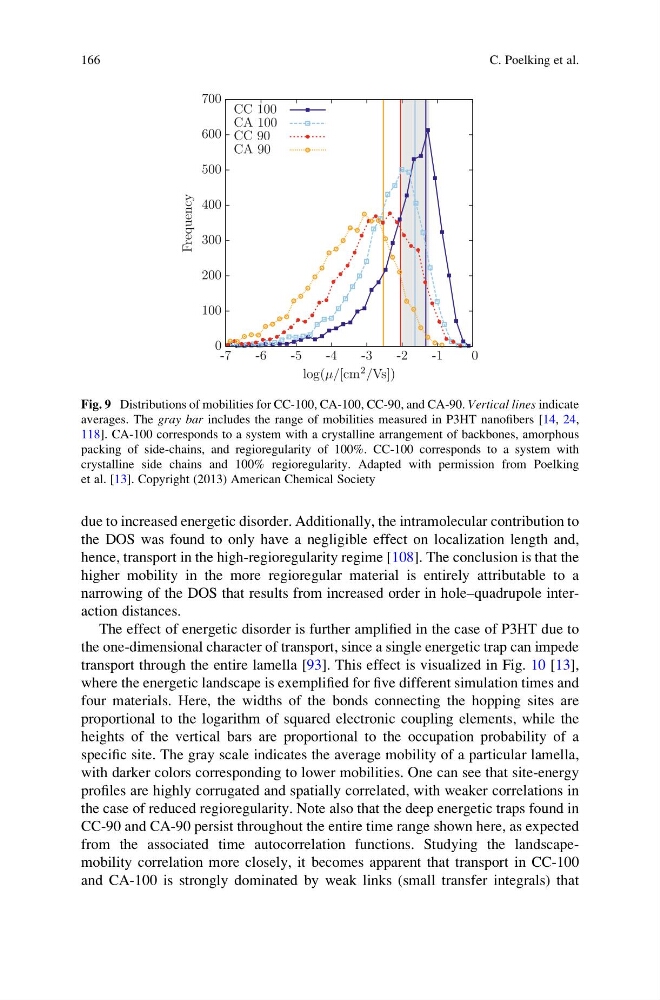
Fig. 9 Distributions of mobilities for CC-100, CA-100, CC-90, and CA-90. Vertical lines indicate
averages. The gray bar includes the range of mobilities measured in P3HT nanofibers [14, 24,
118]. CA-100 corresponds to a system with a crystalline arrangement of backbones, amorphous
packing of side-chains, and regioregularity of 100%. CC-100 corresponds to a system with
crystalline side chains and 100% regioregularity. Adapted with permission from Poelking
et al. [13]. Copyright (2013) American Chemical Society
166
C. Poelking et al.
the DOS was found to only have a negligible effect on localization length and,
hence, transport in the high-regioregularity regime [108]. The conclusion is that the
higher mobility in the more regioregular material is entirely attributable to a
narrowing of the DOS that results from increased order in hole–quadrupole interaction distances.
The effect of energetic disorder is further amplified in the case of P3HT due to
the one-dimensional character of transport, since a single energetic trap can impede
transport through the entire lamella [93]. This effect is visualized in Fig. 10 [13],
where the energetic landscape is exemplified for five different simulation times and
four materials. Here, the widths of the bonds connecting the hopping sites are
proportional to the logarithm of squared electronic coupling elements, while the
heights of the vertical bars are proportional to the occupation probability of a
specific site. The gray scale indicates the average mobility of a particular lamella,
with darker colors corresponding to lower mobilities. One can see that site-energy
profiles are highly corrugated and spatially correlated, with weaker correlations in
the case of reduced regioregularity. Note also that the deep energetic traps found in
CC-90 and CA-90 persist throughout the entire time range shown here, as expected
from the associated time autocorrelation functions. Studying the landscapemobility correlation more closely, it becomes apparent that transport in CC-100
and CA-100 is strongly dominated by weak links (small transfer integrals) that
Fig. 9 Distributions of mobilities for CC-100, CA-100, CC-90, and CA-90. Vertical lines indicate
averages. The gray bar includes the range of mobilities measured in P3HT nanofibers [14, 24,
118]. CA-100 corresponds to a system with a crystalline arrangement of backbones, amorphous
packing of side-chains, and regioregularity of 100%. CC-100 corresponds to a system with
crystalline side chains and 100% regioregularity. Adapted with permission from Poelking
et al. [13]. Copyright (2013) American Chemical Society
166
C. Poelking et al.