

Alternatively, when using KMC, the charge-carrier mobility along the direction
of the external field E can be obtained simply by:
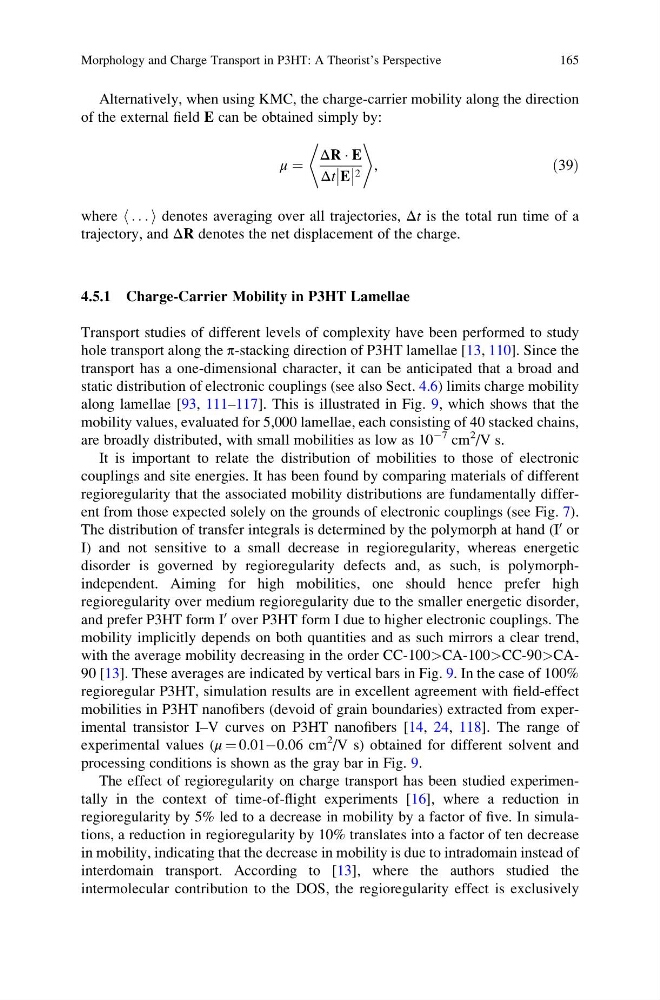
μ ¼
ΔR Á E
Δt
E
2
*
+
,
ð39Þ
where h . . . i denotes averaging over all trajectories, Δt is the total run time of a
trajectory, and ΔR denotes the net displacement of the charge.
4.5.1 Charge-Carrier Mobility in P3HT Lamellae
Transport studies of different levels of complexity have been performed to study
hole transport along the π-stacking direction of P3HT lamellae [13, 110]. Since the
transport has a one-dimensional character, it can be anticipated that a broad and
static distribution of electronic couplings (see also Sect. 4.6) limits charge mobility
along lamellae [93, 111–117]. This is illustrated in Fig. 9, which shows that the
mobility values, evaluated for 5,000 lamellae, each consisting of 40 stacked chains,
are broadly distributed, with small mobilities as low as 10
À7 cm
2 /V s.
It is important to relate the distribution of mobilities to those of electronic
couplings and site energies. It has been found by comparing materials of different
regioregularity that the associated mobility distributions are fundamentally different from those expected solely on the grounds of electronic couplings (see Fig. 7).
The distribution of transfer integrals is determined by the polymorph at hand (I
0 or
I) and not sensitive to a small decrease in regioregularity, whereas energetic
disorder is governed by regioregularity defects and, as such, is polymorphindependent. Aiming for high mobilities, one should hence prefer high
regioregularity over medium regioregularity due to the smaller energetic disorder,
and prefer P3HT form I
0 over P3HT form I due to higher electronic couplings. The
mobility implicitly depends on both quantities and as such mirrors a clear trend,
with the average mobility decreasing in the order CC-100>CA-100>CC-90>CA90 [13]. These averages are indicated by vertical bars in Fig. 9. In the case of 100%
regioregular P3HT, simulation results are in excellent agreement with field-effect
mobilities in P3HT nanofibers (devoid of grain boundaries) extracted from experimental transistor I–V curves on P3HT nanofibers [14, 24, 118]. The range of
experimental values (μ ¼ 0.01À0.06 cm
2 /V s) obtained for different solvent and
processing conditions is shown as the gray bar in Fig. 9.
The effect of regioregularity on charge transport has been studied experimentally in the context of time-of-flight experiments [16], where a reduction in
regioregularity by 5% led to a decrease in mobility by a factor of five. In simulations, a reduction in regioregularity by 10% translates into a factor of ten decrease
in mobility, indicating that the decrease in mobility is due to intradomain instead of
interdomain transport. According to [13], where the authors studied the
intermolecular contribution to the DOS, the regioregularity effect is exclusively
Morphology and Charge Transport in P3HT: A Theorist’s Perspective
165
of the external field E can be obtained simply by:
μ ¼
ΔR Á E
Δt
E
2
*
+
,
ð39Þ
where h . . . i denotes averaging over all trajectories, Δt is the total run time of a
trajectory, and ΔR denotes the net displacement of the charge.
4.5.1 Charge-Carrier Mobility in P3HT Lamellae
Transport studies of different levels of complexity have been performed to study
hole transport along the π-stacking direction of P3HT lamellae [13, 110]. Since the
transport has a one-dimensional character, it can be anticipated that a broad and
static distribution of electronic couplings (see also Sect. 4.6) limits charge mobility
along lamellae [93, 111–117]. This is illustrated in Fig. 9, which shows that the
mobility values, evaluated for 5,000 lamellae, each consisting of 40 stacked chains,
are broadly distributed, with small mobilities as low as 10
À7 cm
2 /V s.
It is important to relate the distribution of mobilities to those of electronic
couplings and site energies. It has been found by comparing materials of different
regioregularity that the associated mobility distributions are fundamentally different from those expected solely on the grounds of electronic couplings (see Fig. 7).
The distribution of transfer integrals is determined by the polymorph at hand (I
0 or
I) and not sensitive to a small decrease in regioregularity, whereas energetic
disorder is governed by regioregularity defects and, as such, is polymorphindependent. Aiming for high mobilities, one should hence prefer high
regioregularity over medium regioregularity due to the smaller energetic disorder,
and prefer P3HT form I
0 over P3HT form I due to higher electronic couplings. The
mobility implicitly depends on both quantities and as such mirrors a clear trend,
with the average mobility decreasing in the order CC-100>CA-100>CC-90>CA90 [13]. These averages are indicated by vertical bars in Fig. 9. In the case of 100%
regioregular P3HT, simulation results are in excellent agreement with field-effect
mobilities in P3HT nanofibers (devoid of grain boundaries) extracted from experimental transistor I–V curves on P3HT nanofibers [14, 24, 118]. The range of
experimental values (μ ¼ 0.01À0.06 cm
2 /V s) obtained for different solvent and
processing conditions is shown as the gray bar in Fig. 9.
The effect of regioregularity on charge transport has been studied experimentally in the context of time-of-flight experiments [16], where a reduction in
regioregularity by 5% led to a decrease in mobility by a factor of five. In simulations, a reduction in regioregularity by 10% translates into a factor of ten decrease
in mobility, indicating that the decrease in mobility is due to intradomain instead of
interdomain transport. According to [13], where the authors studied the
intermolecular contribution to the DOS, the regioregularity effect is exclusively
Morphology and Charge Transport in P3HT: A Theorist’s Perspective
165