

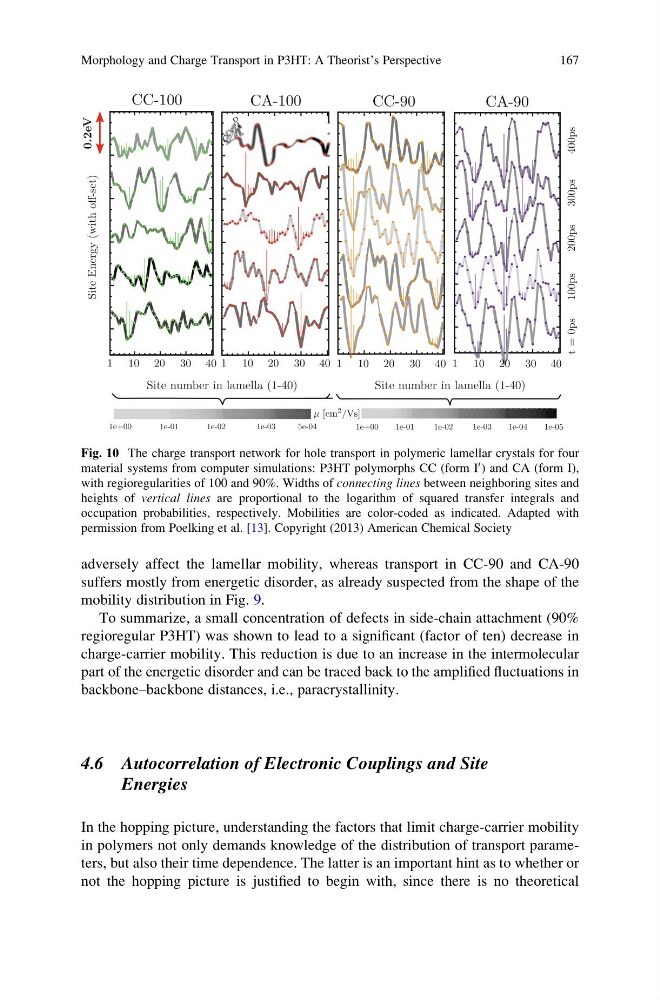
adversely affect the lamellar mobility, whereas transport in CC-90 and CA-90
suffers mostly from energetic disorder, as already suspected from the shape of the
mobility distribution in Fig. 9.
To summarize, a small concentration of defects in side-chain attachment (90%
regioregular P3HT) was shown to lead to a significant (factor of ten) decrease in
charge-carrier mobility. This reduction is due to an increase in the intermolecular
part of the energetic disorder and can be traced back to the amplified fluctuations in
backbone–backbone distances, i.e., paracrystallinity.
4.6 Autocorrelation of Electronic Couplings and Site
Energies
In the hopping picture, understanding the factors that limit charge-carrier mobility
in polymers not only demands knowledge of the distribution of transport parameters, but also their time dependence. The latter is an important hint as to whether or
not the hopping picture is justified to begin with, since there is no theoretical
Fig. 10 The charge transport network for hole transport in polymeric lamellar crystals for four
material systems from computer simulations: P3HT polymorphs CC (form I
0 ) and CA (form I),
with regioregularities of 100 and 90%. Widths of connecting lines between neighboring sites and
heights of vertical lines are proportional to the logarithm of squared transfer integrals and
occupation probabilities, respectively. Mobilities are color-coded as indicated. Adapted with
permission from Poelking et al. [13]. Copyright (2013) American Chemical Society
Morphology and Charge Transport in P3HT: A Theorist’s Perspective
167
suffers mostly from energetic disorder, as already suspected from the shape of the
mobility distribution in Fig. 9.
To summarize, a small concentration of defects in side-chain attachment (90%
regioregular P3HT) was shown to lead to a significant (factor of ten) decrease in
charge-carrier mobility. This reduction is due to an increase in the intermolecular
part of the energetic disorder and can be traced back to the amplified fluctuations in
backbone–backbone distances, i.e., paracrystallinity.
4.6 Autocorrelation of Electronic Couplings and Site
Energies
In the hopping picture, understanding the factors that limit charge-carrier mobility
in polymers not only demands knowledge of the distribution of transport parameters, but also their time dependence. The latter is an important hint as to whether or
not the hopping picture is justified to begin with, since there is no theoretical
Fig. 10 The charge transport network for hole transport in polymeric lamellar crystals for four
material systems from computer simulations: P3HT polymorphs CC (form I
0 ) and CA (form I),
with regioregularities of 100 and 90%. Widths of connecting lines between neighboring sites and
heights of vertical lines are proportional to the logarithm of squared transfer integrals and
occupation probabilities, respectively. Mobilities are color-coded as indicated. Adapted with
permission from Poelking et al. [13]. Copyright (2013) American Chemical Society
Morphology and Charge Transport in P3HT: A Theorist’s Perspective
167