

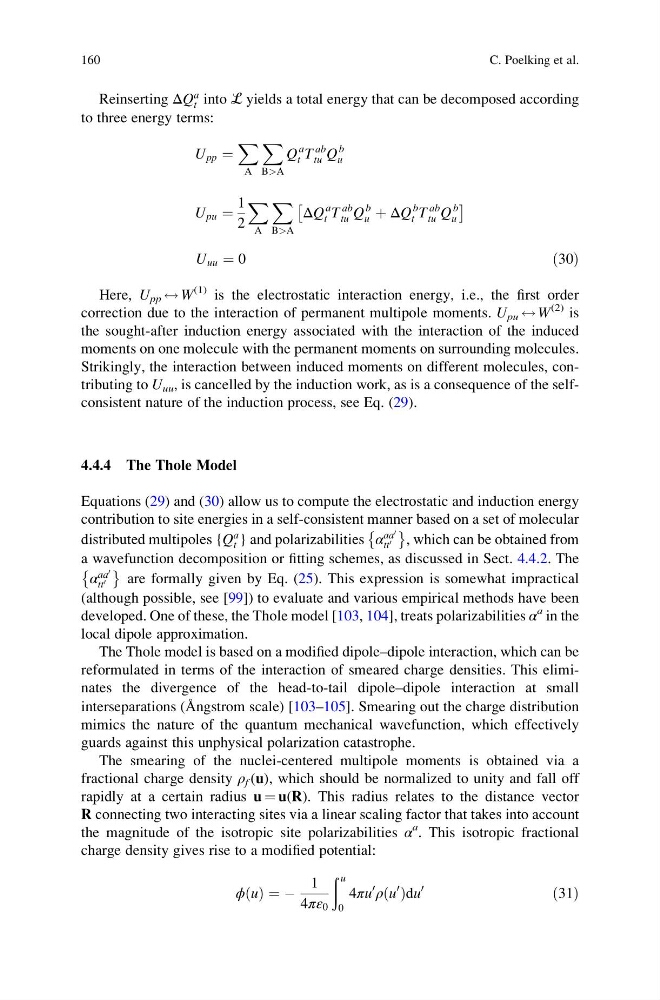
Reinserting ΔQ
a
t into ℒ yields a total energy that can be decomposed according
to three energy terms:
U pp ¼
X
A
X
B>A
Q
a
t T
ab
tu Q
b
u
U pu ¼
1
2
X
A
X
B>A
ΔQ
a
t T
ab
tu Q
b
u þ ΔQ
b
t T
ab
tu Q
b
u
Â
Ã
U uu ¼ 0
ð30Þ
Here, U pp $ W
(1) is the electrostatic interaction energy, i.e., the first order
correction due to the interaction of permanent multipole moments. U pu $ W
(2) is
the sought-after induction energy associated with the interaction of the induced
moments on one molecule with the permanent moments on surrounding molecules.
Strikingly, the interaction between induced moments on different molecules, contributing to U uu , is cancelled by the induction work, as is a consequence of the selfconsistent nature of the induction process, see Eq. (29).
4.4.4 The Thole Model
Equations (29) and (30) allow us to compute the electrostatic and induction energy
contribution to site energies in a self-consistent manner based on a set of molecular
distributed multipoles {Q
a
t } and polarizabilities α
aa
0
tt 0
È É
, which can be obtained from
a wavefunction decomposition or fitting schemes, as discussed in Sect. 4.4.2. The
α
aa
0
tt 0
È É
are formally given by Eq. (25). This expression is somewhat impractical
(although possible, see [99]) to evaluate and various empirical methods have been
developed. One of these, the Thole model [103, 104], treats polarizabilities α
a in the
local dipole approximation.
The Thole model is based on a modified dipole–dipole interaction, which can be
reformulated in terms of the interaction of smeared charge densities. This eliminates the divergence of the head-to-tail dipole–dipole interaction at small
interseparations (Ångstrom scale) [103–105]. Smearing out the charge distribution
mimics the nature of the quantum mechanical wavefunction, which effectively
guards against this unphysical polarization catastrophe.
The smearing of the nuclei-centered multipole moments is obtained via a
fractional charge density ρ f (u), which should be normalized to unity and fall off
rapidly at a certain radius u ¼ u(R). This radius relates to the distance vector
R connecting two interacting sites via a linear scaling factor that takes into account
the magnitude of the isotropic site polarizabilities α
a . This isotropic fractional
charge density gives rise to a modified potential:
ϕ u
ð Þ ¼ À
1
4πε 0
ð u
0
4πu
0
ρ u
0
ð Þdu
0
ð31Þ
160
C. Poelking et al.
a
t into ℒ yields a total energy that can be decomposed according
to three energy terms:
U pp ¼
X
A
X
B>A
Q
a
t T
ab
tu Q
b
u
U pu ¼
1
2
X
A
X
B>A
ΔQ
a
t T
ab
tu Q
b
u þ ΔQ
b
t T
ab
tu Q
b
u
Â
Ã
U uu ¼ 0
ð30Þ
Here, U pp $ W
(1) is the electrostatic interaction energy, i.e., the first order
correction due to the interaction of permanent multipole moments. U pu $ W
(2) is
the sought-after induction energy associated with the interaction of the induced
moments on one molecule with the permanent moments on surrounding molecules.
Strikingly, the interaction between induced moments on different molecules, contributing to U uu , is cancelled by the induction work, as is a consequence of the selfconsistent nature of the induction process, see Eq. (29).
4.4.4 The Thole Model
Equations (29) and (30) allow us to compute the electrostatic and induction energy
contribution to site energies in a self-consistent manner based on a set of molecular
distributed multipoles {Q
a
t } and polarizabilities α
aa
0
tt 0
È É
, which can be obtained from
a wavefunction decomposition or fitting schemes, as discussed in Sect. 4.4.2. The
α
aa
0
tt 0
È É
are formally given by Eq. (25). This expression is somewhat impractical
(although possible, see [99]) to evaluate and various empirical methods have been
developed. One of these, the Thole model [103, 104], treats polarizabilities α
a in the
local dipole approximation.
The Thole model is based on a modified dipole–dipole interaction, which can be
reformulated in terms of the interaction of smeared charge densities. This eliminates the divergence of the head-to-tail dipole–dipole interaction at small
interseparations (Ångstrom scale) [103–105]. Smearing out the charge distribution
mimics the nature of the quantum mechanical wavefunction, which effectively
guards against this unphysical polarization catastrophe.
The smearing of the nuclei-centered multipole moments is obtained via a
fractional charge density ρ f (u), which should be normalized to unity and fall off
rapidly at a certain radius u ¼ u(R). This radius relates to the distance vector
R connecting two interacting sites via a linear scaling factor that takes into account
the magnitude of the isotropic site polarizabilities α
a . This isotropic fractional
charge density gives rise to a modified potential:
ϕ u
ð Þ ¼ À
1
4πε 0
ð u
0
4πu
0
ρ u
0
ð Þdu
0
ð31Þ
160
C. Poelking et al.