

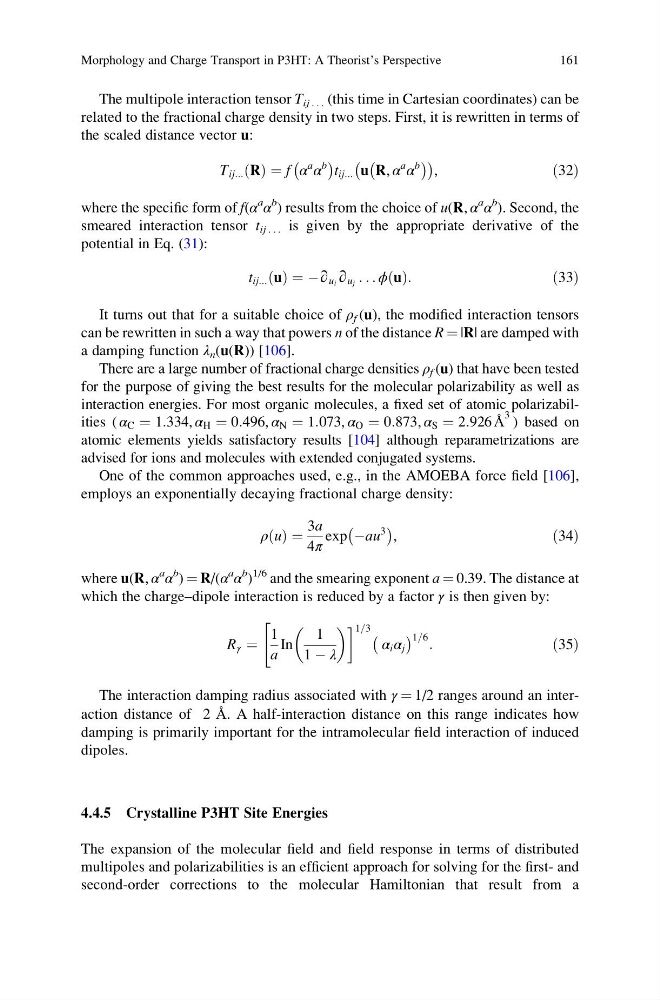
The multipole interaction tensor T ij . . . (this time in Cartesian coordinates) can be
related to the fractional charge density in two steps. First, it is rewritten in terms of
the scaled distance vector u:
T ij... R
ð Þ ¼ f α
a
α
b
À
Á
t ij... u R, α
a
α
b
À
Á
À
Á
,
ð32Þ
where the specific form of f(α
a
α
b ) results from the choice of u(R, α
a
α
b ). Second, the
smeared interaction tensor t ij . . . is given by the appropriate derivative of the
potential in Eq. (31):
t ij... u
ð Þ ¼ À∂ u i ∂ u j . . . ϕ u
ð Þ:
ð33Þ
It turns out that for a suitable choice of ρ f (u), the modified interaction tensors
can be rewritten in such a way that powers n of the distance R ¼ |R| are damped with
a damping function λ n (u(R)) [106].
There are a large number of fractional charge densities ρ f (u) that have been tested
for the purpose of giving the best results for the molecular polarizability as well as
interaction energies. For most organic molecules, a fixed set of atomic polarizabilities ( α C ¼ 1:334, α H ¼ 0:496, α N ¼ 1:073, α O ¼ 0:873, α S ¼ 2:926 Å
3 ) based on
atomic elements yields satisfactory results [104] although reparametrizations are
advised for ions and molecules with extended conjugated systems.
One of the common approaches used, e.g., in the AMOEBA force field [106],
employs an exponentially decaying fractional charge density:
ρ u
ð Þ ¼
3a
4π
exp Àau
3
À
Á
,
ð34Þ
where u(R, α
a
α
b ) ¼ R/(α
a
α
b )
1/6 and the smearing exponent a ¼ 0.39. The distance at
which the charge–dipole interaction is reduced by a factor γ is then given by:
R γ ¼
1
a
In
1
1 À λ
! 1=3
α i α j
À
Á 1=6 :
"
ð35Þ
The interaction damping radius associated with γ ¼ 1/2 ranges around an interaction distance of 2 Å. A half-interaction distance on this range indicates how
damping is primarily important for the intramolecular field interaction of induced
dipoles.
4.4.5 Crystalline P3HT Site Energies
The expansion of the molecular field and field response in terms of distributed
multipoles and polarizabilities is an efficient approach for solving for the first- and
second-order corrections to the molecular Hamiltonian that result from a
Morphology and Charge Transport in P3HT: A Theorist’s Perspective
161
related to the fractional charge density in two steps. First, it is rewritten in terms of
the scaled distance vector u:
T ij... R
ð Þ ¼ f α
a
α
b
À
Á
t ij... u R, α
a
α
b
À
Á
À
Á
,
ð32Þ
where the specific form of f(α
a
α
b ) results from the choice of u(R, α
a
α
b ). Second, the
smeared interaction tensor t ij . . . is given by the appropriate derivative of the
potential in Eq. (31):
t ij... u
ð Þ ¼ À∂ u i ∂ u j . . . ϕ u
ð Þ:
ð33Þ
It turns out that for a suitable choice of ρ f (u), the modified interaction tensors
can be rewritten in such a way that powers n of the distance R ¼ |R| are damped with
a damping function λ n (u(R)) [106].
There are a large number of fractional charge densities ρ f (u) that have been tested
for the purpose of giving the best results for the molecular polarizability as well as
interaction energies. For most organic molecules, a fixed set of atomic polarizabilities ( α C ¼ 1:334, α H ¼ 0:496, α N ¼ 1:073, α O ¼ 0:873, α S ¼ 2:926 Å
3 ) based on
atomic elements yields satisfactory results [104] although reparametrizations are
advised for ions and molecules with extended conjugated systems.
One of the common approaches used, e.g., in the AMOEBA force field [106],
employs an exponentially decaying fractional charge density:
ρ u
ð Þ ¼
3a
4π
exp Àau
3
À
Á
,
ð34Þ
where u(R, α
a
α
b ) ¼ R/(α
a
α
b )
1/6 and the smearing exponent a ¼ 0.39. The distance at
which the charge–dipole interaction is reduced by a factor γ is then given by:
R γ ¼
1
a
In
1
1 À λ
! 1=3
α i α j
À
Á 1=6 :
"
ð35Þ
The interaction damping radius associated with γ ¼ 1/2 ranges around an interaction distance of 2 Å. A half-interaction distance on this range indicates how
damping is primarily important for the intramolecular field interaction of induced
dipoles.
4.4.5 Crystalline P3HT Site Energies
The expansion of the molecular field and field response in terms of distributed
multipoles and polarizabilities is an efficient approach for solving for the first- and
second-order corrections to the molecular Hamiltonian that result from a
Morphology and Charge Transport in P3HT: A Theorist’s Perspective
161