

considering the dense packing and (also important) strongly anisotropic charge
density. This inevitably leads to breakdown of the single-point expansion at small
interseparations. It is possible to avoid this breakdown by choosing multiple
expansion sites (“polar sites”) per molecule in such a way as to accurately represent
the molecular electrostatic potential, with a set of suitably chosen multipole
moments {Q
a
lk } allocated to each site. We then simply extend the expression for
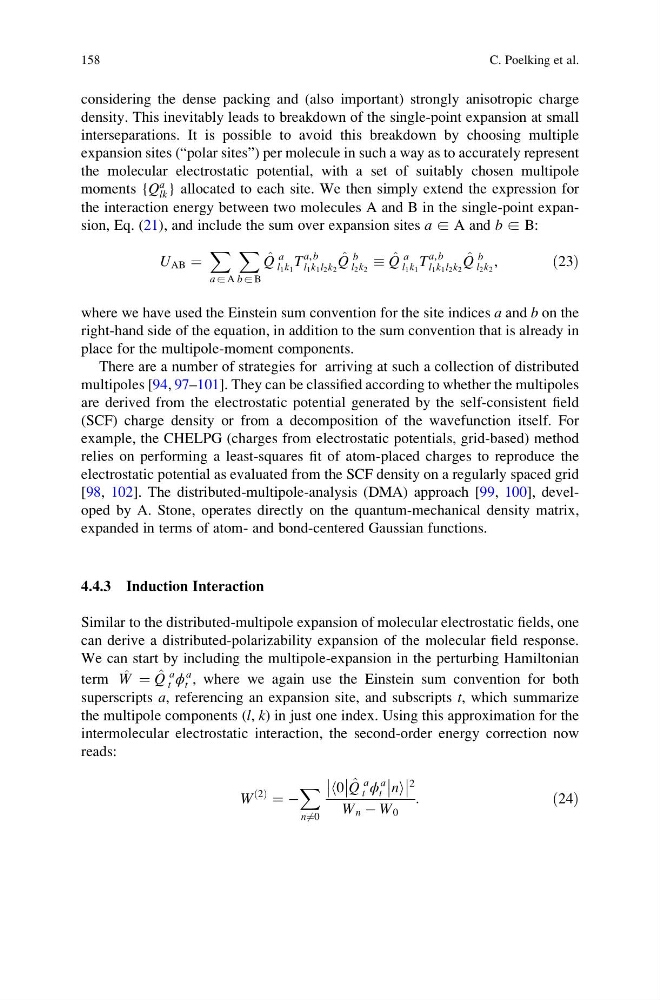
the interaction energy between two molecules A and B in the single-point expansion, Eq. (21), and include the sum over expansion sites a ∈ A and b ∈ B:
U AB ¼
X
a ∈ A
X
b ∈ B
^
Q
a
l 1 k 1
T
a, b
l 1 k 1 l 2 k 2
^
Q
b
l 2 k 2
^
Q
a
l 1 k 1
T
a, b
l 1 k 1 l 2 k 2
^
Q
b
l 2 k 2
,
ð23Þ
where we have used the Einstein sum convention for the site indices a and b on the
right-hand side of the equation, in addition to the sum convention that is already in
place for the multipole-moment components.
There are a number of strategies for arriving at such a collection of distributed
multipoles [94, 97–101]. They can be classified according to whether the multipoles
are derived from the electrostatic potential generated by the self-consistent field
(SCF) charge density or from a decomposition of the wavefunction itself. For
example, the CHELPG (charges from electrostatic potentials, grid-based) method
relies on performing a least-squares fit of atom-placed charges to reproduce the
electrostatic potential as evaluated from the SCF density on a regularly spaced grid
[98, 102]. The distributed-multipole-analysis (DMA) approach [99, 100], developed by A. Stone, operates directly on the quantum-mechanical density matrix,
expanded in terms of atom- and bond-centered Gaussian functions.
4.4.3 Induction Interaction
Similar to the distributed-multipole expansion of molecular electrostatic fields, one
can derive a distributed-polarizability expansion of the molecular field response.
We can start by including the multipole-expansion in the perturbing Hamiltonian
term ^
W ¼ ^
Q
a
t ϕ
a
t , where we again use the Einstein sum convention for both
superscripts a, referencing an expansion site, and subscripts t, which summarize
the multipole components (l, k) in just one index. Using this approximation for the
intermolecular electrostatic interaction, the second-order energy correction now
reads:
W
2
ð Þ
¼ À
X
n6 ¼0
0
h
^
Q
a
t ϕ
a
t
ni
2
W n À W 0
:
ð24Þ
158
C. Poelking et al.
density. This inevitably leads to breakdown of the single-point expansion at small
interseparations. It is possible to avoid this breakdown by choosing multiple
expansion sites (“polar sites”) per molecule in such a way as to accurately represent
the molecular electrostatic potential, with a set of suitably chosen multipole
moments {Q
a
lk } allocated to each site. We then simply extend the expression for
the interaction energy between two molecules A and B in the single-point expansion, Eq. (21), and include the sum over expansion sites a ∈ A and b ∈ B:
U AB ¼
X
a ∈ A
X
b ∈ B
^
Q
a
l 1 k 1
T
a, b
l 1 k 1 l 2 k 2
^
Q
b
l 2 k 2
^
Q
a
l 1 k 1
T
a, b
l 1 k 1 l 2 k 2
^
Q
b
l 2 k 2
,
ð23Þ
where we have used the Einstein sum convention for the site indices a and b on the
right-hand side of the equation, in addition to the sum convention that is already in
place for the multipole-moment components.
There are a number of strategies for arriving at such a collection of distributed
multipoles [94, 97–101]. They can be classified according to whether the multipoles
are derived from the electrostatic potential generated by the self-consistent field
(SCF) charge density or from a decomposition of the wavefunction itself. For
example, the CHELPG (charges from electrostatic potentials, grid-based) method
relies on performing a least-squares fit of atom-placed charges to reproduce the
electrostatic potential as evaluated from the SCF density on a regularly spaced grid
[98, 102]. The distributed-multipole-analysis (DMA) approach [99, 100], developed by A. Stone, operates directly on the quantum-mechanical density matrix,
expanded in terms of atom- and bond-centered Gaussian functions.
4.4.3 Induction Interaction
Similar to the distributed-multipole expansion of molecular electrostatic fields, one
can derive a distributed-polarizability expansion of the molecular field response.
We can start by including the multipole-expansion in the perturbing Hamiltonian
term ^
W ¼ ^
Q
a
t ϕ
a
t , where we again use the Einstein sum convention for both
superscripts a, referencing an expansion site, and subscripts t, which summarize
the multipole components (l, k) in just one index. Using this approximation for the
intermolecular electrostatic interaction, the second-order energy correction now
reads:
W
2
ð Þ
¼ À
X
n6 ¼0
0
h
^
Q
a
t ϕ
a
t
ni
2
W n À W 0
:
ð24Þ
158
C. Poelking et al.