

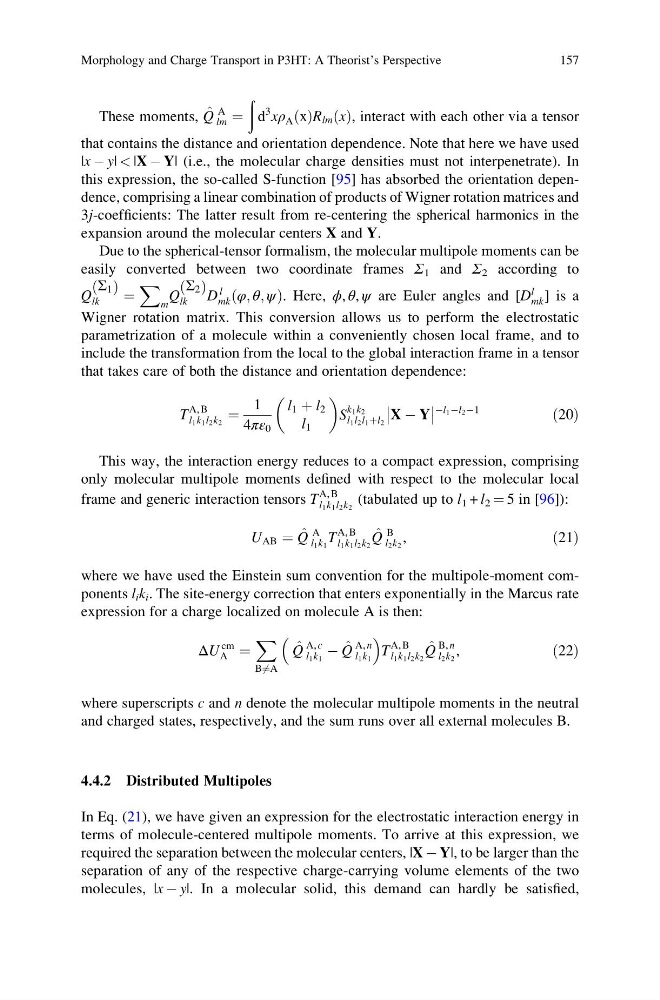
These moments, ^
Q
A
lm ¼
ð
d
3 xρ A x
ð ÞR lm x
ð Þ, interact with each other via a tensor
that contains the distance and orientation dependence. Note that here we have used
|x À y| < |X À Y| (i.e., the molecular charge densities must not interpenetrate). In
this expression, the so-called S-function [95] has absorbed the orientation dependence, comprising a linear combination of products of Wigner rotation matrices and
3j-coefficients: The latter result from re-centering the spherical harmonics in the
expansion around the molecular centers X and Y.
Due to the spherical-tensor formalism, the molecular multipole moments can be
easily converted between two coordinate frames Σ 1 and Σ 2 according to
Q
Σ 1
ð Þ
lk
¼
X
m
Q
Σ 2
ð Þ
lk
D
l
mk φ; θ; ψ
ð
Þ. Here, ϕ, θ, ψ are Euler angles and [D
l
mk ] is a
Wigner rotation matrix. This conversion allows us to perform the electrostatic
parametrization of a molecule within a conveniently chosen local frame, and to
include the transformation from the local to the global interaction frame in a tensor
that takes care of both the distance and orientation dependence:
T
A, B
l 1 k 1 l 2 k 2
¼
1
4πε 0
l 1 þ l 2
l 1
S
k 1 k 2
l 1 l 2 l 1 þl 2
X À Y
Àl 1 Àl 2 À1
ð20Þ
This way, the interaction energy reduces to a compact expression, comprising
only molecular multipole moments defined with respect to the molecular local
frame and generic interaction tensors T
A, B
l 1 k 1 l 2 k 2
(tabulated up to l 1 + l 2 ¼ 5 in [96]):
U AB ¼ ^
Q
A
l 1 k 1
T
A, B
l 1 k 1 l 2 k 2
^
Q
B
l 2 k 2
,
ð21Þ
where we have used the Einstein sum convention for the multipole-moment components l i k i . The site-energy correction that enters exponentially in the Marcus rate
expression for a charge localized on molecule A is then:
ΔU
cm
A ¼
X
B6 ¼A
^
Q
A, c
l 1 k 1
À ^
Q
A, n
l 1 k 1
T
A, B
l 1 k 1 l 2 k 2
^
Q
B, n
l 2 k 2
,
ð22Þ
where superscripts c and n denote the molecular multipole moments in the neutral
and charged states, respectively, and the sum runs over all external molecules B.
4.4.2 Distributed Multipoles
In Eq. (21), we have given an expression for the electrostatic interaction energy in
terms of molecule-centered multipole moments. To arrive at this expression, we
required the separation between the molecular centers, |X À Y|, to be larger than the
separation of any of the respective charge-carrying volume elements of the two
molecules, |x À y|. In a molecular solid, this demand can hardly be satisfied,
Morphology and Charge Transport in P3HT: A Theorist’s Perspective
157
Q
A
lm ¼
ð
d
3 xρ A x
ð ÞR lm x
ð Þ, interact with each other via a tensor
that contains the distance and orientation dependence. Note that here we have used
|x À y| < |X À Y| (i.e., the molecular charge densities must not interpenetrate). In
this expression, the so-called S-function [95] has absorbed the orientation dependence, comprising a linear combination of products of Wigner rotation matrices and
3j-coefficients: The latter result from re-centering the spherical harmonics in the
expansion around the molecular centers X and Y.
Due to the spherical-tensor formalism, the molecular multipole moments can be
easily converted between two coordinate frames Σ 1 and Σ 2 according to
Q
Σ 1
ð Þ
lk
¼
X
m
Q
Σ 2
ð Þ
lk
D
l
mk φ; θ; ψ
ð
Þ. Here, ϕ, θ, ψ are Euler angles and [D
l
mk ] is a
Wigner rotation matrix. This conversion allows us to perform the electrostatic
parametrization of a molecule within a conveniently chosen local frame, and to
include the transformation from the local to the global interaction frame in a tensor
that takes care of both the distance and orientation dependence:
T
A, B
l 1 k 1 l 2 k 2
¼
1
4πε 0
l 1 þ l 2
l 1
S
k 1 k 2
l 1 l 2 l 1 þl 2
X À Y
Àl 1 Àl 2 À1
ð20Þ
This way, the interaction energy reduces to a compact expression, comprising
only molecular multipole moments defined with respect to the molecular local
frame and generic interaction tensors T
A, B
l 1 k 1 l 2 k 2
(tabulated up to l 1 + l 2 ¼ 5 in [96]):
U AB ¼ ^
Q
A
l 1 k 1
T
A, B
l 1 k 1 l 2 k 2
^
Q
B
l 2 k 2
,
ð21Þ
where we have used the Einstein sum convention for the multipole-moment components l i k i . The site-energy correction that enters exponentially in the Marcus rate
expression for a charge localized on molecule A is then:
ΔU
cm
A ¼
X
B6 ¼A
^
Q
A, c
l 1 k 1
À ^
Q
A, n
l 1 k 1
T
A, B
l 1 k 1 l 2 k 2
^
Q
B, n
l 2 k 2
,
ð22Þ
where superscripts c and n denote the molecular multipole moments in the neutral
and charged states, respectively, and the sum runs over all external molecules B.
4.4.2 Distributed Multipoles
In Eq. (21), we have given an expression for the electrostatic interaction energy in
terms of molecule-centered multipole moments. To arrive at this expression, we
required the separation between the molecular centers, |X À Y|, to be larger than the
separation of any of the respective charge-carrying volume elements of the two
molecules, |x À y|. In a molecular solid, this demand can hardly be satisfied,
Morphology and Charge Transport in P3HT: A Theorist’s Perspective
157