

4.4 Site Energies
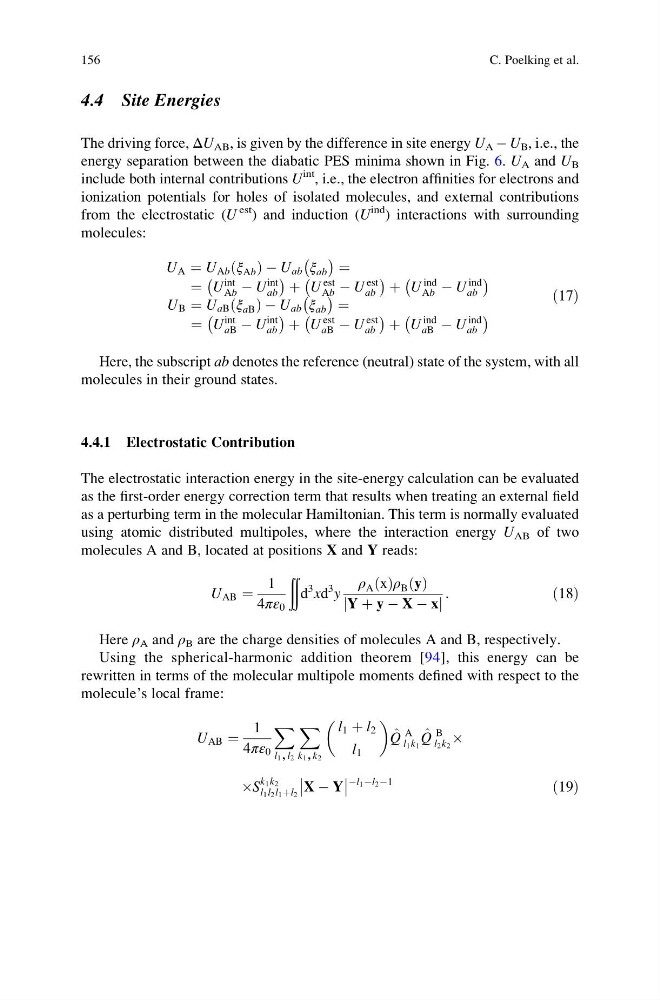
The driving force, ΔU AB , is given by the difference in site energy U A À U B , i.e., the
energy separation between the diabatic PES minima shown in Fig. 6. U A and U B
include both internal contributions U
int , i.e., the electron affinities for electrons and
ionization potentials for holes of isolated molecules, and external contributions
from the electrostatic (U
est ) and induction (U
ind ) interactions with surrounding
molecules:
U A ¼ U Ab ξ Ab
ð ÞÀU ab
À ξ ab
Á ¼
¼ U
int
Ab À U
int
ab
À
Á þ
À
U
est
Ab À U
est
ab
Á þ
À
U
ind
Ab À U
ind
ab
Á
U B ¼ U aB ξ aB
ð ÞÀU ab
À ξ ab
Á ¼
¼ U
int
aB À U
int
ab
À
Á þ
À
U
est
aB À U
est
ab
Á þ
À
U
ind
aB À U
ind
ab
Á
ð17Þ
Here, the subscript ab denotes the reference (neutral) state of the system, with all
molecules in their ground states.
4.4.1 Electrostatic Contribution
The electrostatic interaction energy in the site-energy calculation can be evaluated
as the first-order energy correction term that results when treating an external field
as a perturbing term in the molecular Hamiltonian. This term is normally evaluated
using atomic distributed multipoles, where the interaction energy U AB of two
molecules A and B, located at positions X and Y reads:
U AB ¼
1
4πε 0
ðð
d
3 xd
3 y
ρ A x
ð Þρ B y
ð Þ
Y þ y À X À x
j
j
:
ð18Þ
Here ρ A and ρ B are the charge densities of molecules A and B, respectively.
Using the spherical-harmonic addition theorem [94], this energy can be
rewritten in terms of the molecular multipole moments defined with respect to the
molecule’s local frame:
U AB ¼
1
4πε 0
X
l 1 , l 2
X
k 1 , k 2
l 1 þ l 2
l 1
^
Q
A
l 1 k 1
^
Q
B
l 2 k 2
Â
ÂS
k 1 k 2
l 1 l 2 l 1 þl 2
X À Y
Àl 1 Àl 2 À1
ð19Þ
156
C. Poelking et al.
The driving force, ΔU AB , is given by the difference in site energy U A À U B , i.e., the
energy separation between the diabatic PES minima shown in Fig. 6. U A and U B
include both internal contributions U
int , i.e., the electron affinities for electrons and
ionization potentials for holes of isolated molecules, and external contributions
from the electrostatic (U
est ) and induction (U
ind ) interactions with surrounding
molecules:
U A ¼ U Ab ξ Ab
ð ÞÀU ab
À ξ ab
Á ¼
¼ U
int
Ab À U
int
ab
À
Á þ
À
U
est
Ab À U
est
ab
Á þ
À
U
ind
Ab À U
ind
ab
Á
U B ¼ U aB ξ aB
ð ÞÀU ab
À ξ ab
Á ¼
¼ U
int
aB À U
int
ab
À
Á þ
À
U
est
aB À U
est
ab
Á þ
À
U
ind
aB À U
ind
ab
Á
ð17Þ
Here, the subscript ab denotes the reference (neutral) state of the system, with all
molecules in their ground states.
4.4.1 Electrostatic Contribution
The electrostatic interaction energy in the site-energy calculation can be evaluated
as the first-order energy correction term that results when treating an external field
as a perturbing term in the molecular Hamiltonian. This term is normally evaluated
using atomic distributed multipoles, where the interaction energy U AB of two
molecules A and B, located at positions X and Y reads:
U AB ¼
1
4πε 0
ðð
d
3 xd
3 y
ρ A x
ð Þρ B y
ð Þ
Y þ y À X À x
j
j
:
ð18Þ
Here ρ A and ρ B are the charge densities of molecules A and B, respectively.
Using the spherical-harmonic addition theorem [94], this energy can be
rewritten in terms of the molecular multipole moments defined with respect to the
molecule’s local frame:
U AB ¼
1
4πε 0
X
l 1 , l 2
X
k 1 , k 2
l 1 þ l 2
l 1
^
Q
A
l 1 k 1
^
Q
B
l 2 k 2
Â
ÂS
k 1 k 2
l 1 l 2 l 1 þl 2
X À Y
Àl 1 Àl 2 À1
ð19Þ
156
C. Poelking et al.