

into the respective coordinate frames of the thiophenes. The electronic coupling
elements are calculated for each molecular pair (ij) from the neighbor list using the
semi-empirical ZINDO method [88–90]. A pair of molecules is added to the list of
neighbors if the distance between the centers-of-mass of any of the thiophene
groups is below a cut-off of 0.5 nm. This small, fragment-based cut-off ensures
that only nearest neighbors are added to the neighbor list.
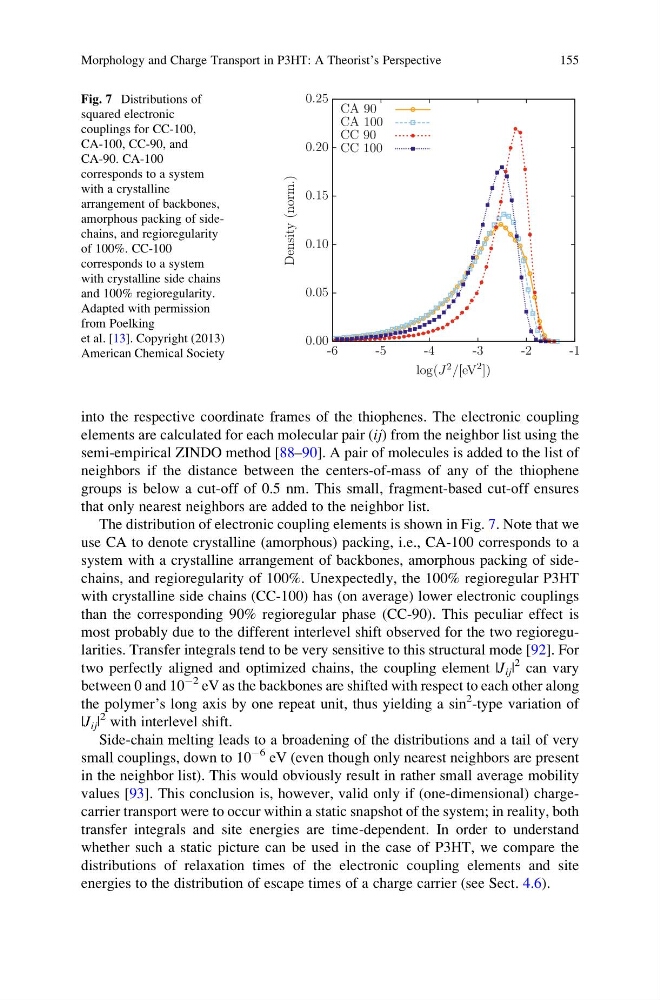
The distribution of electronic coupling elements is shown in Fig. 7. Note that we
use CA to denote crystalline (amorphous) packing, i.e., CA-100 corresponds to a
system with a crystalline arrangement of backbones, amorphous packing of sidechains, and regioregularity of 100%. Unexpectedly, the 100% regioregular P3HT
with crystalline side chains (CC-100) has (on average) lower electronic couplings
than the corresponding 90% regioregular phase (CC-90). This peculiar effect is
most probably due to the different interlevel shift observed for the two regioregularities. Transfer integrals tend to be very sensitive to this structural mode [92]. For
two perfectly aligned and optimized chains, the coupling element |J ij |
2 can vary
between 0 and 10
À2 eV as the backbones are shifted with respect to each other along
the polymer’s long axis by one repeat unit, thus yielding a sin
2 -type variation of
|J ij |
2 with interlevel shift.
Side-chain melting leads to a broadening of the distributions and a tail of very
small couplings, down to 10
À6 eV (even though only nearest neighbors are present
in the neighbor list). This would obviously result in rather small average mobility
values [93]. This conclusion is, however, valid only if (one-dimensional) chargecarrier transport were to occur within a static snapshot of the system; in reality, both
transfer integrals and site energies are time-dependent. In order to understand
whether such a static picture can be used in the case of P3HT, we compare the
distributions of relaxation times of the electronic coupling elements and site
energies to the distribution of escape times of a charge carrier (see Sect. 4.6).
Fig. 7 Distributions of
squared electronic
couplings for CC-100,
CA-100, CC-90, and
CA-90. CA-100
corresponds to a system
with a crystalline
arrangement of backbones,
amorphous packing of sidechains, and regioregularity
of 100%. CC-100
corresponds to a system
with crystalline side chains
and 100% regioregularity.
Adapted with permission
from Poelking
et al. [13]. Copyright (2013)
American Chemical Society
Morphology and Charge Transport in P3HT: A Theorist’s Perspective
155
elements are calculated for each molecular pair (ij) from the neighbor list using the
semi-empirical ZINDO method [88–90]. A pair of molecules is added to the list of
neighbors if the distance between the centers-of-mass of any of the thiophene
groups is below a cut-off of 0.5 nm. This small, fragment-based cut-off ensures
that only nearest neighbors are added to the neighbor list.
The distribution of electronic coupling elements is shown in Fig. 7. Note that we
use CA to denote crystalline (amorphous) packing, i.e., CA-100 corresponds to a
system with a crystalline arrangement of backbones, amorphous packing of sidechains, and regioregularity of 100%. Unexpectedly, the 100% regioregular P3HT
with crystalline side chains (CC-100) has (on average) lower electronic couplings
than the corresponding 90% regioregular phase (CC-90). This peculiar effect is
most probably due to the different interlevel shift observed for the two regioregularities. Transfer integrals tend to be very sensitive to this structural mode [92]. For
two perfectly aligned and optimized chains, the coupling element |J ij |
2 can vary
between 0 and 10
À2 eV as the backbones are shifted with respect to each other along
the polymer’s long axis by one repeat unit, thus yielding a sin
2 -type variation of
|J ij |
2 with interlevel shift.
Side-chain melting leads to a broadening of the distributions and a tail of very
small couplings, down to 10
À6 eV (even though only nearest neighbors are present
in the neighbor list). This would obviously result in rather small average mobility
values [93]. This conclusion is, however, valid only if (one-dimensional) chargecarrier transport were to occur within a static snapshot of the system; in reality, both
transfer integrals and site energies are time-dependent. In order to understand
whether such a static picture can be used in the case of P3HT, we compare the
distributions of relaxation times of the electronic coupling elements and site
energies to the distribution of escape times of a charge carrier (see Sect. 4.6).
Fig. 7 Distributions of
squared electronic
couplings for CC-100,
CA-100, CC-90, and
CA-90. CA-100
corresponds to a system
with a crystalline
arrangement of backbones,
amorphous packing of sidechains, and regioregularity
of 100%. CC-100
corresponds to a system
with crystalline side chains
and 100% regioregularity.
Adapted with permission
from Poelking
et al. [13]. Copyright (2013)
American Chemical Society
Morphology and Charge Transport in P3HT: A Theorist’s Perspective
155