

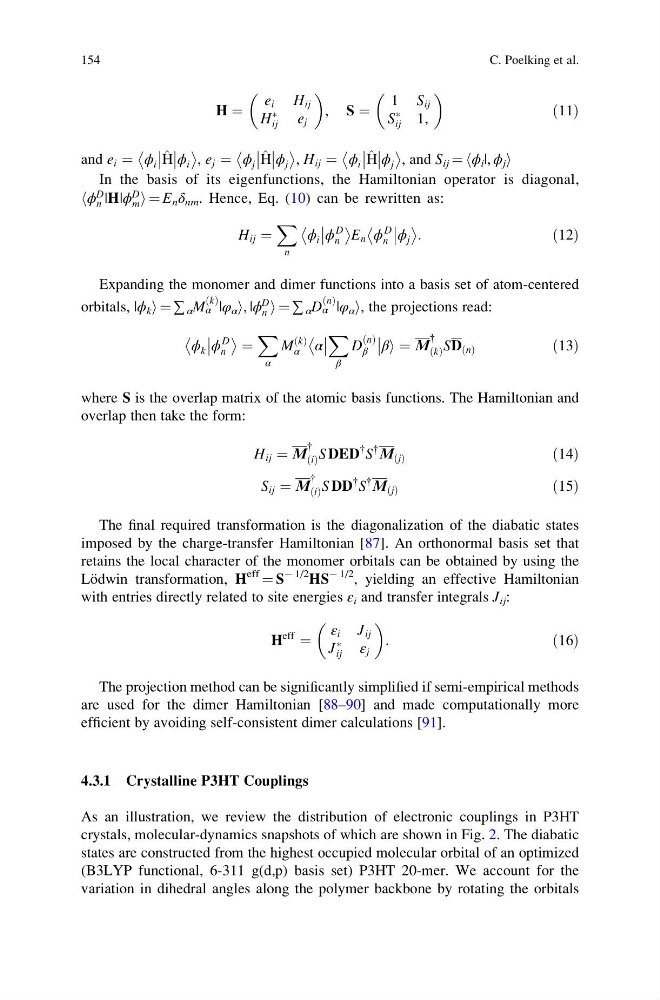
H ¼
e i H ij
H
Ã
ij
e j
, S ¼
1 S ij
S
Ã
ij
1,
ð11Þ
and e i ¼ ϕ i
^ H
ϕ i
, e j ¼ ϕ j
^ H
ϕ j
, H ij ¼ ϕ i
^ H
ϕ j
, and S ij ¼ hϕ i |, ϕ j i
In the basis of its eigenfunctions, the Hamiltonian operator is diagonal,
hϕ
D
n |H|ϕ
D
m i ¼ E n δ nm . Hence, Eq. (10) can be rewritten as:
H ij ¼
X
n
ϕ i
ϕ
D
n
E n ϕ
D
n
ϕ j
:
ð12Þ
Expanding the monomer and dimer functions into a basis set of atom-centered
orbitals, |ϕ k i ¼ ∑ α M
ðkÞ
α |φ α i, |ϕ
D
n i ¼ ∑ α D
ðnÞ
α |φ α i, the projections read:
ϕ k
ϕ
D
n
¼
X
α
M
k
ð Þ
α α
X
β
D
n
ð Þ
β
βi ¼ M
{
k
ð Þ SD n
ð Þ
ð13Þ
where S is the overlap matrix of the atomic basis functions. The Hamiltonian and
overlap then take the form:
H ij ¼ M
{
i
ð Þ S DED
{ S
{
M j
ð Þ
ð14Þ
S ij ¼ M
{
i
ð Þ S DD
{ S
{
M j
ð Þ
ð15Þ
The final required transformation is the diagonalization of the diabatic states
imposed by the charge-transfer Hamiltonian [87]. An orthonormal basis set that
retains the local character of the monomer orbitals can be obtained by using the
Lo ¨dwin transformation, H
eff
¼ S
À 1/2 HS
À 1/2 , yielding an effective Hamiltonian
with entries directly related to site energies ε i and transfer integrals J ij :
H
eff
¼
ε i J ij
J
Ã
ij
ε j
:
ð16Þ
The projection method can be significantly simplified if semi-empirical methods
are used for the dimer Hamiltonian [88–90] and made computationally more
efficient by avoiding self-consistent dimer calculations [91].
4.3.1 Crystalline P3HT Couplings
As an illustration, we review the distribution of electronic couplings in P3HT
crystals, molecular-dynamics snapshots of which are shown in Fig. 2. The diabatic
states are constructed from the highest occupied molecular orbital of an optimized
(B3LYP functional, 6-311 g(d,p) basis set) P3HT 20-mer. We account for the
variation in dihedral angles along the polymer backbone by rotating the orbitals
154
C. Poelking et al.
e i H ij
H
Ã
ij
e j
, S ¼
1 S ij
S
Ã
ij
1,
ð11Þ
and e i ¼ ϕ i
^ H
ϕ i
, e j ¼ ϕ j
^ H
ϕ j
, H ij ¼ ϕ i
^ H
ϕ j
, and S ij ¼ hϕ i |, ϕ j i
In the basis of its eigenfunctions, the Hamiltonian operator is diagonal,
hϕ
D
n |H|ϕ
D
m i ¼ E n δ nm . Hence, Eq. (10) can be rewritten as:
H ij ¼
X
n
ϕ i
ϕ
D
n
E n ϕ
D
n
ϕ j
:
ð12Þ
Expanding the monomer and dimer functions into a basis set of atom-centered
orbitals, |ϕ k i ¼ ∑ α M
ðkÞ
α |φ α i, |ϕ
D
n i ¼ ∑ α D
ðnÞ
α |φ α i, the projections read:
ϕ k
ϕ
D
n
¼
X
α
M
k
ð Þ
α α
X
β
D
n
ð Þ
β
βi ¼ M
{
k
ð Þ SD n
ð Þ
ð13Þ
where S is the overlap matrix of the atomic basis functions. The Hamiltonian and
overlap then take the form:
H ij ¼ M
{
i
ð Þ S DED
{ S
{
M j
ð Þ
ð14Þ
S ij ¼ M
{
i
ð Þ S DD
{ S
{
M j
ð Þ
ð15Þ
The final required transformation is the diagonalization of the diabatic states
imposed by the charge-transfer Hamiltonian [87]. An orthonormal basis set that
retains the local character of the monomer orbitals can be obtained by using the
Lo ¨dwin transformation, H
eff
¼ S
À 1/2 HS
À 1/2 , yielding an effective Hamiltonian
with entries directly related to site energies ε i and transfer integrals J ij :
H
eff
¼
ε i J ij
J
Ã
ij
ε j
:
ð16Þ
The projection method can be significantly simplified if semi-empirical methods
are used for the dimer Hamiltonian [88–90] and made computationally more
efficient by avoiding self-consistent dimer calculations [91].
4.3.1 Crystalline P3HT Couplings
As an illustration, we review the distribution of electronic couplings in P3HT
crystals, molecular-dynamics snapshots of which are shown in Fig. 2. The diabatic
states are constructed from the highest occupied molecular orbital of an optimized
(B3LYP functional, 6-311 g(d,p) basis set) P3HT 20-mer. We account for the
variation in dihedral angles along the polymer backbone by rotating the orbitals
154
C. Poelking et al.