

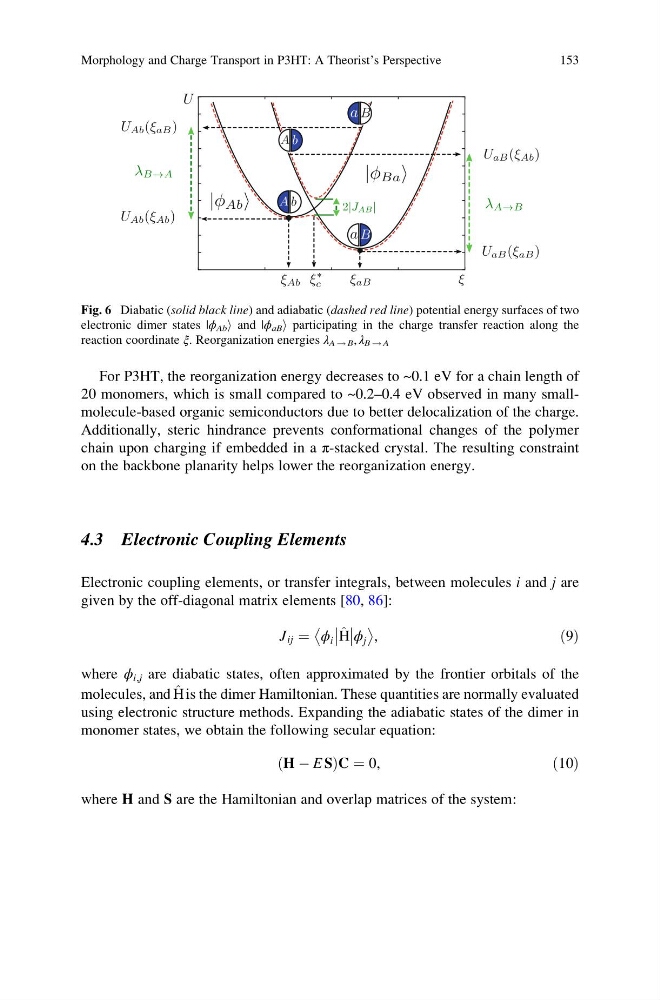
For P3HT, the reorganization energy decreases to ~0.1 eV for a chain length of
20 monomers, which is small compared to ~0.2–0.4 eV observed in many smallmolecule-based organic semiconductors due to better delocalization of the charge.
Additionally, steric hindrance prevents conformational changes of the polymer
chain upon charging if embedded in a π-stacked crystal. The resulting constraint
on the backbone planarity helps lower the reorganization energy.
4.3 Electronic Coupling Elements
Electronic coupling elements, or transfer integrals, between molecules i and j are
given by the off-diagonal matrix elements [80, 86]:
J ij ¼ ϕ i
^ H
ϕ j
,
ð9Þ
where ϕ i,j are diabatic states, often approximated by the frontier orbitals of the
molecules, and ^
H is the dimer Hamiltonian. These quantities are normally evaluated
using electronic structure methods. Expanding the adiabatic states of the dimer in
monomer states, we obtain the following secular equation:
H À E S
ð
Þ C ¼ 0,
ð10Þ
where H and S are the Hamiltonian and overlap matrices of the system:
Fig. 6 Diabatic (solid black line) and adiabatic (dashed red line) potential energy surfaces of two
electronic dimer states |ϕ Ab i and |ϕ aB i participating in the charge transfer reaction along the
reaction coordinate ξ. Reorganization energies λ A ! B , λ B ! A
Morphology and Charge Transport in P3HT: A Theorist’s Perspective
153
20 monomers, which is small compared to ~0.2–0.4 eV observed in many smallmolecule-based organic semiconductors due to better delocalization of the charge.
Additionally, steric hindrance prevents conformational changes of the polymer
chain upon charging if embedded in a π-stacked crystal. The resulting constraint
on the backbone planarity helps lower the reorganization energy.
4.3 Electronic Coupling Elements
Electronic coupling elements, or transfer integrals, between molecules i and j are
given by the off-diagonal matrix elements [80, 86]:
J ij ¼ ϕ i
^ H
ϕ j
,
ð9Þ
where ϕ i,j are diabatic states, often approximated by the frontier orbitals of the
molecules, and ^
H is the dimer Hamiltonian. These quantities are normally evaluated
using electronic structure methods. Expanding the adiabatic states of the dimer in
monomer states, we obtain the following secular equation:
H À E S
ð
Þ C ¼ 0,
ð10Þ
where H and S are the Hamiltonian and overlap matrices of the system:
Fig. 6 Diabatic (solid black line) and adiabatic (dashed red line) potential energy surfaces of two
electronic dimer states |ϕ Ab i and |ϕ aB i participating in the charge transfer reaction along the
reaction coordinate ξ. Reorganization energies λ A ! B , λ B ! A
Morphology and Charge Transport in P3HT: A Theorist’s Perspective
153