

distribution, currents, and eventually mobility, all as a function of temperature,
external field, charge density, and, importantly, morphology. Here we will start
with the charge transfer rate and introduce microscopic quantities that affect charge
dynamics.
4.1 Rates
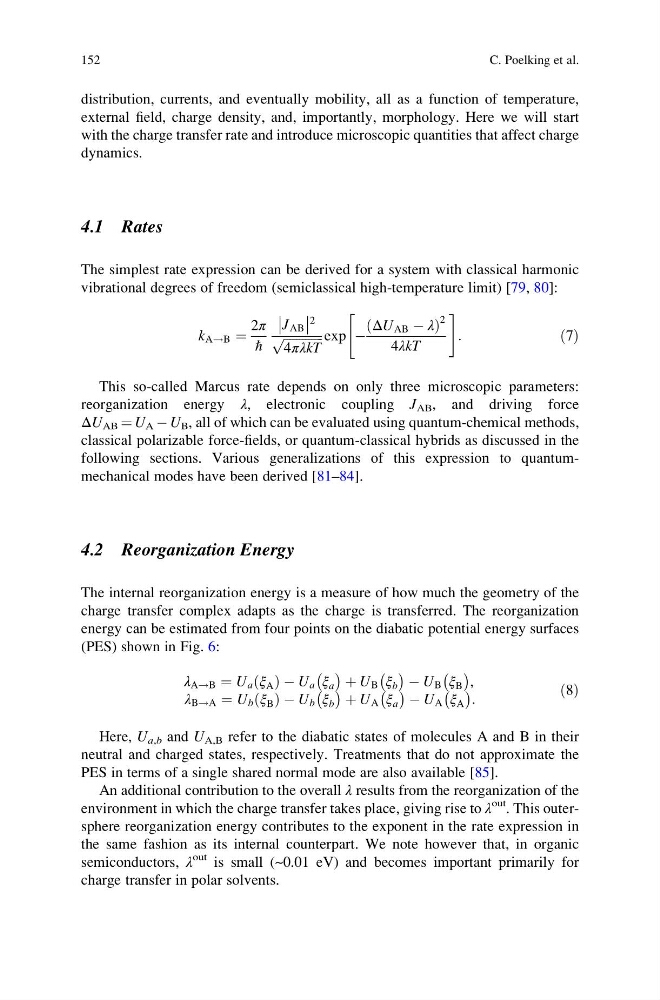
The simplest rate expression can be derived for a system with classical harmonic
vibrational degrees of freedom (semiclassical high-temperature limit) [79, 80]:
k A!B ¼
2π
ℏ
J AB
2
ffiffiffiffiffiffiffiffiffiffiffiffi ffi
4πλkT
p
exp À
ΔU AB À λ
ð
Þ
2
4λkT
!
:
"
ð7Þ
This so-called Marcus rate depends on only three microscopic parameters:
reorganization energy λ, electronic coupling J AB , and driving force
ΔU AB ¼ U A À U B , all of which can be evaluated using quantum-chemical methods,
classical polarizable force-fields, or quantum-classical hybrids as discussed in the
following sections. Various generalizations of this expression to quantummechanical modes have been derived [81–84].
4.2 Reorganization Energy
The internal reorganization energy is a measure of how much the geometry of the
charge transfer complex adapts as the charge is transferred. The reorganization
energy can be estimated from four points on the diabatic potential energy surfaces
(PES) shown in Fig. 6:
λ A!B ¼ U a ξ A
ð Þ À U a
À
ξ a
Á þ U B
À ξ b
Á À U B
À ξ B
Á
,
λ B!A ¼ U b ξ B
ð Þ À U b
À
ξ b
Á þ U A
À
ξ a
Á À U A
À ξ A
Á
:
ð8Þ
Here, U a,b and U A,B refer to the diabatic states of molecules A and B in their
neutral and charged states, respectively. Treatments that do not approximate the
PES in terms of a single shared normal mode are also available [85].
An additional contribution to the overall λ results from the reorganization of the
environment in which the charge transfer takes place, giving rise to λ
out . This outersphere reorganization energy contributes to the exponent in the rate expression in
the same fashion as its internal counterpart. We note however that, in organic
semiconductors, λ
out is small (~0.01 eV) and becomes important primarily for
charge transfer in polar solvents.
152
C. Poelking et al.
external field, charge density, and, importantly, morphology. Here we will start
with the charge transfer rate and introduce microscopic quantities that affect charge
dynamics.
4.1 Rates
The simplest rate expression can be derived for a system with classical harmonic
vibrational degrees of freedom (semiclassical high-temperature limit) [79, 80]:
k A!B ¼
2π
ℏ
J AB
2
ffiffiffiffiffiffiffiffiffiffiffiffi ffi
4πλkT
p
exp À
ΔU AB À λ
ð
Þ
2
4λkT
!
:
"
ð7Þ
This so-called Marcus rate depends on only three microscopic parameters:
reorganization energy λ, electronic coupling J AB , and driving force
ΔU AB ¼ U A À U B , all of which can be evaluated using quantum-chemical methods,
classical polarizable force-fields, or quantum-classical hybrids as discussed in the
following sections. Various generalizations of this expression to quantummechanical modes have been derived [81–84].
4.2 Reorganization Energy
The internal reorganization energy is a measure of how much the geometry of the
charge transfer complex adapts as the charge is transferred. The reorganization
energy can be estimated from four points on the diabatic potential energy surfaces
(PES) shown in Fig. 6:
λ A!B ¼ U a ξ A
ð Þ À U a
À
ξ a
Á þ U B
À ξ b
Á À U B
À ξ B
Á
,
λ B!A ¼ U b ξ B
ð Þ À U b
À
ξ b
Á þ U A
À
ξ a
Á À U A
À ξ A
Á
:
ð8Þ
Here, U a,b and U A,B refer to the diabatic states of molecules A and B in their
neutral and charged states, respectively. Treatments that do not approximate the
PES in terms of a single shared normal mode are also available [85].
An additional contribution to the overall λ results from the reorganization of the
environment in which the charge transfer takes place, giving rise to λ
out . This outersphere reorganization energy contributes to the exponent in the rate expression in
the same fashion as its internal counterpart. We note however that, in organic
semiconductors, λ
out is small (~0.01 eV) and becomes important primarily for
charge transfer in polar solvents.
152
C. Poelking et al.