

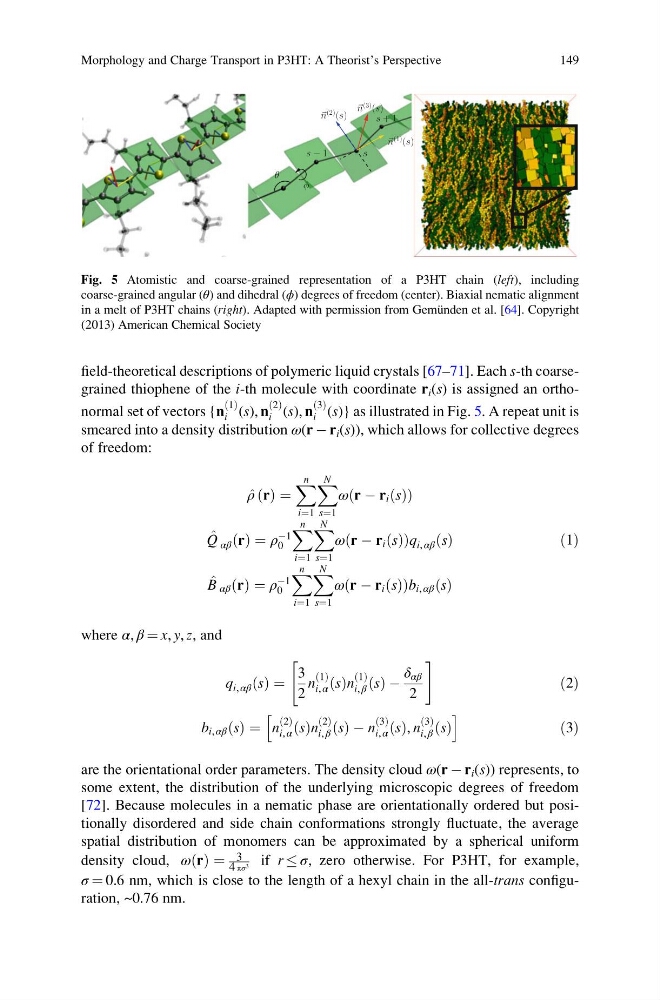
field-theoretical descriptions of polymeric liquid crystals [67–71]. Each s-th coarsegrained thiophene of the i-th molecule with coordinate r i (s) is assigned an orthonormal set of vectors {n
ð1Þ
i (s), n
ð2Þ
i (s), n
ð3Þ
i (s)} as illustrated in Fig. 5. A repeat unit is
smeared into a density distribution ω(r À r i (s)), which allows for collective degrees
of freedom:
^
ρ r
ð Þ ¼
X n
i¼1
X N
s¼1
ω r À r i s
ð Þ
ð
Þ
^
Q αβ r
ð Þ ¼ ρ
À1
0
X n
i¼1
X N
s¼1
ω r À r i s
ð Þ
ð
Þ q i, αβ s
ð Þ
^
B αβ r
ð Þ ¼ ρ
À1
0
X n
i¼1
X N
s¼1
ω r À r i s
ð Þ
ð
Þ b i, αβ s
ð Þ
ð1Þ
where α, β ¼ x, y, z, and
q i, αβ s
ð Þ ¼
3
2
n
1
ð Þ
i, α s
ð Þn
1
ð Þ
i, β s
ð Þ À
δ αβ
2
!
"
ð2Þ
b i, αβ s
ð Þ ¼ n
2
ð Þ
i, α s
ð Þn
2
ð Þ
i, β s
ð Þ À n
3
ð Þ
i, α s
ð Þ, n
3
ð Þ
i, β s
ð Þ
h
i
ð3Þ
are the orientational order parameters. The density cloud ω(r À r i (s)) represents, to
some extent, the distribution of the underlying microscopic degrees of freedom
[72]. Because molecules in a nematic phase are orientationally ordered but positionally disordered and side chain conformations strongly fluctuate, the average
spatial distribution of monomers can be approximated by a spherical uniform
density cloud, ω r
ð Þ ¼ 3
4 πσ 3 if r σ, zero otherwise. For P3HT, for example,
σ ¼ 0.6 nm, which is close to the length of a hexyl chain in the all-trans configuration, ~0.76 nm.
s − 1
θ
s
s + 1
n
(1) (s)
n
(3) (s)
n
(2) (s)
φ
Fig. 5 Atomistic and coarse-grained representation of a P3HT chain (left), including
coarse-grained angular (θ) and dihedral (ϕ) degrees of freedom (center). Biaxial nematic alignment
in a melt of P3HT chains (right). Adapted with permission from Gemu ¨nden et al. [64]. Copyright
(2013) American Chemical Society
Morphology and Charge Transport in P3HT: A Theorist’s Perspective
149
ð1Þ
i (s), n
ð2Þ
i (s), n
ð3Þ
i (s)} as illustrated in Fig. 5. A repeat unit is
smeared into a density distribution ω(r À r i (s)), which allows for collective degrees
of freedom:
^
ρ r
ð Þ ¼
X n
i¼1
X N
s¼1
ω r À r i s
ð Þ
ð
Þ
^
Q αβ r
ð Þ ¼ ρ
À1
0
X n
i¼1
X N
s¼1
ω r À r i s
ð Þ
ð
Þ q i, αβ s
ð Þ
^
B αβ r
ð Þ ¼ ρ
À1
0
X n
i¼1
X N
s¼1
ω r À r i s
ð Þ
ð
Þ b i, αβ s
ð Þ
ð1Þ
where α, β ¼ x, y, z, and
q i, αβ s
ð Þ ¼
3
2
n
1
ð Þ
i, α s
ð Þn
1
ð Þ
i, β s
ð Þ À
δ αβ
2
!
"
ð2Þ
b i, αβ s
ð Þ ¼ n
2
ð Þ
i, α s
ð Þn
2
ð Þ
i, β s
ð Þ À n
3
ð Þ
i, α s
ð Þ, n
3
ð Þ
i, β s
ð Þ
h
i
ð3Þ
are the orientational order parameters. The density cloud ω(r À r i (s)) represents, to
some extent, the distribution of the underlying microscopic degrees of freedom
[72]. Because molecules in a nematic phase are orientationally ordered but positionally disordered and side chain conformations strongly fluctuate, the average
spatial distribution of monomers can be approximated by a spherical uniform
density cloud, ω r
ð Þ ¼ 3
4 πσ 3 if r σ, zero otherwise. For P3HT, for example,
σ ¼ 0.6 nm, which is close to the length of a hexyl chain in the all-trans configuration, ~0.76 nm.
s − 1
θ
s
s + 1
n
(1) (s)
n
(3) (s)
n
(2) (s)
φ
Fig. 5 Atomistic and coarse-grained representation of a P3HT chain (left), including
coarse-grained angular (θ) and dihedral (ϕ) degrees of freedom (center). Biaxial nematic alignment
in a melt of P3HT chains (right). Adapted with permission from Gemu ¨nden et al. [64]. Copyright
(2013) American Chemical Society
Morphology and Charge Transport in P3HT: A Theorist’s Perspective
149