

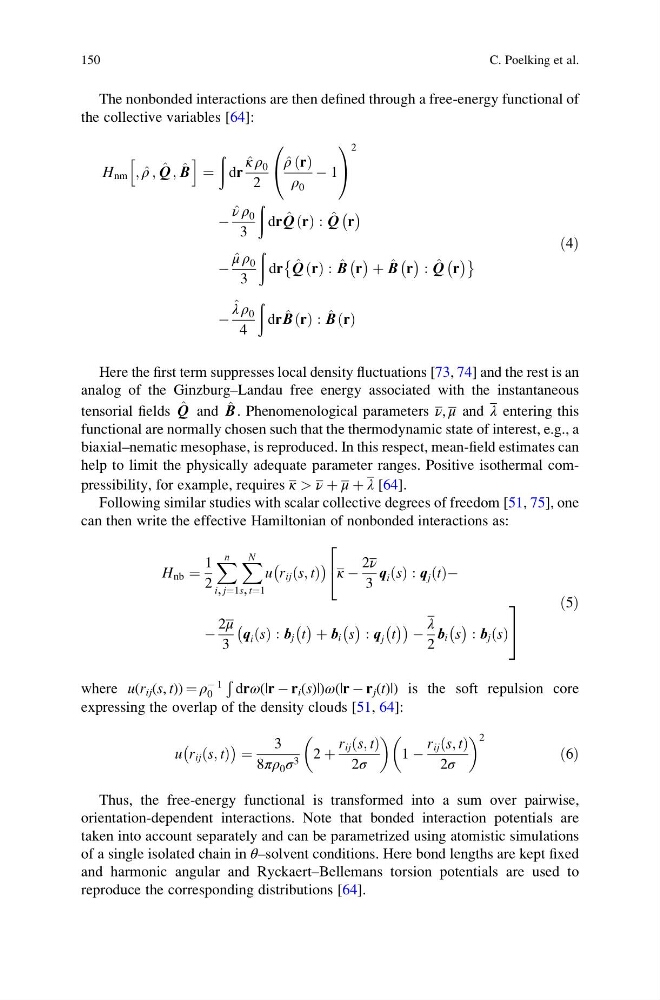
The nonbonded interactions are then defined through a free-energy functional of
the collective variables [64]:
H nm ; ^
ρ ; ^
Q ; ^
B
h
i
¼
ð
dr
^
κ ρ 0
2
^
ρ r
ð Þ
ρ 0
À 1
0
@
1
A
2
À
^
ν ρ 0
3
ð
dr ^
Q r
ð Þ : ^
Q
À
r
Á
À
^
μ ρ 0
3
ð
dr
È ^
Q r
ð Þ : ^
B
À
r
Á þ ^
B
À
r
Á : ^
Q
À
r
ÁÉ
À
^
λ ρ 0
4
ð
dr ^
B r
ð Þ : ^
B r
ð Þ
ð4Þ
Here the first term suppresses local density fluctuations [73, 74] and the rest is an
analog of the Ginzburg–Landau free energy associated with the instantaneous
tensorial fields ^
Q and ^
B . Phenomenological parameters ν, μ and λ entering this
functional are normally chosen such that the thermodynamic state of interest, e.g., a
biaxial–nematic mesophase, is reproduced. In this respect, mean-field estimates can
help to limit the physically adequate parameter ranges. Positive isothermal compressibility, for example, requires κ > ν þ μ þ λ [64].
Following similar studies with scalar collective degrees of freedom [51, 75], one
can then write the effective Hamiltonian of nonbonded interactions as:
H nb ¼
1
2
X n
i, j¼1
X N
s, t¼1
u r ij s; t
ð Þ
À
Á κ À
2ν
3
q i s
ð Þ : q j t
ð ÞÀ
2
4
À
2μ
3
À q i s
ð Þ : b j
À
t
Á þ b i
À
s
Á : q j
À
t
ÁÁ À
λ
2
b i
À
s
Á : b j s
ð Þ
!
ð5Þ
where u(r ij (s, t)) ¼ ρ
À 1
0
Ð
drω(|r À r i (s)|)ω(|r À r j (t)|) is the soft repulsion core
expressing the overlap of the density clouds [51, 64]:
u r ij s; t
ð Þ
À
Á ¼
3
8πρ 0 σ 3 2 þ
r ij s; t
ð Þ
2σ
1 À
r ij s; t
ð Þ
2σ
2
ð6Þ
Thus, the free-energy functional is transformed into a sum over pairwise,
orientation-dependent interactions. Note that bonded interaction potentials are
taken into account separately and can be parametrized using atomistic simulations
of a single isolated chain in θ–solvent conditions. Here bond lengths are kept fixed
and harmonic angular and Ryckaert–Bellemans torsion potentials are used to
reproduce the corresponding distributions [64].
150
C. Poelking et al.
the collective variables [64]:
H nm ; ^
ρ ; ^
Q ; ^
B
h
i
¼
ð
dr
^
κ ρ 0
2
^
ρ r
ð Þ
ρ 0
À 1
0
@
1
A
2
À
^
ν ρ 0
3
ð
dr ^
Q r
ð Þ : ^
Q
À
r
Á
À
^
μ ρ 0
3
ð
dr
È ^
Q r
ð Þ : ^
B
À
r
Á þ ^
B
À
r
Á : ^
Q
À
r
ÁÉ
À
^
λ ρ 0
4
ð
dr ^
B r
ð Þ : ^
B r
ð Þ
ð4Þ
Here the first term suppresses local density fluctuations [73, 74] and the rest is an
analog of the Ginzburg–Landau free energy associated with the instantaneous
tensorial fields ^
Q and ^
B . Phenomenological parameters ν, μ and λ entering this
functional are normally chosen such that the thermodynamic state of interest, e.g., a
biaxial–nematic mesophase, is reproduced. In this respect, mean-field estimates can
help to limit the physically adequate parameter ranges. Positive isothermal compressibility, for example, requires κ > ν þ μ þ λ [64].
Following similar studies with scalar collective degrees of freedom [51, 75], one
can then write the effective Hamiltonian of nonbonded interactions as:
H nb ¼
1
2
X n
i, j¼1
X N
s, t¼1
u r ij s; t
ð Þ
À
Á κ À
2ν
3
q i s
ð Þ : q j t
ð ÞÀ
2
4
À
2μ
3
À q i s
ð Þ : b j
À
t
Á þ b i
À
s
Á : q j
À
t
ÁÁ À
λ
2
b i
À
s
Á : b j s
ð Þ
!
ð5Þ
where u(r ij (s, t)) ¼ ρ
À 1
0
Ð
drω(|r À r i (s)|)ω(|r À r j (t)|) is the soft repulsion core
expressing the overlap of the density clouds [51, 64]:
u r ij s; t
ð Þ
À
Á ¼
3
8πρ 0 σ 3 2 þ
r ij s; t
ð Þ
2σ
1 À
r ij s; t
ð Þ
2σ
2
ð6Þ
Thus, the free-energy functional is transformed into a sum over pairwise,
orientation-dependent interactions. Note that bonded interaction potentials are
taken into account separately and can be parametrized using atomistic simulations
of a single isolated chain in θ–solvent conditions. Here bond lengths are kept fixed
and harmonic angular and Ryckaert–Bellemans torsion potentials are used to
reproduce the corresponding distributions [64].
150
C. Poelking et al.