

3.2 Soft Models
The three-site models with explicit beads for side chains are too complex for
simulations of dense systems and long chains. For homopolymer melts, oligomers
of 15 repeat units have been used [59], whereas simulations of P3HT/PCBM blends
employed chains of 48 repeat units [45]. Further reducing the number of degrees of
freedom, e.g., by removing coarse-grained side chains, necessitates orientationally
anisotropic interaction potentials, otherwise even the lamellar order is no longer
produced. In other words, anisotropic interactions are needed to account for the
conformational frustration of side chains and the energetically favorable stacking of
backbones. In this sense, they incorporate entropic and enthalpic contributions to
the free energy of the system.
As the model becomes cruder and cruder, the number of microscopic states that
correspond to the same coarse-grained state increases. As a result, the coarsegrained interaction potentials become softer. This, in combination with the reduction in the degrees of freedom, boosts computational efficiency. At the same time,
the thermodynamic nature of the coarse-grained potentials becomes more prominent and transferability is gradually lost [62]. To remedy the situation, thermodynamic properties of the system can be incorporated into the coarse-grained model
by using (phenomenological) top-down approaches. For conjugated polymers, the
symmetry of the mesophase can be directly included into the anisotropic interaction
potential, as has been shown for liquid crystalline mesophases [63, 64] observed
experimentally in poly[3-(2
0 -ethyl)hexylthiophene] and poly(3-dodecylthiophene)
[65, 66].
In such coarse-grained models, nonbonded interactions are chosen such that the
system possesses a desired phase behavior, e.g., a nematic to isotropic transition.
In practice, one starts with an appropriate density functional, in the spirit of
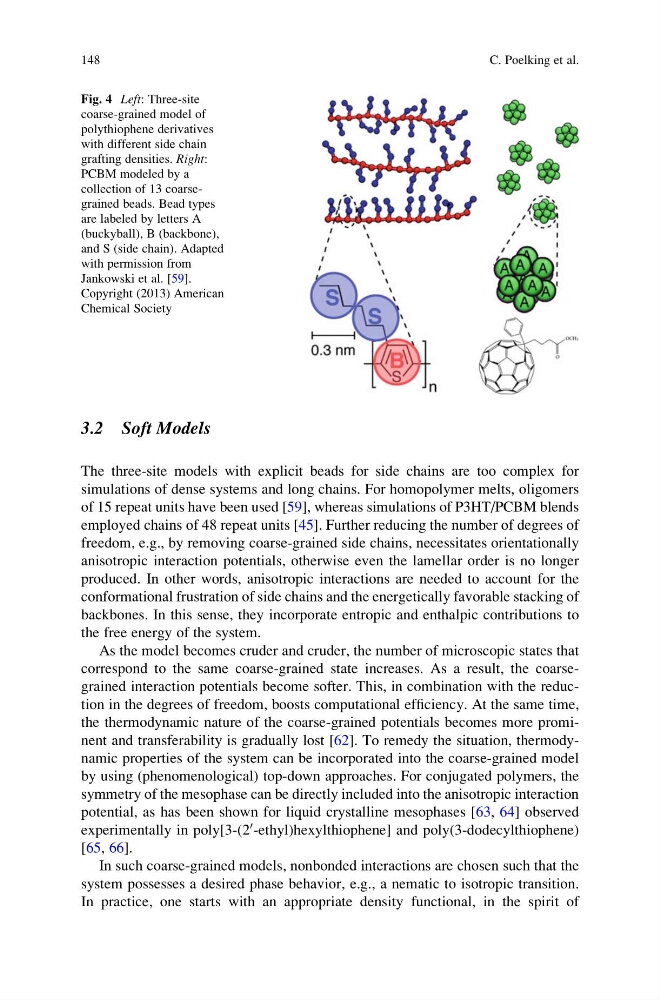
Fig. 4 Left: Three-site
coarse-grained model of
polythiophene derivatives
with different side chain
grafting densities. Right:
PCBM modeled by a
collection of 13 coarsegrained beads. Bead types
are labeled by letters A
(buckyball), B (backbone),
and S (side chain). Adapted
with permission from
Jankowski et al. [59].
Copyright (2013) American
Chemical Society
148
C. Poelking et al.
The three-site models with explicit beads for side chains are too complex for
simulations of dense systems and long chains. For homopolymer melts, oligomers
of 15 repeat units have been used [59], whereas simulations of P3HT/PCBM blends
employed chains of 48 repeat units [45]. Further reducing the number of degrees of
freedom, e.g., by removing coarse-grained side chains, necessitates orientationally
anisotropic interaction potentials, otherwise even the lamellar order is no longer
produced. In other words, anisotropic interactions are needed to account for the
conformational frustration of side chains and the energetically favorable stacking of
backbones. In this sense, they incorporate entropic and enthalpic contributions to
the free energy of the system.
As the model becomes cruder and cruder, the number of microscopic states that
correspond to the same coarse-grained state increases. As a result, the coarsegrained interaction potentials become softer. This, in combination with the reduction in the degrees of freedom, boosts computational efficiency. At the same time,
the thermodynamic nature of the coarse-grained potentials becomes more prominent and transferability is gradually lost [62]. To remedy the situation, thermodynamic properties of the system can be incorporated into the coarse-grained model
by using (phenomenological) top-down approaches. For conjugated polymers, the
symmetry of the mesophase can be directly included into the anisotropic interaction
potential, as has been shown for liquid crystalline mesophases [63, 64] observed
experimentally in poly[3-(2
0 -ethyl)hexylthiophene] and poly(3-dodecylthiophene)
[65, 66].
In such coarse-grained models, nonbonded interactions are chosen such that the
system possesses a desired phase behavior, e.g., a nematic to isotropic transition.
In practice, one starts with an appropriate density functional, in the spirit of
Fig. 4 Left: Three-site
coarse-grained model of
polythiophene derivatives
with different side chain
grafting densities. Right:
PCBM modeled by a
collection of 13 coarsegrained beads. Bead types
are labeled by letters A
(buckyball), B (backbone),
and S (side chain). Adapted
with permission from
Jankowski et al. [59].
Copyright (2013) American
Chemical Society
148
C. Poelking et al.