

with strong π–π stacking and edge-on orientation with respect to the substrate,
resulting in mobilities of up to 0.1 cm
2 V
À1 s
À1 , whereas less regioregular P3HT
(~80%) exhibited face-on orientation and low mobilities of about
2 Â 10
À4 cm
2 V
À1 s
À1 [4, 5]. High regioregularity leads to increased planarization
of the polymer backbone and therefore increased conjugation length, which can be
quantified by the ratio of the 0–0 and 0–1 peaks in the absorption spectrum
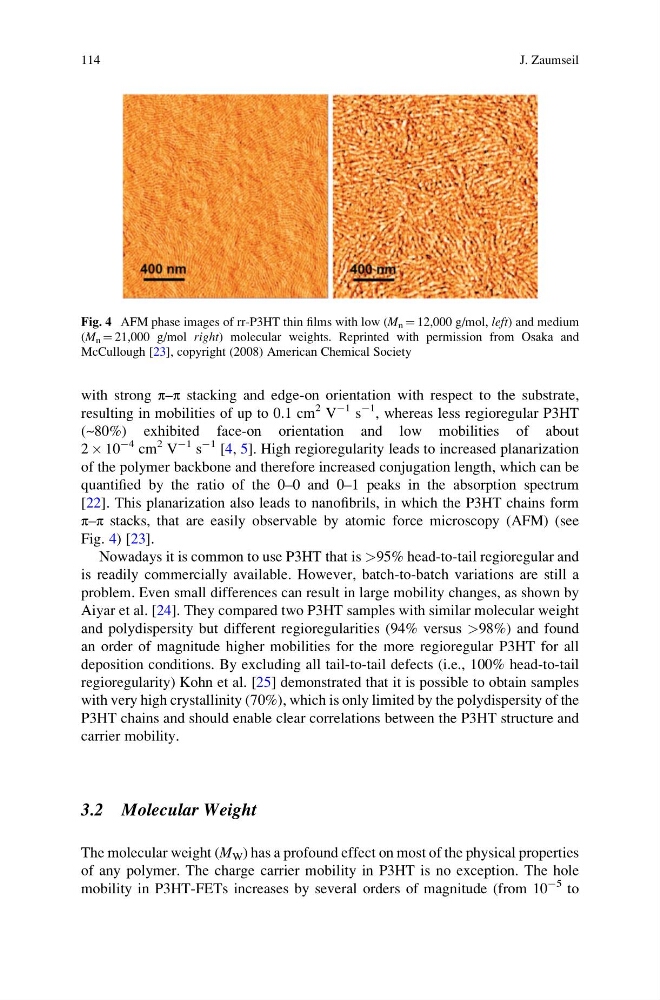
[22]. This planarization also leads to nanofibrils, in which the P3HT chains form
π–π stacks, that are easily observable by atomic force microscopy (AFM) (see
Fig. 4) [23].
Nowadays it is common to use P3HT that is >95% head-to-tail regioregular and
is readily commercially available. However, batch-to-batch variations are still a
problem. Even small differences can result in large mobility changes, as shown by
Aiyar et al. [24]. They compared two P3HT samples with similar molecular weight
and polydispersity but different regioregularities (94% versus >98%) and found
an order of magnitude higher mobilities for the more regioregular P3HT for all
deposition conditions. By excluding all tail-to-tail defects (i.e., 100% head-to-tail
regioregularity) Kohn et al. [25] demonstrated that it is possible to obtain samples
with very high crystallinity (70%), which is only limited by the polydispersity of the
P3HT chains and should enable clear correlations between the P3HT structure and
carrier mobility.
3.2 Molecular Weight
The molecular weight (M W ) has a profound effect on most of the physical properties
of any polymer. The charge carrier mobility in P3HT is no exception. The hole
mobility in P3HT-FETs increases by several orders of magnitude (from 10
À5 to
Fig. 4 AFM phase images of rr-P3HT thin films with low (M n ¼ 12,000 g/mol, left) and medium
(M n ¼ 21,000 g/mol right) molecular weights. Reprinted with permission from Osaka and
McCullough [23], copyright (2008) American Chemical Society
114
J. Zaumseil
resulting in mobilities of up to 0.1 cm
2 V
À1 s
À1 , whereas less regioregular P3HT
(~80%) exhibited face-on orientation and low mobilities of about
2 Â 10
À4 cm
2 V
À1 s
À1 [4, 5]. High regioregularity leads to increased planarization
of the polymer backbone and therefore increased conjugation length, which can be
quantified by the ratio of the 0–0 and 0–1 peaks in the absorption spectrum
[22]. This planarization also leads to nanofibrils, in which the P3HT chains form
π–π stacks, that are easily observable by atomic force microscopy (AFM) (see
Fig. 4) [23].
Nowadays it is common to use P3HT that is >95% head-to-tail regioregular and
is readily commercially available. However, batch-to-batch variations are still a
problem. Even small differences can result in large mobility changes, as shown by
Aiyar et al. [24]. They compared two P3HT samples with similar molecular weight
and polydispersity but different regioregularities (94% versus >98%) and found
an order of magnitude higher mobilities for the more regioregular P3HT for all
deposition conditions. By excluding all tail-to-tail defects (i.e., 100% head-to-tail
regioregularity) Kohn et al. [25] demonstrated that it is possible to obtain samples
with very high crystallinity (70%), which is only limited by the polydispersity of the
P3HT chains and should enable clear correlations between the P3HT structure and
carrier mobility.
3.2 Molecular Weight
The molecular weight (M W ) has a profound effect on most of the physical properties
of any polymer. The charge carrier mobility in P3HT is no exception. The hole
mobility in P3HT-FETs increases by several orders of magnitude (from 10
À5 to
Fig. 4 AFM phase images of rr-P3HT thin films with low (M n ¼ 12,000 g/mol, left) and medium
(M n ¼ 21,000 g/mol right) molecular weights. Reprinted with permission from Osaka and
McCullough [23], copyright (2008) American Chemical Society
114
J. Zaumseil