

long-term stability of P3HT-FETs. Understanding the origin and impact of these
parameters has led to substantial performance improvements in P3HT-FETs, from
the first reports to today’s state-of-the art devices. One of the most compelling
properties of P3HT is its ability to form highly ordered π-stacks and side-chain
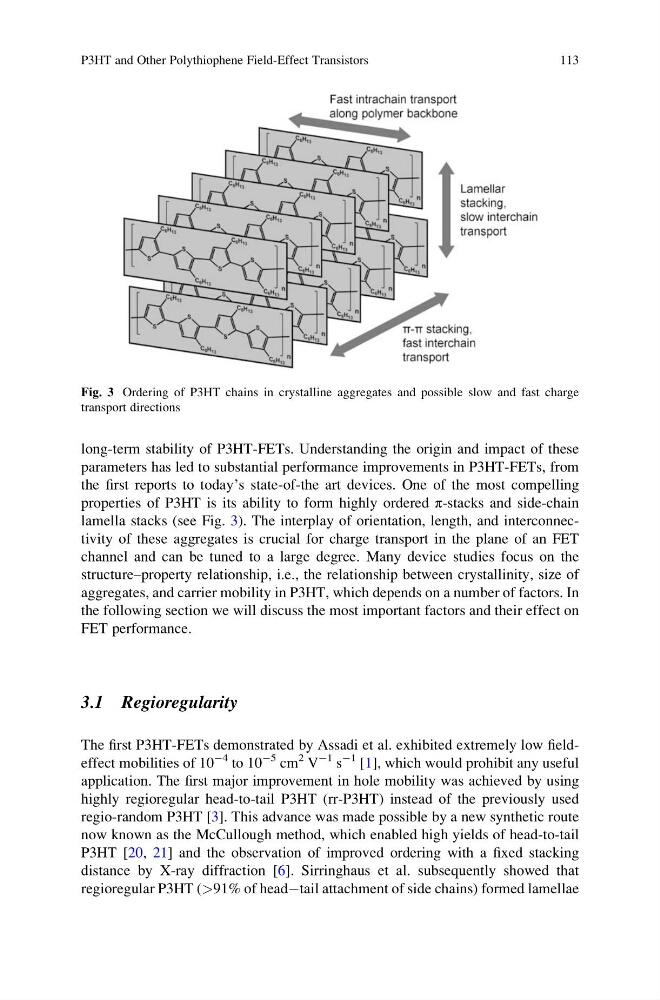
lamella stacks (see Fig. 3). The interplay of orientation, length, and interconnectivity of these aggregates is crucial for charge transport in the plane of an FET
channel and can be tuned to a large degree. Many device studies focus on the
structure–property relationship, i.e., the relationship between crystallinity, size of
aggregates, and carrier mobility in P3HT, which depends on a number of factors. In
the following section we will discuss the most important factors and their effect on
FET performance.
3.1 Regioregularity
The first P3HT-FETs demonstrated by Assadi et al. exhibited extremely low fieldeffect mobilities of 10
À4 to 10
À5 cm
2 V
À1 s
À1 [1], which would prohibit any useful
application. The first major improvement in hole mobility was achieved by using
highly regioregular head-to-tail P3HT (rr-P3HT) instead of the previously used
regio-random P3HT [3]. This advance was made possible by a new synthetic route
now known as the McCullough method, which enabled high yields of head-to-tail
P3HT [20, 21] and the observation of improved ordering with a fixed stacking
distance by X-ray diffraction [6]. Sirringhaus et al. subsequently showed that
regioregular P3HT (>91% of headÀtail attachment of side chains) formed lamellae
Fig. 3 Ordering of P3HT chains in crystalline aggregates and possible slow and fast charge
transport directions
P3HT and Other Polythiophene Field-Effect Transistors
113
parameters has led to substantial performance improvements in P3HT-FETs, from
the first reports to today’s state-of-the art devices. One of the most compelling
properties of P3HT is its ability to form highly ordered π-stacks and side-chain
lamella stacks (see Fig. 3). The interplay of orientation, length, and interconnectivity of these aggregates is crucial for charge transport in the plane of an FET
channel and can be tuned to a large degree. Many device studies focus on the
structure–property relationship, i.e., the relationship between crystallinity, size of
aggregates, and carrier mobility in P3HT, which depends on a number of factors. In
the following section we will discuss the most important factors and their effect on
FET performance.
3.1 Regioregularity
The first P3HT-FETs demonstrated by Assadi et al. exhibited extremely low fieldeffect mobilities of 10
À4 to 10
À5 cm
2 V
À1 s
À1 [1], which would prohibit any useful
application. The first major improvement in hole mobility was achieved by using
highly regioregular head-to-tail P3HT (rr-P3HT) instead of the previously used
regio-random P3HT [3]. This advance was made possible by a new synthetic route
now known as the McCullough method, which enabled high yields of head-to-tail
P3HT [20, 21] and the observation of improved ordering with a fixed stacking
distance by X-ray diffraction [6]. Sirringhaus et al. subsequently showed that
regioregular P3HT (>91% of headÀtail attachment of side chains) formed lamellae
Fig. 3 Ordering of P3HT chains in crystalline aggregates and possible slow and fast charge
transport directions
P3HT and Other Polythiophene Field-Effect Transistors
113