

0.1 cm
2 V
À1 s
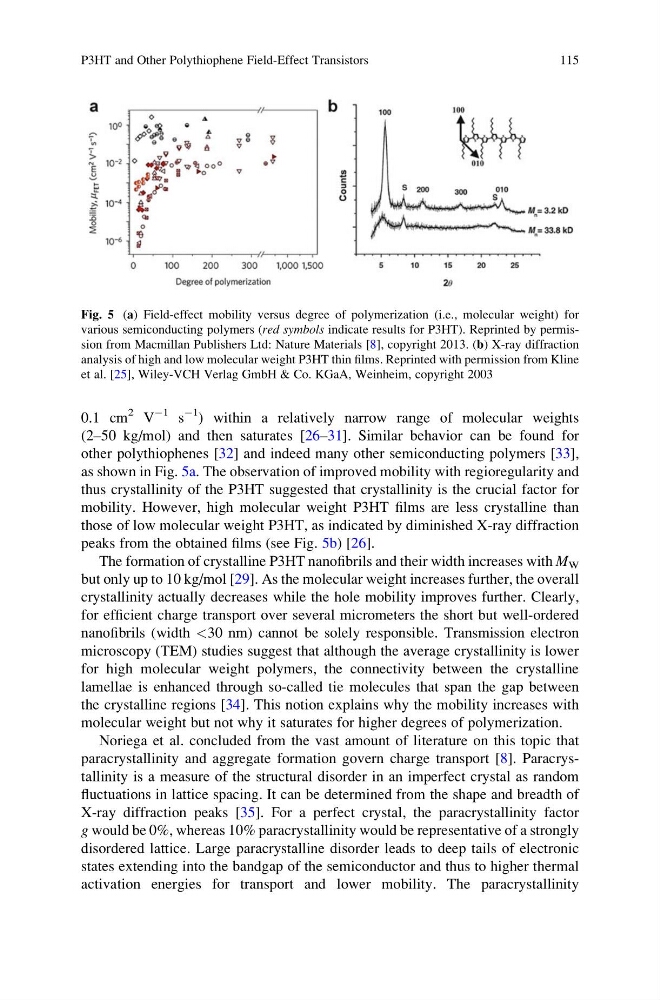
À1 ) within a relatively narrow range of molecular weights
(2–50 kg/mol) and then saturates [26–31]. Similar behavior can be found for
other polythiophenes [32] and indeed many other semiconducting polymers [33],
as shown in Fig. 5a. The observation of improved mobility with regioregularity and
thus crystallinity of the P3HT suggested that crystallinity is the crucial factor for
mobility. However, high molecular weight P3HT films are less crystalline than
those of low molecular weight P3HT, as indicated by diminished X-ray diffraction
peaks from the obtained films (see Fig. 5b) [26].
The formation of crystalline P3HT nanofibrils and their width increases with M W
but only up to 10 kg/mol [29]. As the molecular weight increases further, the overall
crystallinity actually decreases while the hole mobility improves further. Clearly,
for efficient charge transport over several micrometers the short but well-ordered
nanofibrils (width <30 nm) cannot be solely responsible. Transmission electron
microscopy (TEM) studies suggest that although the average crystallinity is lower
for high molecular weight polymers, the connectivity between the crystalline
lamellae is enhanced through so-called tie molecules that span the gap between
the crystalline regions [34]. This notion explains why the mobility increases with
molecular weight but not why it saturates for higher degrees of polymerization.
Noriega et al. concluded from the vast amount of literature on this topic that
paracrystallinity and aggregate formation govern charge transport [8]. Paracrystallinity is a measure of the structural disorder in an imperfect crystal as random
fluctuations in lattice spacing. It can be determined from the shape and breadth of
X-ray diffraction peaks [35]. For a perfect crystal, the paracrystallinity factor
g would be 0%, whereas 10% paracrystallinity would be representative of a strongly
disordered lattice. Large paracrystalline disorder leads to deep tails of electronic
states extending into the bandgap of the semiconductor and thus to higher thermal
activation energies for transport and lower mobility. The paracrystallinity
Fig. 5 (a) Field-effect mobility versus degree of polymerization (i.e., molecular weight) for
various semiconducting polymers (red symbols indicate results for P3HT). Reprinted by permission from Macmillan Publishers Ltd: Nature Materials [8], copyright 2013. (b) X-ray diffraction
analysis of high and low molecular weight P3HT thin films. Reprinted with permission from Kline
et al. [25], Wiley-VCH Verlag GmbH & Co. KGaA, Weinheim, copyright 2003
P3HT and Other Polythiophene Field-Effect Transistors
115
2 V
À1 s
À1 ) within a relatively narrow range of molecular weights
(2–50 kg/mol) and then saturates [26–31]. Similar behavior can be found for
other polythiophenes [32] and indeed many other semiconducting polymers [33],
as shown in Fig. 5a. The observation of improved mobility with regioregularity and
thus crystallinity of the P3HT suggested that crystallinity is the crucial factor for
mobility. However, high molecular weight P3HT films are less crystalline than
those of low molecular weight P3HT, as indicated by diminished X-ray diffraction
peaks from the obtained films (see Fig. 5b) [26].
The formation of crystalline P3HT nanofibrils and their width increases with M W
but only up to 10 kg/mol [29]. As the molecular weight increases further, the overall
crystallinity actually decreases while the hole mobility improves further. Clearly,
for efficient charge transport over several micrometers the short but well-ordered
nanofibrils (width <30 nm) cannot be solely responsible. Transmission electron
microscopy (TEM) studies suggest that although the average crystallinity is lower
for high molecular weight polymers, the connectivity between the crystalline
lamellae is enhanced through so-called tie molecules that span the gap between
the crystalline regions [34]. This notion explains why the mobility increases with
molecular weight but not why it saturates for higher degrees of polymerization.
Noriega et al. concluded from the vast amount of literature on this topic that
paracrystallinity and aggregate formation govern charge transport [8]. Paracrystallinity is a measure of the structural disorder in an imperfect crystal as random
fluctuations in lattice spacing. It can be determined from the shape and breadth of
X-ray diffraction peaks [35]. For a perfect crystal, the paracrystallinity factor
g would be 0%, whereas 10% paracrystallinity would be representative of a strongly
disordered lattice. Large paracrystalline disorder leads to deep tails of electronic
states extending into the bandgap of the semiconductor and thus to higher thermal
activation energies for transport and lower mobility. The paracrystallinity
Fig. 5 (a) Field-effect mobility versus degree of polymerization (i.e., molecular weight) for
various semiconducting polymers (red symbols indicate results for P3HT). Reprinted by permission from Macmillan Publishers Ltd: Nature Materials [8], copyright 2013. (b) X-ray diffraction
analysis of high and low molecular weight P3HT thin films. Reprinted with permission from Kline
et al. [25], Wiley-VCH Verlag GmbH & Co. KGaA, Weinheim, copyright 2003
P3HT and Other Polythiophene Field-Effect Transistors
115